Quick answer: the best East Coast hikes for a classic day out are Katahdin in Maine, the Beehive Trail in Acadia National Park, the Franconia Ridge Loop in New Hampshire, Old Rag in Virginia’s Shenandoah National Park, McAfee Knob near Roanoke, Virginia, and Mount LeConte via the Alum Cave Trail in the Great Smoky Mountains. Together they cover rugged northern granite, a coastal cliff climb, an above-treeline ridge, a famous rock scramble, the Appalachian Trail’s most photographed ledge and the Smokies’ signature summit.
BrokeMountain is reader-supported. We may earn a commission when you buy through links on this page, at no extra cost to you. Learn more.
How we put this together: we haven’t hiked every trail on this list in person. Distances, permits and rules come from the National Park Service, Baxter State Park and other official or trail-club sources, which we link. Trail rules change, so always check the official page before you go.
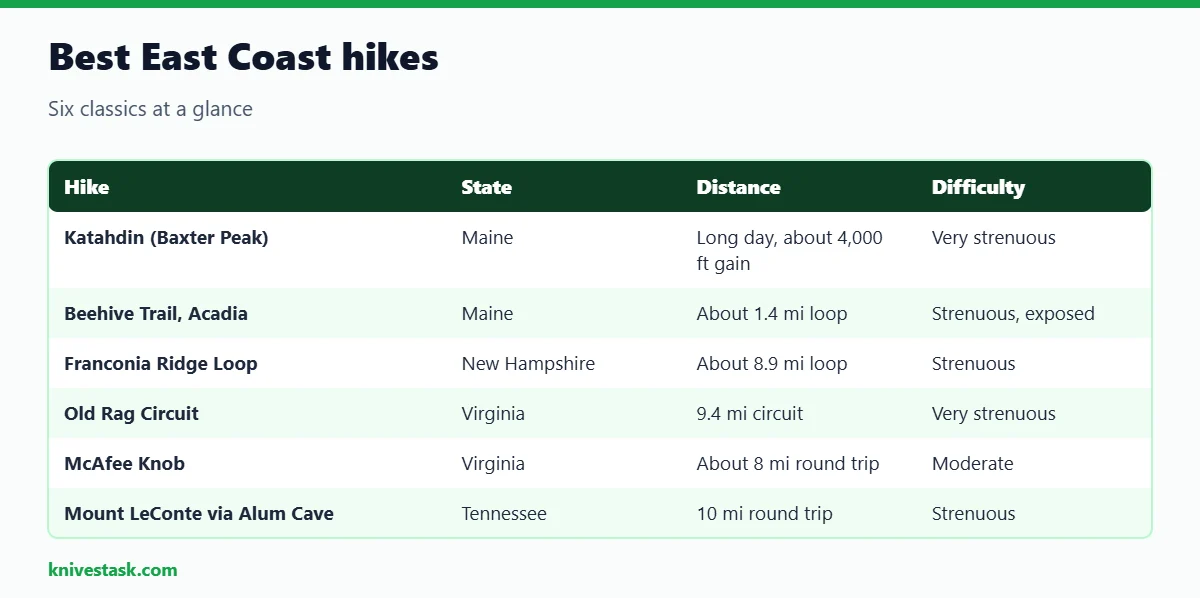
Best East Coast hikes at a glance
| Hike | State | Distance | Difficulty | Permit or booking |
|---|---|---|---|---|
| Katahdin (Baxter Peak) | Maine | Long day, about 4,000 ft gain | Very strenuous | Trailhead parking reservation recommended |
| Beehive Trail, Acadia | Maine | About 1.4 mi loop | Strenuous, exposed | Park entrance pass |
| Franconia Ridge Loop | New Hampshire | About 8.9 mi loop | Strenuous | None; arrive early for parking |
| Old Rag Circuit | Virginia | 9.4 mi circuit | Very strenuous | Day-use ticket (Mar-Nov) plus park pass |
| McAfee Knob | Virginia | About 8 mi round trip | Moderate | None; limited parking, shuttle available |
| Mount LeConte via Alum Cave | Tennessee | 10 mi round trip | Strenuous | Park parking tag |
Distances vary a little between sources and GPS devices. Where the park publishes an official figure, we use it.
1. Katahdin, Baxter State Park, Maine
Katahdin is Maine’s highest mountain and the northern end of the Appalachian Trail, and it is the toughest day hike on this list. Friends of Baxter State Park says every route gains about 4,000 feet and that the round trip takes 8 to 12 hours, so it is only for fit, experienced hikers. The park limits the number of hikers through a reservation system for parking at the Katahdin trailheads, so book ahead for summer weekends.
The most famous route crosses the Knife Edge, a narrow, exposed ridge between Pamola Peak and Baxter Peak. Baxter State Park notes it takes about an hour to an hour and a half one way, and it does not recommend crossing it and coming back. If exposure makes you nervous, you can reach the summit on other trails and still have a huge day.
- Best for: experienced hikers who want the biggest mountain day in the East.
- When to go: summer to early fall; check the park’s trail status, because trails close in bad weather and for the season.
2. Beehive Trail, Acadia National Park, Maine
For a short hike with a big thrill, the Beehive is hard to beat. According to Maine Trail Finder, the first section uses iron rungs to climb steep, exposed cliff faces and narrow ledges, and the top gives views of Sand Beach, Great Head and Frenchman Bay. Most hikers do it as a loop of about 1.4 miles. Dogs are not allowed because of the rungs.
Skip it if you are afraid of heights, if you have young children or if the granite is wet. Its bigger sibling, the Precipice Trail, rises more than 1,000 feet in under a mile and is usually closed from late winter until mid-August to protect nesting peregrine falcons, so check the park’s closure page first.
- Best for: a short, exciting climb with ocean views.
- When to go: dry days from late spring to fall; go early to beat the crowds.
3. Franconia Ridge Loop, White Mountains, New Hampshire
Franconia Ridge is one of the best above-treeline walks in the eastern United States. The usual loop climbs the Falling Waters Trail past several waterfalls, follows the exposed ridge over Little Haystack (4,760 ft), Mount Lincoln (5,089 ft) and Mount Lafayette (5,249 ft), then drops past the AMC’s Greenleaf Hut on the way down the Old Bridle Path. Trail to Peak lists it at about 8.9 miles with roughly 3,860 feet of gain and 6 to 8 hours of hiking.
Most hikers go up Falling Waters and down Old Bridle Path, which gets the steepest, wettest rock out of the way while you are fresh. The ridge is fully exposed, so turn back if storms build or the wind picks up.
- Best for: big views and a true alpine ridge walk.
- When to go: summer and early fall; start early, as the trailhead parking fills fast.
4. Old Rag Circuit, Shenandoah National Park, Virginia
Old Rag is the most famous hike in the mid-Atlantic, thanks to its granite rock scramble and 360-degree summit views. The National Park Service rates the 9.4-mile circuit as very strenuous, with a 2,348-foot elevation gain and 6 to 10 hours of hiking time. From March through November you need an Old Rag day-use ticket in addition to a park entrance pass, so book it before you drive out.
Pets are not allowed on this hike. The scramble involves squeezing between boulders and using your hands, which is great fun for adventurous hikers but slow when the trail is busy. Go on a weekday if you can.
- Best for: a full-day adventure with real scrambling.
- When to go: spring and fall; summer can be hot and crowded.
5. McAfee Knob, Appalachian Trail, Virginia
McAfee Knob’s overhanging ledge is one of the most photographed spots on the entire Appalachian Trail. Visit Roanoke describes an approximately 4-mile, white-blazed climb to the 3,197-foot summit, for a round trip of about 8 miles. The grade is steady rather than steep, which makes it one of the more achievable classic hikes on this list.
The catch is popularity: the trailhead lot on Route 311 is small and fills early, especially on weekends. Hike midweek or use the seasonal McAfee Knob shuttle. Strong hikers can link it with Dragon’s Tooth and Tinker Cliffs for Virginia’s “Triple Crown” backpacking trip.
- Best for: an iconic view without a technical scramble.
- When to go: any season with dry trails; sunrise and sunset are popular.
6. Mount LeConte via the Alum Cave Trail, Great Smoky Mountains, Tennessee
The Alum Cave Trail is the signature hike of the Smokies. The National Park Service says that at 10 miles round trip it is the shortest of the five routes to Mount LeConte. Along the way you pass Arch Rock and Alum Cave Bluffs, a huge overhanging rock ledge, before climbing to the summit area and LeConte Lodge, the park’s only lodge.
If 10 miles is too much, turn around at Alum Cave Bluffs for a shorter, still rewarding hike. The park warns of heavy crowding and limited parking at this trailhead, and you need a park parking tag. Dogs are not allowed on park trails. For more trails in the area, see our guide to the best hiking trail in the Smoky Mountains.
- Best for: old-growth forest, rock features and a high Smokies summit.
- When to go: spring wildflowers or fall color; icy in winter.
How to choose the right East Coast hike
- Short on time: Beehive Trail in Acadia, or Alum Cave Bluffs as a shorter turnaround.
- First big mountain day: McAfee Knob, with a steady grade and no scrambling.
- Love scrambling: Old Rag or the Beehive.
- Want alpine views: Franconia Ridge.
- Want the hardest challenge: Katahdin, with or without the Knife Edge.
If you live near New York City or New Jersey and want something closer to home first, try our waterfall hikes near NYC or the South Mountain Reservation hiking guide. In Virginia, our guide to hiking in Charlottesville covers easier Blue Ridge options, and in Maine see hiking near Portland, Maine.

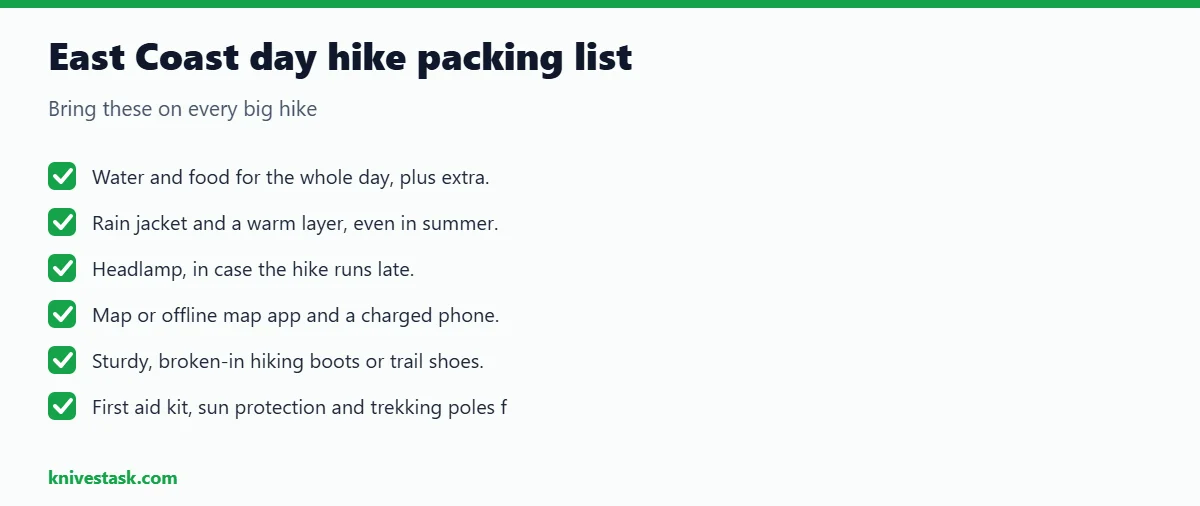
What to pack for a big East Coast day hike
East Coast mountains are not the highest in the country, but the weather on exposed summits can change fast, and long days need planning.
- Water and food for the whole day, plus extra.
- Rain jacket and a warm layer, even in summer.
- Headlamp, in case the hike runs late.
- Map or offline map app and a charged phone.
- Sturdy, broken-in hiking boots or trail shoes.
- First aid kit, sun protection and trekking poles for steep descents.
A good headlamp for hiking is cheap insurance on long hikes like Katahdin and Old Rag, and trekking poles save your knees on steep descents. Our guide on what to wear when hiking covers layers.
Check trekking poles on Amazon
Check hiking headlamps on Amazon
Best time to hike on the East Coast
In the Northeast, the main hiking season runs from late spring to mid-fall. Snow and ice can linger high in the White Mountains and on Katahdin into late spring, and black flies can be heavy in early summer in Maine and New Hampshire. Fall is the favorite season for many hikers: cooler air, fewer bugs and famous foliage, usually from late September in the north to late October in Virginia and the Smokies. In the South, spring brings wildflowers, while summer brings heat, humidity and afternoon thunderstorms, so start early.
Frequently asked questions
What is the best hike on the East Coast?
It depends on what you want. Katahdin is the biggest challenge, Franconia Ridge has the best alpine views, Old Rag has the most fun scramble and McAfee Knob is the most iconic view for the effort.
What is the hardest hike on the East Coast?
Of the classic day hikes, Katahdin is usually considered the hardest, with about 4,000 feet of climbing and 8 to 12 hours on the trail, especially if you cross the Knife Edge.
Do I need a permit for East Coast hikes?
Some popular hikes need one. Old Rag requires a day-use ticket from March through November, Baxter State Park uses reservations for Katahdin trailhead parking, and national parks require an entrance pass or parking tag.
What is the best easy East Coast hike?
Of the hikes here, the shorter Alum Cave Bluffs turnaround is the easiest, and McAfee Knob is the most manageable of the full-length classics. The Beehive is short but exposed, so it is not an easy hike for anyone who dislikes heights.
The bottom line
The best East Coast hikes run from Maine’s Katahdin to Tennessee’s Mount LeConte, and each one offers something different. Start with McAfee Knob or the Beehive if you are building experience, plan carefully for Old Rag and Franconia Ridge, and save Katahdin for when you are ready for the biggest day in the East. Whichever you choose, check the official page for permits and closures before you go.
Last checked: November 2026. Trail conditions, closures, permits and fees change, so check the official park or trail page before you go.

Hi, I am Emam Hasan — founder and editor of BrokeMountain. I oversee this blog’s hiking, camping and outdoor gear guides, making sure every article is well-researched, accurate and genuinely helpful for your time on the trail. Enjoy it!