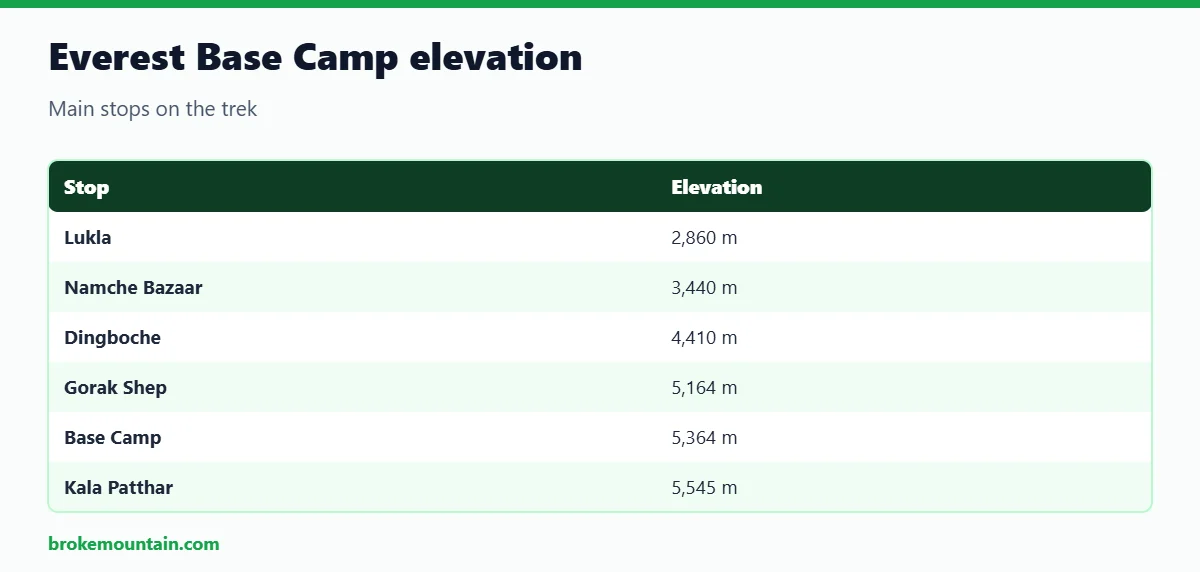
Quick answer: Everest Base Camp elevation is about 5,364 m (17,598 ft) at South Base Camp in Nepal. Most trekkers also climb Kala Patthar, around 5,545 m (18,192 ft), for the best view of Everest. The trek starts in Lukla at about 2,860 m (9,383 ft), so you gain around 2,500 m over roughly eight or nine days of walking up, with rest days in Namche Bazaar and Dingboche to acclimatise.

How we put this together: elevations come from published trek profiles, which differ by a few metres between sources. Health information is based on the CDC Yellow Book and the NHS and is general guidance, not medical advice. Speak to a doctor or travel clinic before a high-altitude trek.
Altitude, not distance, is the real challenge of the Everest Base Camp trek. Here’s the elevation of each main stop, what that altitude does to your body and how to acclimatise safely.
Everest Base Camp elevation profile
| Stop | Approx. elevation | Notes |
|---|---|---|
| Kathmandu | 1,400 m (4,600 ft) | Fly from here to Lukla |
| Lukla | 2,860 m (9,383 ft) | Start of the trek |
| Phakding | 2,610 m (8,563 ft) | First night, slightly lower than Lukla |
| Namche Bazaar | 3,440 m (11,286 ft) | Main Sherpa town; first rest day |
| Tengboche | 3,860 m (12,664 ft) | Famous monastery |
| Dingboche | 4,410 m (14,469 ft) | Second rest day |
| Lobuche | 4,910 m (16,109 ft) | Last stop before Gorak Shep |
| Gorak Shep | 5,164 m (16,942 ft) | Highest overnight stop |
| Everest Base Camp | 5,364 m (17,598 ft) | Visited as a day hike from Gorak Shep |
| Kala Patthar | 5,545 m (18,192 ft) | Highest point of the trek |
Figures from published trek profiles such as Himalayan Hero; other sources differ by a few metres.
How much oxygen is there at Everest Base Camp?
The air contains the same percentage of oxygen at every altitude, but the air pressure falls as you climb, so each breath delivers less oxygen. The CDC Yellow Book explains that at around 3,050 m (10,000 ft) the oxygen you breathe in is only about 69% of that at sea level. At Everest Base Camp, which the CDC lists at about 5,400 m among popular high-altitude destinations, it is roughly half. Your body adapts over days by breathing faster and deeper, which is why every good itinerary includes acclimatisation days.
How to acclimatise on the way to Base Camp
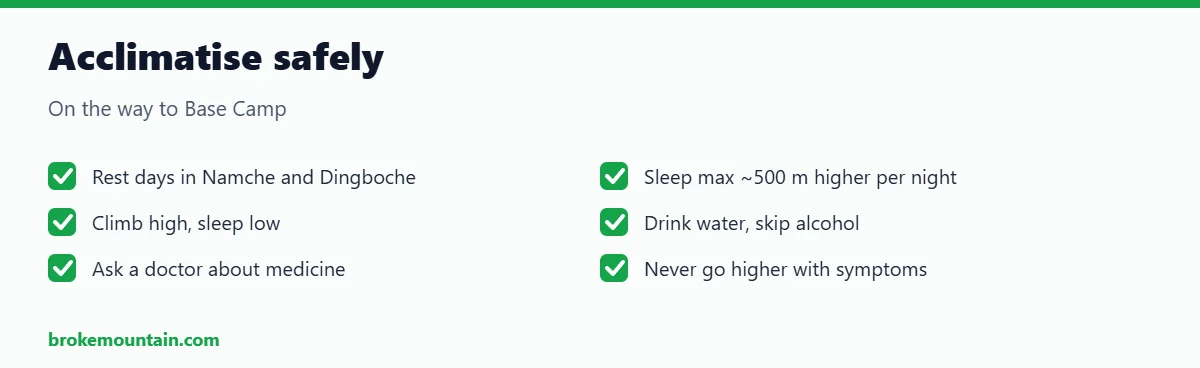
- Follow an itinerary with rest days, usually one in Namche Bazaar and one in Dingboche.
- Limit your sleeping altitude gain. The NHS advises that above 3,000 m you try not to sleep more than 500 m higher than the night before, and take a rest day every three to four days.
- Climb high, sleep low. On rest days, hike to a higher viewpoint and come back down to sleep.
- Drink enough water and avoid alcohol.
- Ask a doctor about medicine to prevent altitude sickness before your trip.
- Never go higher with symptoms. Rest until they pass, or descend.
Daily elevation gain on the classic route
| Day | Route | Sleep | Approx. gain |
|---|---|---|---|
| 1 | Lukla to Phakding | 2,610 m | Slight descent |
| 2 | Phakding to Namche Bazaar | 3,440 m | +830 m |
| 3 | Rest day in Namche | 3,440 m | Day hike only |
| 4 | Namche to Tengboche | 3,860 m | +420 m |
| 5 | Tengboche to Dingboche | 4,410 m | +550 m |
| 6 | Rest day in Dingboche | 4,410 m | Day hike only |
| 7 | Dingboche to Lobuche | 4,910 m | +500 m |
| 8 | Lobuche to Gorak Shep and Base Camp | 5,164 m | +254 m (Base Camp +200 m more) |
| 9 | Kala Patthar at dawn, then descend | Lower | Kala Patthar +381 m |
The biggest single jump is the day to Namche Bazaar, which is why most itineraries put a rest day straight after it. For a full day-by-day plan, see our Everest Base Camp trek itinerary.
Altitude sickness warning signs
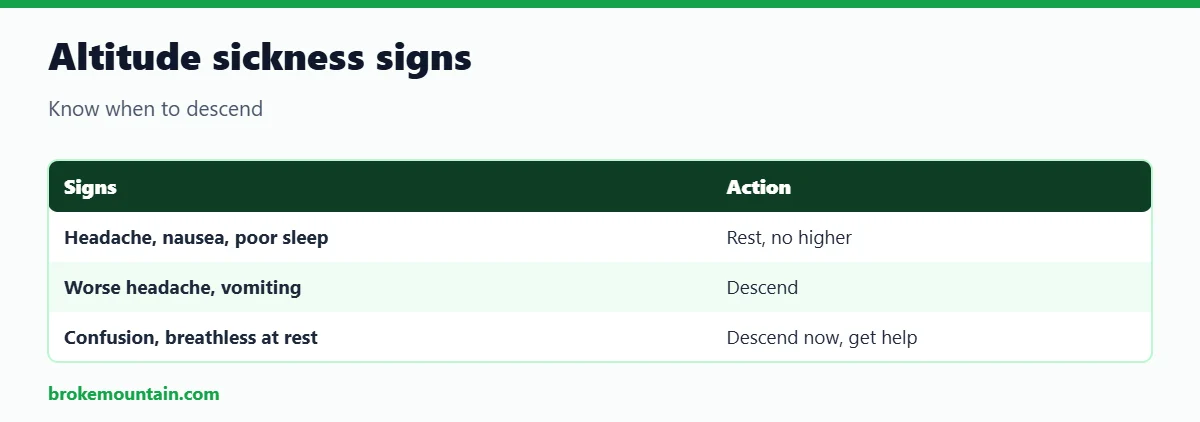
- Mild acute mountain sickness: headache, nausea, dizziness, tiredness and poor sleep. Rest and don’t go higher until you feel better.
- Getting worse: a headache that painkillers don’t help, vomiting or worsening tiredness. Descend.
- Emergency: confusion, loss of coordination, breathlessness at rest or a wet cough can mean HACE or HAPE. Descend immediately and get medical help.
The NHS suggests descending about 300 to 1,000 m if symptoms get worse or don’t improve after a day. In the Khumbu, the health post at Pheriche, below Dingboche, is a common place to seek help.
Everest Base Camp elevation vs other famous places
| Place | Approx. elevation |
|---|---|
| Machu Picchu | 2,430 m |
| Cusco, Peru | 3,400 m |
| Mont Blanc summit | 4,806 m |
| Everest Base Camp | 5,364 m |
| Kilimanjaro summit | 5,895 m |
| Mount Everest summit | 8,849 m |
Everest Base Camp is higher than any summit in the Alps, but lower than Kilimanjaro. Compare it with our Machu Picchu elevation guide.
Preparing your body for the Everest Base Camp elevation
Fitness doesn’t stop altitude sickness, but it makes the trek much more enjoyable. In the months before your trip, build up to long days of walking with a daypack, ideally on hills or stairs, and do several back-to-back hiking days to get used to walking when you are tired. Strong legs help most on the long descents, which are hard on the knees. If you have a heart or lung condition, are pregnant or have had altitude illness before, see a doctor well before you book.
What to pack for the altitude
- A warm down jacket and a good sleeping bag; nights at Gorak Shep are well below freezing for much of the year.
- Sunglasses with high UV protection and high-factor sunscreen; UV is very strong at 5,000 m.
- A water bottle or bladder and water purification; see our hydration bladder guide.
- Trekking poles for the long descents; see what hiking poles are for.
- A small first-aid kit, including anything your doctor has prescribed for altitude.
- Travel insurance that covers trekking above 5,000 m and helicopter evacuation.
How hard is the trek at this altitude?
The trail itself isn’t technical, but walking at over 5,000 m is tiring for everyone. Expect to walk slowly, stop often and sleep poorly at Gorak Shep. See our full guide: how hard is the Everest Base Camp trek? and our guide to the best time to trek Everest Base Camp.
Frequently asked questions
What is the Everest Base Camp elevation in feet?
About 17,598 ft (5,364 m).
How high is Mount Everest?
8,849 m (29,032 ft), as announced by Nepal and China in 2020.
Do you need oxygen to reach Everest Base Camp?
No. Trekkers reach Base Camp without supplemental oxygen, but proper acclimatisation is essential.
Is Kala Patthar higher than Base Camp?
Yes, by about 180 m, and it has a far better view of Everest’s summit. See Kala Patthar vs Everest Base Camp.
Where do you sleep closest to Base Camp?
Most trekkers sleep at Gorak Shep, about 200 m below Base Camp, and visit Base Camp as a day hike. Teahouses there are basic and cold, and few people sleep well at that altitude, so plan only one night if you can.
Plan your Everest trek
- Everest Base Camp trek itinerary (12 days)
- Best time to trek Everest Base Camp
- Kala Patthar vs Everest Base Camp
- Everest Base Camp trek difficulty
Last checked: November 2026. Fees and rules change, so confirm with official sources before you travel.

Hi, I am Emam Hasan — founder and editor of BrokeMountain. I oversee this blog’s hiking, camping and outdoor gear guides, making sure every article is well-researched, accurate and genuinely helpful for your time on the trail. Enjoy it!