
Quick answer: among the best mountain bike helmets, the top pick for most trail riders is the POC Cularis, Bikerumor’s best overall pick for 2026 with a 5-star Virginia Tech safety rating. For great protection at a lower price, the Specialized Ambush 2 also carries a 5-star rating, and the Specialized Camber is the best budget helmet at about $75. Cross-country racers should look at the light Giro Aries Spherical, and e-bike riders at the Sweet Protection Bushwhacker 2Vi MIPS.
BrokeMountain is reader-supported. We may earn a commission when you buy through links on this page, at no extra cost to you. Learn more.
How we put this together: we haven’t tested these helmets in person. We compared Virginia Tech Helmet Lab safety ratings as reported by independent testers, long-term reviews from Bikerumor and Treeline Review, and maker specifications, and we link each source. Prices change, so where we could not confirm a figure we say “check listing”.
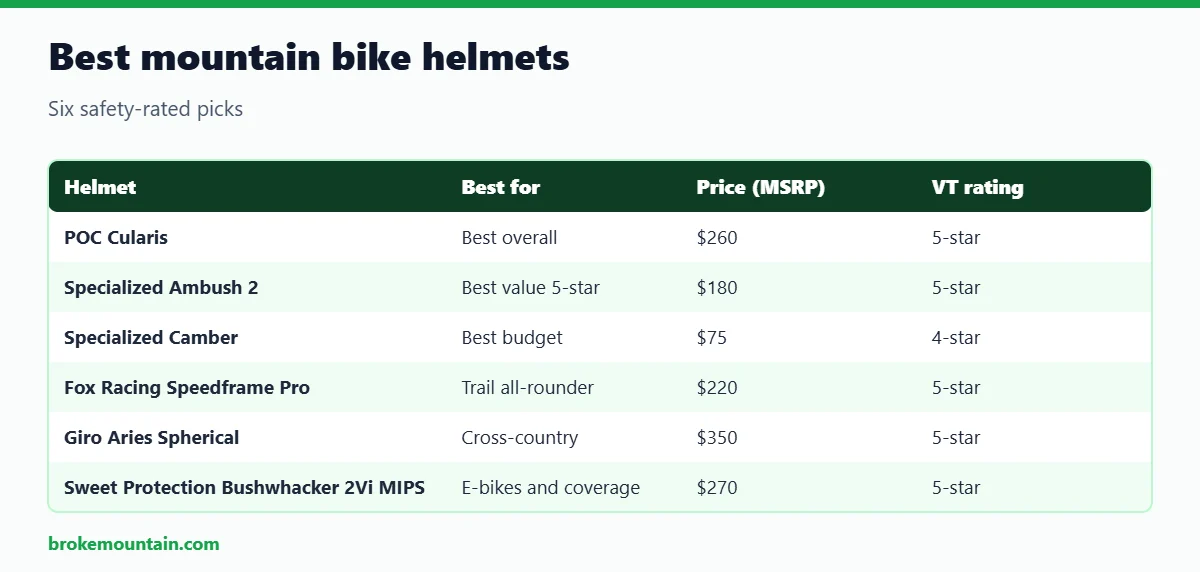
Best mountain bike helmets at a glance
| Helmet | Best for | Price (MSRP) | Weight | VT rating | Rotational system |
|---|---|---|---|---|---|
| POC Cularis | Best overall | $260 | 440 g (L) | 5-star | MIPS Air Node |
| Specialized Ambush 2 | Best value 5-star | $180 | 375 g (L) | 5-star | MIPS SL |
| Specialized Camber | Best budget | $75 | 400 g (L) | 4-star | MIPS |
| Fox Racing Speedframe Pro | Trail all-rounder | $220 | 394 g (L) | 5-star | MIPS Air Node |
| Giro Aries Spherical | Cross-country | $350 | 270 g (M) | 5-star | MIPS Spherical |
| Sweet Protection Bushwhacker 2Vi MIPS | E-bikes and coverage | $270 | 427 g (M/L) | 5-star | MIPS Air |
Prices, weights and ratings above are as listed by Bikerumor’s 2026 mountain bike helmet guide. Virginia Tech updates its ratings as new helmets are tested, so check the current rating before you buy.
Why Virginia Tech ratings matter
All helmets sold in the US must meet the same basic impact standard, but they do not all protect equally well. The Virginia Tech Helmet Lab, which developed its bike helmet ratings with the Insurance Institute for Highway Safety (IIHS), drops helmets onto a test headform and rates how well they reduce the risk of concussion, from 1 to 5 stars. According to Singletracks, Virginia Tech encourages riders to choose only helmets rated 4 or 5 stars.
Two useful takeaways from the ratings: price does not reliably predict safety, and helmets with a rotational-impact system such as MIPS have tended to score well. Virginia Tech also tightened its rating criteria in 2025 as helmets improved, so a 5-star helmet today has met a higher bar.
1. POC Cularis: best overall mountain bike helmet
Bikerumor named the POC Cularis its best overall mountain bike helmet for 2026. It lists the helmet at $260 and 440 grams in size Large, with MIPS Air Node rotational protection, 13 vents and a 5-star Virginia Tech rating. Reviewers praised its ventilation, light weight, breakaway visor, magnetic Fidlock buckle and eyewear storage.
The trade-offs: it is moderately expensive, and Bikerumor found it slightly narrow for rounder heads, so try it on if you can.
Check the POC Cularis on Amazon
2. Specialized Ambush 2: best value 5-star helmet
If you want top safety ratings without paying $250 or more, the Specialized Ambush 2 stands out. Bikerumor lists it at $180 and 375 grams (Large), with MIPS SL, 15 vents and a 5-star Virginia Tech rating, and praises its excellent rear coverage and outstanding ventilation.
The trade-offs: the visor does not block the sun very well, and the styling will not suit everyone.
Check the Specialized Ambush 2 on Amazon
3. Specialized Camber: best budget mountain bike helmet
The Specialized Camber is Bikerumor’s best budget mountain bike helmet. At about $75 it still includes MIPS and earned a 4-star Virginia Tech rating, and it comes in five shell sizes from XS to XL, which helps it fit a wide range of heads.
The trade-offs: basic straps, moderate ventilation and a visor that does not block much sun. For new riders and casual trail use, it is a lot of protection for the money.
Check the Specialized Camber on Amazon
4. Fox Racing Speedframe Pro: best trail all-rounder
The Fox Speedframe Pro has long been a popular trail helmet. Bikerumor lists it at $220 and 394 grams (Large), with MIPS Air Node, 17 vents and a 5-star Virginia Tech result, and calls it comfortable, well ventilated and feature-packed.
The trade-offs: the visor needs two hands to adjust, sunglass storage is limited, and the fit is not the deepest, so riders who like a lot of rear coverage may prefer the Ambush 2.
Check the Fox Speedframe Pro on Amazon
5. Giro Aries Spherical: best cross-country helmet
For long climbs and racing, weight and airflow matter most. Bikerumor named the Giro Aries Spherical its best XC helmet, listing it at just 270 grams (Medium) with 24 vents, MIPS Spherical and a 5-star Virginia Tech rating.
The trade-offs: it is expensive at $350, and it covers less of the head than trail helmets, so it is not the right choice for aggressive downhill riding.
Check the Giro Aries Spherical on Amazon
6. Sweet Protection Bushwhacker 2Vi MIPS: best for e-bikes and coverage
Riders on e-mountain bikes go faster, which is why some helmets now meet the Dutch NTA 8776 e-bike standard. Bikerumor lists the Sweet Protection Bushwhacker 2Vi MIPS as e-bike certified, with great coverage, secure sunglass storage and a 5-star Virginia Tech rating, at $270 and 427 grams (M/L). Sweet Protection says it placed eighth overall in the Virginia Tech ratings.
The trade-offs: it is heavier and more expensive than most helmets here, and sweat management is weaker.
Check the Sweet Protection Bushwhacker on Amazon
If you ride an e-bike, our guide to the best electric bikes for mountain biking covers the bikes themselves.
Trail, XC or full-face: which type do you need?
The best mountain bike helmets fall into three broad types, and the right one depends on where and how fast you ride:
- Trail (open-face) helmets like the POC Cularis, Ambush 2 and Speedframe Pro cover more of the back and sides of the head and suit most riders.
- Cross-country helmets like the Giro Aries Spherical are lighter and better ventilated, but give less coverage.
- Full-face helmets add a chin bar for bike parks, downhill racing and very steep, fast trails.
If you ride a bit of everything, a trail helmet is the safest all-round choice. Many riders who start riding bike parks add a full-face helmet later rather than replacing their trail helmet.
How to choose a mountain bike helmet
- Safety rating first: pick a helmet with a 4 or 5-star Virginia Tech rating where possible.
- Rotational protection: MIPS or a similar system helps manage angled impacts.
- Coverage: trail and enduro helmets cover more of the back and sides; XC helmets trade coverage for weight and airflow.
- Fit: measure your head and check the brand’s size chart; head shapes vary.
- Ventilation: more vents keep you cooler on long climbs.
- Visor and eyewear: an adjustable visor and goggle or sunglass storage are useful on the trail.
For riders who race downhill or ride bike parks, a full-face helmet adds chin protection that none of the open-face helmets above provide.

How to fit a mountain bike helmet
Bikerumor’s buying advice is simple: measure around your head just above your eyebrows and ears with a flexible tape, then check the brand’s size chart, and if you are between sizes, choose the larger one rather than squeezing into the smaller size.
- The helmet should sit level, covering most of your forehead.
- Tighten the rear dial until it feels snug but not tight.
- Leave room for one or two fingers between the chin strap and your neck.
- Keep the side straps clear of your ears where possible.

When to replace your helmet
Always replace a helmet after a crash, even if you cannot see any damage, because the foam is designed to crush once. Bikerumor also notes that daily riders may need a new helmet every couple of seasons, while occasional riders can often get several years of use from one.
Pair your helmet with other key protection and kit: cross-country knee pads, a chest protector for enduro riding and good mountain bike helmet lights for night rides. Our guide to the best mountain bike accessories covers the rest.
Protect your hands too: see our guide to the best mountain bike gloves.
Frequently asked questions
What is the best mountain bike helmet?
For most trail riders, the POC Cularis, Bikerumor’s best overall pick for 2026, with a 5-star Virginia Tech rating, good ventilation and eyewear storage.
What is the safest mountain bike helmet?
Look for a current 5-star Virginia Tech rating. In Bikerumor’s 2026 guide, the POC Cularis, Specialized Ambush 2, Fox Speedframe Pro, Giro Aries Spherical and Sweet Protection Bushwhacker 2Vi MIPS all hold 5-star ratings.
Are cheap mountain bike helmets safe?
Many are. The $75 Specialized Camber has a 4-star Virginia Tech rating, and price does not reliably predict safety.
Do I need a MIPS helmet?
You do not have to have one, but helmets with MIPS or similar rotational systems have tended to score well in Virginia Tech testing, so it is worth choosing one.
The bottom line
The best mountain bike helmets combine a high Virginia Tech rating, a secure fit and the right coverage for how you ride. The POC Cularis is the best all-rounder, the Specialized Ambush 2 brings 5-star protection for less, and the Specialized Camber proves good protection does not have to cost much. Choose the style that suits your riding, fit it properly and replace it after any crash.
Last checked: November 2026. Helmet models, safety ratings and prices change, so check the current Virginia Tech rating and listing before you buy.

Hi, I am Emam Hasan — founder and editor of BrokeMountain. I oversee this blog’s hiking, camping and outdoor gear guides, making sure every article is well-researched, accurate and genuinely helpful for your time on the trail. Enjoy it!


