
Quick answer: when choosing mountain bike handlebars, most trail riders are happiest with a bar about 760 to 800 mm wide, with 20 to 40 mm of rise and a 35 mm clamp. Carbon bars save weight and some are tuned to reduce vibration, but quality matters, so choose a reputable bar rated for your riding. Aluminium bars are cheaper, tough and a safe choice for most riders. Standouts include the OneUp Carbon for comfort, the Renthal Fatbar for a proven aluminium bar, and the Race Face Next SL for cross-country. Match the clamp diameter to your stem (31.8 or 35 mm) and never ride a damaged carbon bar.
BrokeMountain is reader-supported. We may earn a commission when you buy through links on this page, at no extra cost to you. Learn more.
How we chose: we haven’t tested these handlebars in person. Our picks are based on manufacturer specifications and published, hands-on and lab tests. Check current widths, rises and prices before you buy.
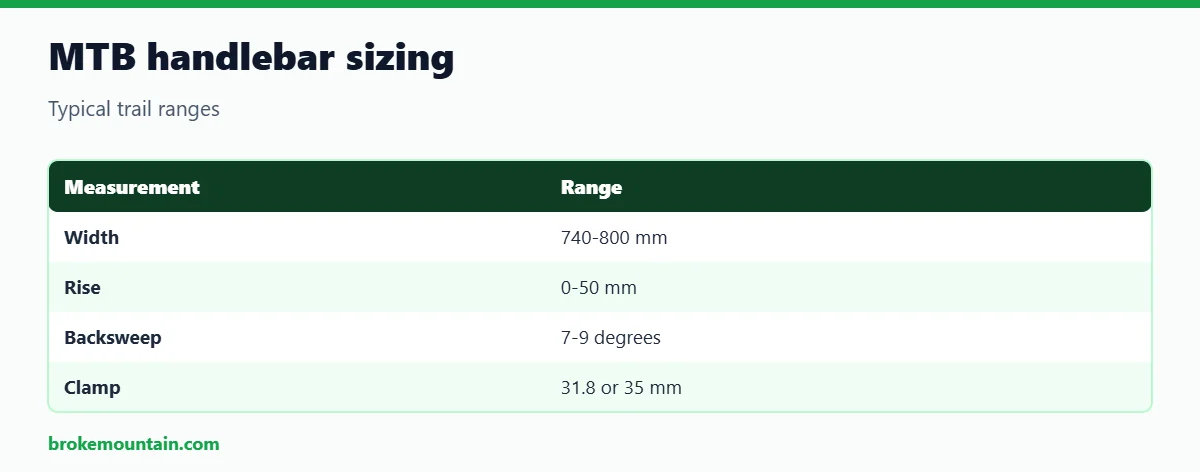
Mountain bike handlebars: width, rise, sweep and clamp
| Measurement | Typical range | Effect |
|---|---|---|
| Width | 740 to 800 mm | Wider gives more control and leverage; narrower is easier between tight trees |
| Rise | 0 to 50 mm | More rise gives a more upright position and takes weight off the front |
| Backsweep | 7 to 9 degrees | How far the bar angles back toward you |
| Upsweep | 4 to 5 degrees | How far the bar angles up at the grips |
| Clamp diameter | 31.8 mm or 35 mm | Must match your stem |
When buying MTB handlebars, choose a wider bar and trim it gradually, 5 to 10 mm per side at a time, to find your preferred width. Your shoulder width is a useful starting point, plus a bit more for control. Many bars have cutting guides marked on the ends.
Carbon vs aluminium mountain bike handlebars
| Carbon | Aluminium | |
|---|---|---|
| Weight | Lighter (often around 170 to 240 g) | Heavier (often around 250 to 350 g) |
| Vibration | Can be tuned for compliance | Usually stiffer |
| Durability | Strong, but damage can be hidden | Tends to bend rather than snap |
| Price | Higher | Lower |
Carbon MTB handlebars aren’t automatically more comfortable. In CyclingAbout’s handlebar vibration tests, the OneUp Carbon bar posted the best vibration result, and the Renthal Fatbar Lite Carbon came close despite being narrower, while some carbon bars transmitted more vibration than aluminium ones. The shape and layup matter more than the material alone.
Check the rating for your riding
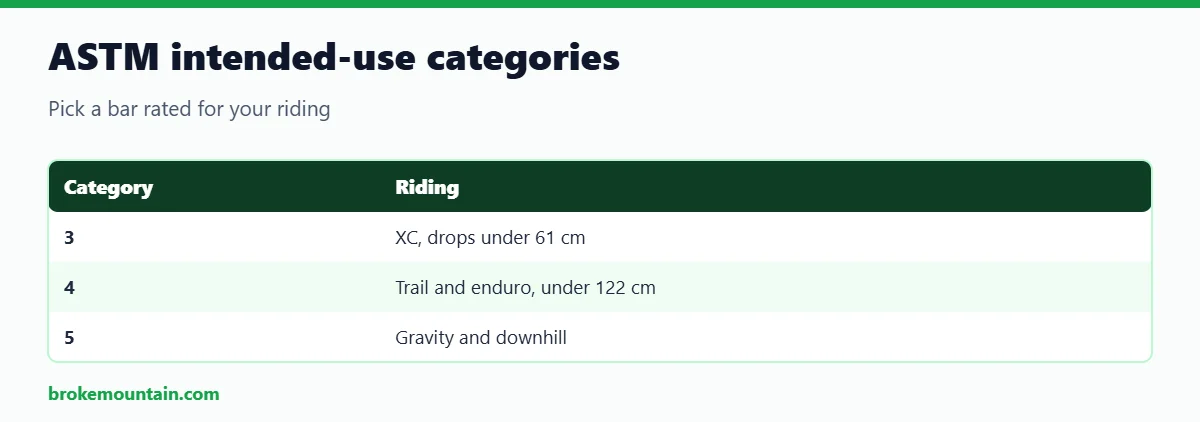
MTB handlebars, like frames and other parts, are often rated using the ASTM F2043 “intended use” categories. As e*thirteen explains, Category 3 covers cross-country and short-travel riding with drops under 61 cm, Category 4 covers trail and enduro riding with drops under 122 cm, and Category 5 covers gravity and downhill riding. Choose a bar rated for the riding you actually do. Very light XC bars aren’t meant for bike park laps.
The best MTB handlebars
1. OneUp Components V2 Carbon: best overall
OneUp’s carbon bar is designed to flex slightly for comfort. Bikerumor named the V2 Carbon its best overall mountain bike handlebar, and OutdoorGearLab rated it the most comfortable carbon bar it tested, listing a 235 g weight with a 35 mm clamp. It comes in 20, 35 and 50 mm rises.
- Good for: trail and enduro riders who want comfort and control.
- Watch out for: premium price; its compliance won’t suit riders who want a very stiff bar.
Check OneUp Carbon prices on Amazon
2. Renthal Fatbar 35: best aluminium bar
The Fatbar is a long-standing favourite from a moto brand. OutdoorGearLab named the Fatbar 35 its best overall aluminium handlebar, praising its control and noting it does a good job of reducing vibration for an aluminium bar. It’s available in 31.8 and 35 mm clamps and several rises, though it’s heavier than carbon bars.
- Good for: riders who want a tough, proven bar at a fair price.
- Watch out for: heavier than carbon.
Check Renthal Fatbar prices on Amazon
3. Renthal Fatbar Lite Carbon: best lightweight comfort
The Fatbar Lite Carbon is a lighter carbon option. CyclingAbout lists it at 191 g with a 35 mm clamp, 7 degrees of backsweep and rises from 10 to 40 mm, and found its vibration damping nearly matched the OneUp Carbon.
- Good for: riders who want a light, comfortable carbon bar.
- Watch out for: check the width suits you; it comes at 760 mm.
Check Renthal Fatbar Lite Carbon prices on Amazon
4. Race Face Next SL: best for cross-country
For racers and riders who count grams, Bikerumor picked the Race Face Next SL as its best bar for XC riding and racing, with a measured weight of 167 g, a 740 mm width and a 35 mm clamp.
- Good for: cross-country riders and racers.
- Watch out for: narrower and less forgiving than trail bars.
Check Race Face Next SL prices on Amazon
5. OneUp Components Aluminium: best aluminium alternative
Bikerumor named the OneUp Aluminium bar its best overall aluminium handlebar, listing an 800 mm width, a 35 mm clamp and a measured weight of 342 g with 35 mm of rise.
- Good for: riders who want OneUp’s shape at a lower price.
- Watch out for: heavier than carbon.
Check OneUp Aluminium prices on Amazon
6. Budget carbon bars: proceed with care
Many unbranded carbon MTB handlebars are sold online at very low prices. Some are fine for gentle riding, but quality control and testing can be unclear, and hidden damage in carbon is hard to spot. For trail, enduro and downhill riding, a bar from an established brand with a clear ASTM rating and warranty is the safer choice.
Quick comparison
| Handlebar | Material | Best for | Trade-off |
|---|---|---|---|
| OneUp V2 Carbon | Carbon | Comfort and control | Price |
| Renthal Fatbar 35 | Aluminium | Proven value | Weight |
| Renthal Fatbar Lite Carbon | Carbon | Light comfort | 760 mm width |
| Race Face Next SL | Carbon | XC racing | Less forgiving |
| OneUp Aluminium | Aluminium | Value | Weight |
Fitting and safety tips
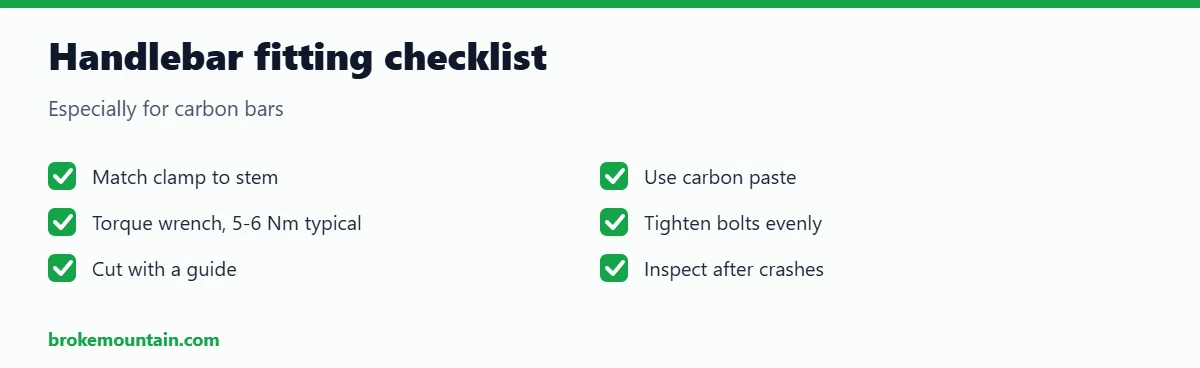
- Use a torque wrench and follow the bar and stem torque specs, usually around 5 to 6 Nm for the stem faceplate.
- Use carbon assembly paste at the clamp on carbon bars.
- Tighten faceplate bolts evenly in a cross pattern.
- Inspect bars for cracks and deep scratches after crashes.
- Replace a carbon bar after a heavy crash, even if no damage is visible.
- Cut bars with a fine-tooth saw and a guide, and never cut into the clamp or control areas.
Check torque wrenches and carbon paste on Amazon
Finding your width and rise
Start with the MTB handlebars that came on your bike and note what you like or dislike. If the front feels twitchy at speed, a wider bar may help. If you clip trees or your shoulders ache, try narrower. If you feel too stretched or your hands get sore on descents, a higher rise can help; if the front wheel lifts on climbs, try a lower rise. Change one thing at a time. Comfortable saddles and grips help too; see our guide to mountain bike saddles.
MTB handlebars and stems work together
Your handlebar and stem together set your hand position, so think about them as a pair. A shorter stem makes steering quicker and moves your weight back, which suits modern trail bikes with long reach. A longer stem puts more weight over the front wheel, which helps on steep climbs but can feel nervous on descents. Most trail and enduro bikes now use stems between about 35 and 50 mm. If you change the rise of your MTB handlebar, you may also want to move headset spacers above or below the stem to fine-tune the height. Always check the steerer still has enough clamping area after moving spacers.
MTB handlebars for e-bikes
E-mountain bikes are heavier and often ridden fast on rough descents, so choose MTB handlebars rated for trail or enduro use rather than lightweight XC bars. Some brands make e-bike-specific bars with extra strength, such as OneUp’s E-Bar. A wider bar and slightly more rise can also help you control the extra weight. Check that the bar has room for an e-bike remote, display and dropper lever alongside your brakes and shifter.
Do not forget grips
Grips are the part of the handlebar you actually touch. Thicker, softer grips reduce hand fatigue and vibration, while thinner grips give more feel. Lock-on grips stay put better than slip-on grips. If your hands get sore or numb, try new grips before buying new MTB handlebars; it is a cheaper fix and often makes a bigger difference than you might expect.
Check mountain bike grips on Amazon
Frequently asked questions
What width MTB handlebars do I need?
Most trail riders use 760 to 800 mm. Start wide and trim in small steps until it feels right.
Are carbon MTB handlebars safe?
Quality carbon MTB handlebars from reputable brands are safe when fitted correctly, used within their rating and inspected regularly.
Does rise matter?
Yes. More rise gives a more upright, confident position on descents; less rise keeps weight over the front for climbing and cornering.
Is a 35 mm clamp better than 31.8 mm?
A 35 mm clamp allows a stiffer bar at the same weight, but many 31.8 mm bars are excellent. What matters most is matching the bar to your stem.
How often should I replace mountain bike handlebars?
There’s no fixed interval, but replace it after any crash that damages it, and check carbon bars carefully after impacts.
Keep reading

Hi, I am Emam Hasan — founder and editor of BrokeMountain. I oversee this blog’s hiking, camping and outdoor gear guides, making sure every article is well-researched, accurate and genuinely helpful for your time on the trail. Enjoy it!


