Quick answer: the best emergency bivvy sacks for hikers are the Go Time Gear Life Bivy for most people, at about 4 oz and $22, and the SOL Escape Bivvy if you want a breathable one that you can use more than once, at 8.5 oz. The Emergency Zone Thermal Bivy is the cheapest at about $8, the Don’t Die In The Woods bivvy is longer and thicker, and the Ortovox Bivy Ultralight is wide enough for two people.
BrokeMountain is reader-supported. We may earn a commission when you buy through links on this page, at no extra cost to you. Learn more.
How we put this together: we haven’t tested these bivvy sacks in person. We compared manufacturer specifications with results from independent testers and we link each source. An emergency bivvy is a back-up and does not replace proper clothing, planning or a sleeping bag.
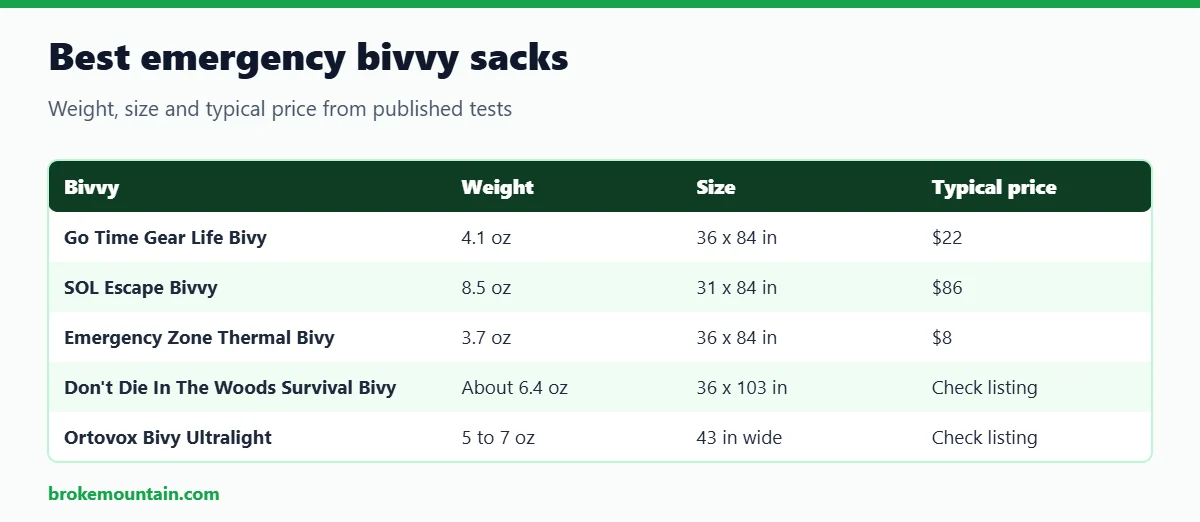
Best emergency bivvy sacks at a glance
| Bivvy | Weight | Size | Material | Typical price | Best for |
|---|---|---|---|---|---|
| Go Time Gear Life Bivy | 4.1 oz | 36 x 84 in | PET (Mylar-type) film | $22 | Best overall |
| SOL Escape Bivvy | 8.5 oz | 31 x 84 in | Breathable reflective fabric | $86 | Breathable and reusable |
| Emergency Zone Thermal Bivy | 3.7 oz | 36 x 84 in | PET film | $8 | Lowest price |
| Don’t Die In The Woods Survival Bivy | About 6.4 oz | 36 x 103 in | Thicker flexible film | Check listing | Tall hikers |
| Ortovox Bivy Ultralight | 5 to 7 oz | 43 in wide | Check listing | Check listing | Two people; snow sports |
Weights, sizes and prices come from TruePrepper’s hands-on test and Wilderness Times’ bivy guide.
What is an emergency bivvy sack?
It is a thin, waterproof, heat-reflecting bag that you climb into if you are caught out overnight or have to wait for help. TruePrepper describes it as more than an emergency blanket and less than a camping bivouac tent. It works in three ways.
- It blocks wind, which is the fastest way to lose heat.
- It keeps rain and wet ground off your clothes.
- Its reflective lining returns some of your body heat.
It has no insulation of its own. It keeps the warmth you already have. An emergency shelter is one of the ten essentials listed by the National Park Service, and a bivvy sack is the lightest way to carry one.
Bivvy sack, blanket or bivy bag?
| Emergency blanket | Emergency bivvy sack | Camping bivy bag | |
|---|---|---|---|
| Weight | 2 to 3 oz | 4 to 9 oz | 1 lb or more |
| Shape | Flat sheet | Closed bag | Shaped shelter with zip |
| Wind and rain | Poor; flaps open | Good | Very good |
| Breathable | No | Most are not | Yes |
| Use | One time | One night to a few uses | Regular camping |
| Price | A few dollars | $8 to $90 | $150 and up |
A blanket is better than nothing. A sack is far easier to keep closed around you in wind, especially with cold hands or an injury.
1. Go Time Gear Life Bivy: best overall
TruePrepper’s best overall pick at $22. It measures 36 by 84 inches and weighs 4.1 oz, or 4.66 oz in its storage bag. In the test the film stretched slightly and resisted tearing, even with shoes on inside, and the seams held. Vents at the bottom corners make it easier to get into and reduce condensation.
- Good: light; tougher than cheap foil bags; comes in bright colours; packs to about the size of a drinks can.
- Less good: the corner vents let some heat out; a thermal camera showed it does not reach the 90% heat reflection claimed; the built-in whistle is weak, so carry a real one.
- Best for: every day pack and car kit.
Check the Go Time Gear Life Bivy on Amazon
2. SOL Escape Bivvy: breathable and reusable
TruePrepper’s upgrade pick at $86 and 8.5 oz, measuring 31 by 84 inches. The fabric is waterproof, windproof and breathable, which reduces the sweat and condensation that build up inside foil bags. The tester calls it the lightest breathable option. Its heat reflection is rated lower, at 70%, and it costs about four times as much.
- Good: stays drier inside; durable enough for repeated use; works as a sleeping bag cover.
- Less good: price; twice the weight; narrower cut.
- Best for: winter hikers, solo trips and anyone who might spend a whole night in it.
Check the SOL Escape Bivvy on Amazon
3. Emergency Zone Thermal Bivy: lowest price
TruePrepper’s budget pick: about $8, 3.7 oz and 36 by 84 inches. It held heat well in the thermal test and its shiny surface helps with signalling. It tore easily on sticks and rocks, and the tester doubted it would last more than one night. It has no reusable stuff sack. Buy several and put one in each pack and glovebox.
Check the Emergency Zone Thermal Bivy on Amazon
4. Don’t Die In The Woods Survival Bivy: tall hikers
Wilderness Times lists this bivvy at 103 by 36 inches, long enough to pull over your head, with a hood and a thicker, more flexible film than standard foil. It weighs about 0.4 lb, which is more than the others here.
5. Ortovox Bivy Ultralight: two people
At 43 inches wide, Wilderness Times notes it can hold one or two people, which lets you share warmth with a cold or injured partner. It resists wind, water and dirt and comes with a stuff sack. The guide gives two different weights, 7 oz in its table and just over 5 oz in the text, and says it costs more than other emergency bags. Check the listing.
Which of the best emergency bivvy sacks suits you?
| You are | Sensible choice |
|---|---|
| A day hiker in three seasons | Go Time Gear Life Bivy |
| Hiking in winter or alone | SOL Escape Bivvy |
| Equipping a family or a car | Emergency Zone Thermal Bivy, one each |
| Over 6 ft tall | Don’t Die In The Woods Survival Bivy |
| Ski touring or with a partner | Ortovox Bivy Ultralight |
What to look for in the best emergency bivvy sacks
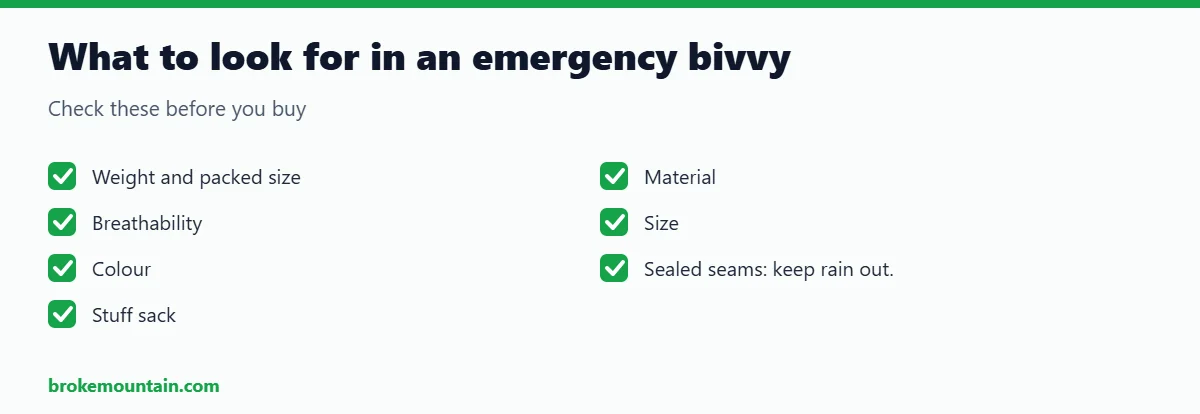
- Weight and packed size: it only helps if it is in your pack every time. Under 9 oz is easy to carry.
- Material: thin PET film is cheapest and tears most easily. Thicker film and fabric last longer.
- Breathability: foil bags trap moisture. TruePrepper explains that makers deal with this either with breathable fabric or with vents, and vents give up some warmth.
- Size: check the length against your height, with room to pull it over your head.
- Colour: orange or another bright colour is easier for rescuers to see.
- Sealed seams: keep rain out.
- Stuff sack: a reusable one keeps it protected in your pack.
Condensation: the main drawback
A non-breathable bag traps the moisture from your skin and breath. After some hours your clothes get damp, and damp clothes are cold. To limit it:
- Leave a small opening near your face and breathe outside the bag.
- Vent it when you warm up.
- Keep your insulating layers on inside the bag.
- Choose a breathable bivvy if you expect to use one for a full night.
How to use an emergency bivvy sack
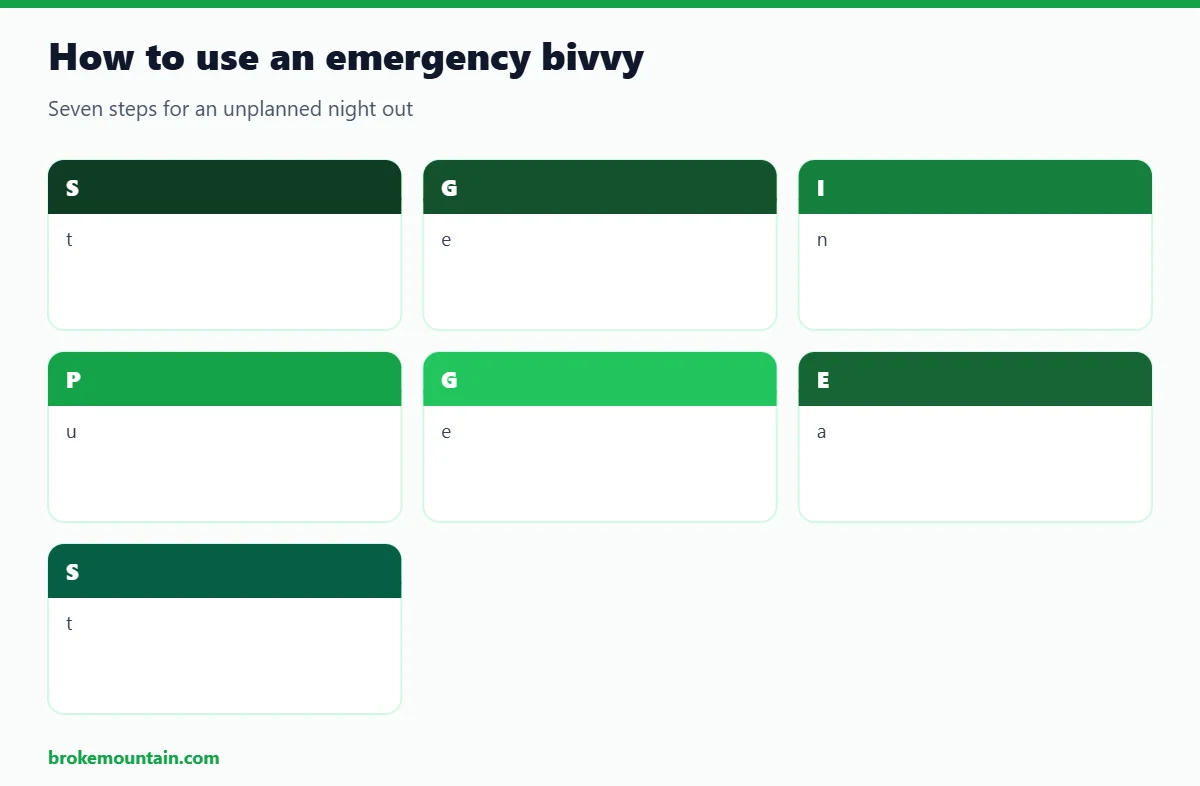
- Stop early. Set up before you are soaked, exhausted or in the dark.
- Get out of the wind, behind rocks, trees or a bank.
- Insulate yourself from the ground. Sit or lie on your pack, a rope, a foam pad or dry branches.
- Put on every dry layer you have, with hat and gloves.
- Get in feet first and pull the opening up around your shoulders or head.
- Eat and drink something. Your body needs fuel to make heat.
- Stay put and make yourself visible. Use a whistle, a light and bright colours.
The ground takes heat faster than the air, so step 3 matters as much as the bag. Practise once at home, because thin film is awkward to handle with cold hands.
What an emergency bivvy cannot do
- It does not add warmth. TruePrepper warns against relying on one beyond its temperature rating.
- It does not replace a sleeping bag for planned camping. For that, see our backpacking sleeping bags.
- Foil types are for short-term use and may not survive a second night.
- It does not call for help. Carry a way to do that; see satellite messengers for hiking.
Who should carry one?
- Day hikers, who usually carry no shelter at all.
- Anyone hiking alone, in winter or above the tree line.
- Trail runners and mountain bikers, who dress lightly and cool quickly when they stop.
- Drivers in cold or remote areas.
The rest of the kit is covered in what to bring when you go hiking, and the National Park Service hiking safety page explains how to plan so that you are less likely to need it.
Care and replacement
- Keep it in its sack, away from sharp gear.
- Check foil bags each season for cracks along the folds.
- Replace a foil bivvy after you use it. Refolding weakens the film.
- A fabric bivvy can be dried, folded and reused.
What else to carry with it
An emergency bivvy works as part of a small kit. These items weigh little and make a cold night much safer.
| Item | Why |
|---|---|
| Whistle | Carries further than a shout and takes no energy |
| Head torch | Lets you set up and signal after dark |
| Spare insulating layer | The bivvy only keeps the heat your clothes hold |
| Hat and gloves | Small, and they cut heat loss quickly |
| Sit pad or foam square | Insulation from the ground |
| High-energy food | Fuel for making heat |
| Charged phone or satellite messenger | To call for help |
| Lighter or fire starter | Warmth and a signal where fires are allowed |
See our headlamps for hiking and camping for the torch.
Signs you should stop and shelter
Do not wait until you are in trouble. Stop and get into shelter if:
- someone is shivering hard, stumbling or slurring words, which are early signs of hypothermia;
- you are lost and the light is going;
- an injury means you cannot keep moving at a safe pace;
- the weather has turned and the way ahead is exposed.
Call for help early if you can. A bivvy buys time while you wait.
Frequently asked questions
Do emergency bivvy sacks really work?
Yes, for blocking wind and rain and holding in some body heat. They work best with dry layers and insulation under you.
How warm is an emergency bivvy?
It adds no insulation. Treat any temperature rating as a survival limit, not a comfort figure.
Can I reuse one?
Fabric models such as the SOL Escape, yes. Thin foil models are hard to repack and tear easily.
Is a bivvy better than a space blanket?
In wind and rain, yes, because it closes around you. A blanket is lighter and cheaper.
Can I use one instead of a sleeping bag?
No. Some ultralight hikers use a breathable bivvy over a quilt, which is a different use.
Where should I pack it?
In the top or an outside pocket, where you can reach it with cold hands.
Last checked: November 2026. Prices, specifications and availability change, so confirm details on the maker’s or retailer’s page before you buy.

Hi, I am Emam Hasan — founder and editor of BrokeMountain. I oversee this blog’s hiking, camping and outdoor gear guides, making sure every article is well-researched, accurate and genuinely helpful for your time on the trail. Enjoy it!