
Quick answer: the best mountain bike hydration pack for most riders is the Osprey Raptor, Singletracks’ top MTB hydration pack: a stable 10 to 18 liter backpack with a 2.5 liter reservoir and a built-in tool roll. The CamelBak M.U.L.E. is the classic, well-built alternative. For shorter rides, the CamelBak Chase vest and the EVOC Hip Pack Pro carry water without a full backpack, and enduro riders should look at the EVOC Trail Pro with its built-in back protector.
BrokeMountain is reader-supported. We may earn a commission when you buy through links on this page, at no extra cost to you. Learn more.
How we put this together: we haven’t tested these packs in person. We compared long-term testing from Singletracks, BikePerfect and GearJunkie with maker specifications, and we link each source. Prices change often, so check the current listing before you buy.
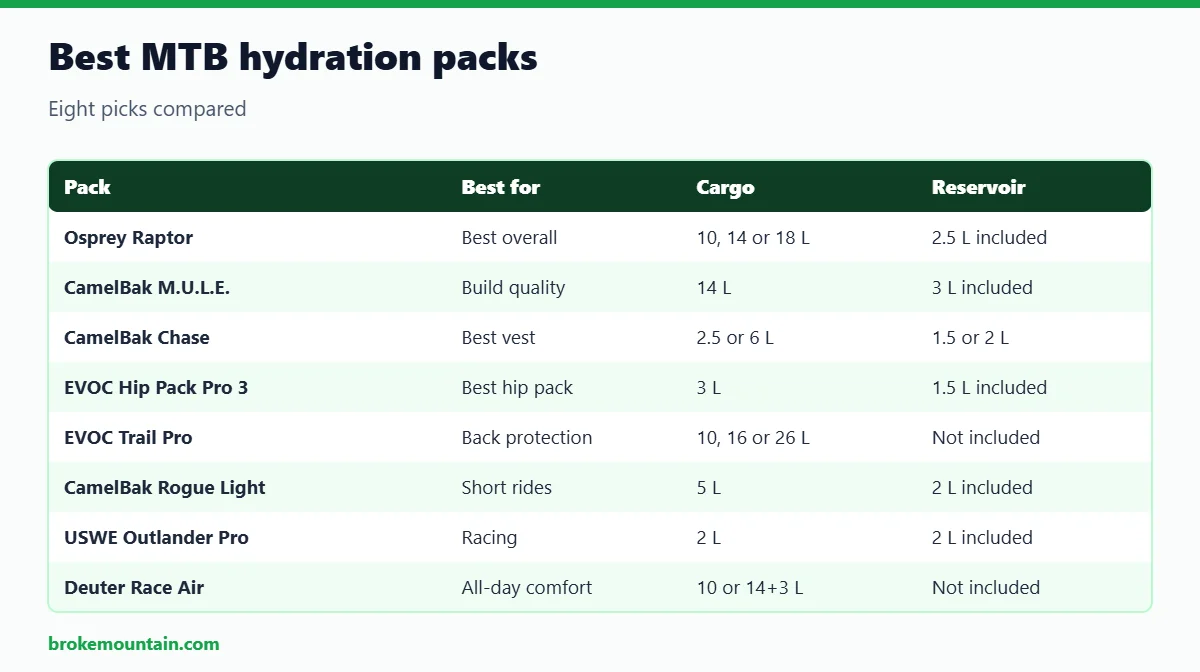
Best mountain bike hydration packs at a glance
| Pack | Best for | Price | Cargo | Reservoir |
|---|---|---|---|---|
| Osprey Raptor | Best overall | From $165 | 10, 14 or 18 L | 2.5 L included |
| CamelBak M.U.L.E. | Build quality | Check listing | 14 L | 3 L included |
| CamelBak Chase | Best vest | From $105 | 2.5 or 6 L | 1.5 or 2 L |
| EVOC Hip Pack Pro 3 | Best hip pack | Check listing | 3 L | 1.5 L included |
| EVOC Trail Pro | Back protection | $260 | 10, 16 or 26 L | Not included |
| CamelBak Rogue Light | Short rides | $85 | 5 L | 2 L included |
| USWE Outlander Pro | Racing | $110 | 2 L | 2 L included |
| Deuter Race Air | All-day comfort | $175 | 10 or 14+3 L | Not included |
Prices and capacities come from Singletracks’ hydration pack guide, last updated in May 2025, and BikePerfect’s hydration pack guide for the M.U.L.E. and EVOC Hip Pack Pro. Check the current listing before you buy.
Why use a hydration pack for mountain biking?
Many full-suspension frames only fit one small bottle, or none at all, and a bottle cage does nothing to carry a pump, tube or jacket. A hydration pack solves both: you can drink without taking your hands far from the bars, and your tools, snacks and layers ride with you. The best mountain bike hydration packs now go well beyond backpacks, with vests and hip packs that carry less but feel lighter on hot days.
1. Osprey Raptor: best overall MTB hydration pack
Singletracks named the Osprey Raptor the best MTB hydration pack it has tested. It comes in 10, 14 and 18 liter sizes from $165, with a 2.5 liter reservoir included. Singletracks highlights the wide, stable hip belt with snack pockets, the tool roll inside the main pouch, a magnetic hose clip and a helmet clip, and says the straps keep it steady when jumping. BikePerfect rated the Raptor 14 its best all-rounder for its comfort and stability. The Osprey Raven is the women’s version.
The trade-offs: BikePerfect found the key keeper not very secure and thought the bite valve could be better.
Check the Osprey Raptor on Amazon
2. CamelBak M.U.L.E.: best build quality
The M.U.L.E. is one of the best-known mountain bike packs. BikePerfect picked it for build quality, praising its excellent 3 liter reservoir, helmet clips and an Air Support back panel that helps keep your back dry. Its tested version has 14 liters of cargo space.
The trade-off: BikePerfect thought the waist strap could be more substantial.
Check the CamelBak M.U.L.E. on Amazon
3. CamelBak Chase: best hydration vest
Vests sit higher and closer to the body than backpacks, so they bounce less. Singletracks calls the CamelBak Chase the best mountain bike hydration vest, from $105, with 2.5 or 6 liters of cargo and a 1.5 or 2 liter reservoir depending on the model. It praises the wide harness, which spreads the weight well, and the easy-reach shoulder pockets for a phone and snacks.
The trade-off: the main rear pocket only fits a few small tools.
Check the CamelBak Chase on Amazon
4. EVOC Hip Pack Pro 3: best hip pack with a bladder
Hip packs take the weight off your shoulders and leave your back free to breathe. The EVOC Hip Pack Pro 3 is a top pick in both tests we checked: GearJunkie gave it a 9.4/10 rating, and BikePerfect named it its best overall pack. BikePerfect lists 3 liters of cargo, a 1.5 liter reservoir, room for two bottles and 453 grams, and praises the dedicated tool storage and very comfortable fit.
The trade-offs: it is not fully waterproof, and 1.5 liters is not enough water for long, hot rides.
Check the EVOC Hip Pack Pro 3 on Amazon
5. EVOC Trail Pro: best pack with back protection
Enduro riders and bike park regulars can get spine protection built into their pack. Singletracks lists the EVOC Trail Pro at $260 in 10, 16 and 26 liter sizes, with a ventilated back protector, five pouches and an included rain cover.
The trade-offs: it is expensive, and the 3 liter reservoir is sold separately.
Check the EVOC Trail Pro on Amazon
6. CamelBak Rogue Light: best minimal pack for short rides
For after-work laps, a small pack is enough. Singletracks lists the Rogue Light at $85, with 5 liters of storage and a 2 liter reservoir, and says its S-shaped straps stay stable on technical trails. It has an open quick-access pocket and a zippered pocket for tools and keys.
The trade-off: storage is limited, so it is not a pack for long days.
Check the CamelBak Rogue Light on Amazon
7. USWE Outlander Pro: best for racing
USWE packs are known for harnesses that barely move. Singletracks lists the Outlander Pro at $110 with a 2 liter reservoir and 2 liters of storage, and says its X-shaped harness stays stable during hard efforts. BikePerfect named the similar Outlander 2 its best lightweight pack at 417 grams.
The trade-offs: the close fit is less breathable, and it is built for riding, not for comfort off the bike.
Check the USWE Outlander on Amazon
8. Deuter Race Air: best for all-day comfort
The Deuter Race Air is a vented, lightweight pack for long rides. Singletracks lists it at $175 in 10 and 14+3 liter versions, with a rain cover and a net to hold your helmet.
The trade-off: the 2 liter reservoir is not included.
Check the Deuter Race Air on Amazon
Backpack, vest or hip pack?
- Backpack: the most water and storage, best for long rides and big days. Most hold a 2 to 3 liter reservoir.
- Vest: a closer, more stable fit with pockets on the straps. Good for fast trail rides and racing.
- Hip pack: no weight on your shoulders and a cooler back. Best for rides of a couple of hours or less.
- Back protector pack: for enduro and bike park riding, at the cost of weight and price.

How much water and storage do you need?
BikePerfect suggests planning for roughly 0.5 liters of fluid per hour, adjusted for distance, heat and whether you can refill on the way. Singletracks says 8 to 10 liters of storage is average, under 6 liters suits racing, and 18 liters or more is for overnight trips or camera gear. Hot days and big climbs use more water, so if in doubt, carry more.
How to choose a mountain bike hydration pack
The best mountain bike hydration packs all fit snugly and carry enough water for your longest usual ride. Work through these steps:
- Choose the type that matches your usual ride length.
- Pick a reservoir size: 1.5 liters for short rides, 2 to 3 liters for long ones.
- Check the fit: adjustable shoulder straps, a sternum strap and a hip belt that takes some of the load.
- Look for a ventilated back panel if you ride in the heat.
- Make sure there is a place for your tools, tube and pump.
- Choose a reservoir with a wide opening so it is easy to fill and clean.
What to carry in your pack
A good pack holds the essentials for fixing the most common trail problems. Start with a mountain bike tool kit, a puncture repair kit and one of the best mountain bike mini pumps, then add snacks, a light jacket and your phone. If you already own a reservoir, see our guide to the best hiking hydration bladders; Singletracks notes that most reservoirs fit most packs.
Cleaning your reservoir
Rinse the reservoir after every ride and dry it fully, hanging it open or turning it inside out, as Singletracks recommends. Clean the hose with a pipe cleaner from time to time. If your reservoir leaks, check the cap and hose connection first, as these are the most common causes.
Frequently asked questions
What is the best mountain bike hydration pack?
For most riders, the Osprey Raptor, Singletracks’ top pick: stable, well organized and supplied with a 2.5 liter reservoir. The CamelBak M.U.L.E. is a strong alternative.
Is a hip pack better than a backpack for mountain biking?
For shorter rides, many riders prefer a hip pack because it is cooler and keeps weight off the shoulders. For long rides or hot days, a backpack carries more water and gear.
What size hydration pack do I need for mountain biking?
About 8 to 10 liters of storage and a 2 to 3 liter reservoir covers most trail rides. Choose a smaller pack for racing or short laps.
Can I use a hiking hydration pack for mountain biking?
Yes, but bike-specific packs sit lower, use straps that stay put when you ride rough ground and often include tool storage and helmet holders.
How do I stop my reservoir tasting like plastic?
Rinse and dry it after every ride, store it dry, and clean it regularly. Wide-opening reservoirs are much easier to clean.
The bottom line
The best mountain bike hydration packs match your ride length. The Osprey Raptor and CamelBak M.U.L.E. are the top all-round backpacks, the Chase vest and EVOC Hip Pack Pro 3 suit shorter rides, and the EVOC Trail Pro adds back protection for enduro. Pick the right capacity, get the fit snug, and keep your reservoir clean.
Last checked: November 2026. Pack models, sizes and prices change each season, so check the current listing, capacity and reservoir details before you buy.

Hi, I am Emam Hasan — founder and editor of BrokeMountain. I oversee this blog’s hiking, camping and outdoor gear guides, making sure every article is well-researched, accurate and genuinely helpful for your time on the trail. Enjoy it!


