Quick answer: XC race shoes should be stiff, light and secure. Look for a carbon or carbon-reinforced sole for efficient power transfer, a BOA dial or similar quick-adjust closure, two-bolt (SPD-style) cleat compatibility and enough rubber tread to run up a muddy climb. If you also ride technical trails, a slightly softer, more walkable shoe is the better all-rounder.
BrokeMountain is reader-supported. We may earn a commission when you buy through links on this page, at no extra cost to you. Learn more.
What makes an XC race shoe different
Cross-country racing rewards efficiency. Every pedal stroke on a long climb transfers power through the sole, so race shoes use stiff soles that flex very little. They are also light, close-fitting and quick to adjust mid-race. Trail and enduro shoes trade some of that stiffness for comfort, grip and protection when you are off the bike or putting a foot down.
What to look for
Sole stiffness
Brands rate stiffness on their own scales (Shimano uses 1–12, for example). Race shoes typically sit at the top of the range. A full carbon sole is the stiffest and lightest; a nylon sole with carbon reinforcement is cheaper and a little more comfortable for long rides and hike-a-bikes.
Closure
BOA dials let you fine-tune tension in small steps and loosen or tighten on the move. Many race shoes use two dials; mid-range shoes often use one dial plus a strap. Laces are light and even but cannot be adjusted while riding.
Cleat compatibility
Nearly all MTB shoes use the two-bolt SPD standard, which works with Shimano SPD, Crankbrothers, Time and most other MTB pedals. Make sure the cleat area is recessed so you can walk without the cleat touching the ground.
Tread and toe spikes
A rubber tread with good lugs helps on running sections and muddy climbs. Threaded toe-spike holes let you add studs for mud or cyclocross-style courses.
Fit and weight
Race shoes are snug. Try them on in the afternoon (feet swell during the day) and with your riding socks. A pair of performance XC shoes usually weighs around 600–750 g in a mid size.
| Shoe type | Stiffness | Best for |
|---|---|---|
| Race XC shoe | Very high, carbon sole | Racing, fast training rides |
| Performance XC/trail | High, carbon-reinforced | Long rides, marathon, mixed trails |
| Entry XC shoe | Medium, nylon sole | Beginners, commuting, indoor cycling |
Our picks


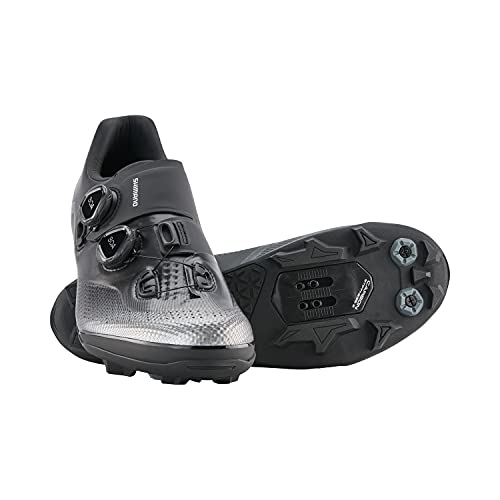


We picked these by comparing sole stiffness, closure systems, weight, tread and how riders rate fit and durability. Shimano’s XC range is the reference point: the XC7 (SH-XC702) is a race-ready shoe, the ME7 suits trail and marathon riders who walk more, and the XC1 and XC5 are great value. Fizik’s Terra X5 is a light, stiff option with a wide-fitting toe box.
Setting up cleats
- Position the cleat so the ball of your foot sits just in front of the pedal axle.
- Set the cleat angle to match how your feet naturally point.
- Use a little grease on the bolts and torque them to about 5–6 Nm.
- Start with low pedal tension until you get used to clipping out.
Frequently asked questions
Do I need XC race shoes if I don’t race?
Not necessarily. A slightly softer performance shoe is more comfortable for most riders and still pedals efficiently.
Can I use XC shoes for indoor cycling?
Yes, if the indoor bike has SPD-compatible pedals.
Are flat-pedal shoes OK for XC?
Many riders use them, but clipless shoes are more efficient for long climbs and racing.
Keep reading

Hi, I am Emam Hasan — founder and editor of BrokeMountain. I oversee this blog’s hiking, camping and outdoor gear guides, making sure every article is well-researched, accurate and genuinely helpful for your time on the trail. Enjoy it!