
Quick answer: choose mountain bike tyres in this order: the right size for your wheels, a tread that suits your terrain, a width that fits your rims and frame, a casing strong enough for your riding, and a rubber compound that balances grip and wear. For most trail riders, a 2.3 to 2.5-inch tubeless-ready tyre with a medium-soft compound and a reinforced casing is the best all-rounder, such as the Maxxis Minion DHF and DHR II pair. Run a grippier tyre on the front and a faster-rolling one on the rear.
BrokeMountain is reader-supported. We may earn a commission when you buy through links on this page, at no extra cost to you. Learn more.
How we chose: we haven’t tested these tyres in person. This guide is based on manufacturer specifications, published tyre tests and standard sizing information. Tyre ranges change often, so check the current version before you buy.
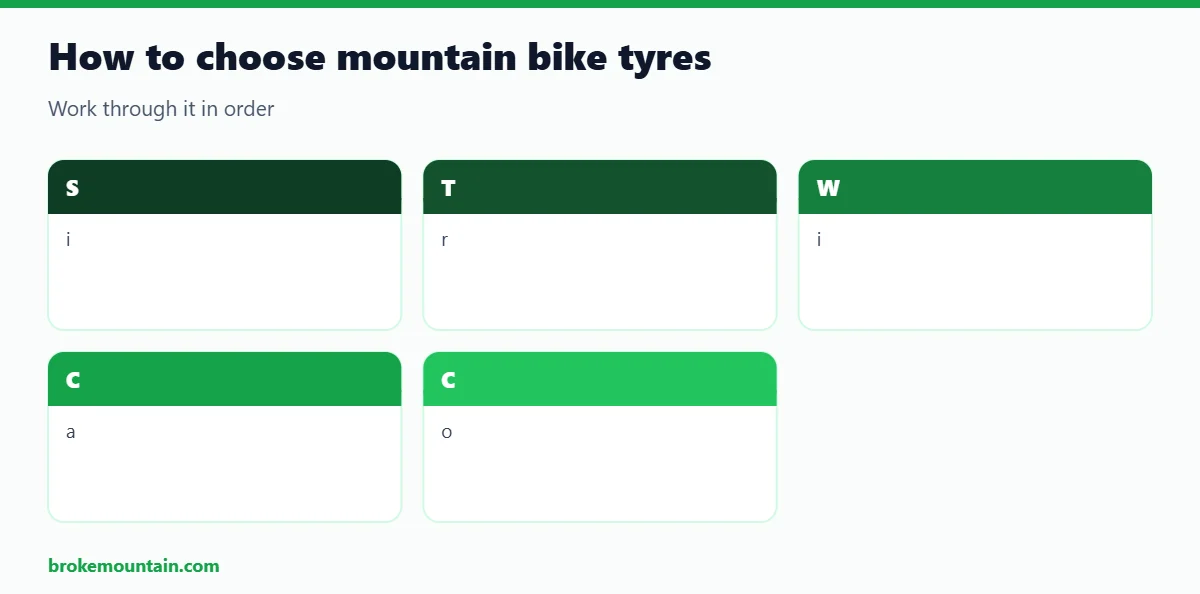
1. Size: match your wheel
The tyre’s diameter must match your wheel: 26, 27.5 (also called 650b) or 29 inch. The most reliable reference is the ISO (ETRTO) number on the sidewall, written as width and bead seat diameter in millimetres. For example, 60-622 means a tyre about 60 mm wide for a 29-inch rim. The bead seat diameters are 559 mm for 26 inch, 584 mm for 27.5 inch and 622 mm for 29 inch. Sheldon Brown’s tyre sizing guide explains the system in detail.
2. Tread: match your terrain
| Tread | Best for |
|---|---|
| Low, closely spaced knobs | Cross-country, hardpack and gravel; fast rolling |
| Medium knobs with strong shoulders | All-round trail riding |
| Tall, open knobs | Loose and soft ground, enduro |
| Spike or mud tread | Deep mud and winter riding |
Shoulder knobs give cornering grip, while centre knobs give braking and climbing traction. Ramped centre knobs roll faster; square-edged knobs brake better.
3. Width: match rims and frame
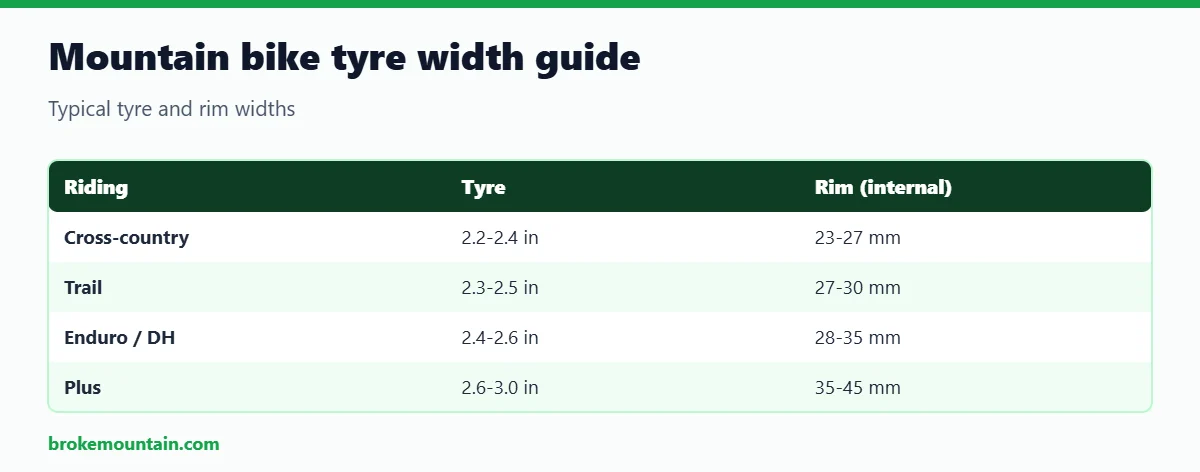
| Riding | Typical tyre width | Rim internal width |
|---|---|---|
| Cross-country | 2.2 to 2.4 in | About 23 to 27 mm |
| Trail | 2.3 to 2.5 in | About 27 to 30 mm |
| Enduro and downhill | 2.4 to 2.6 in | About 28 to 35 mm |
| Plus | 2.6 to 3.0 in | About 35 to 45 mm |
The same tyre will measure wider on a wider rim. BikeRadar’s rim width guide notes that older mountain bike wheels often had 25 mm internal rims, while many modern wheelsets use 30 mm or 35 mm, and recommends checking the wheel or tyre maker’s chart for compatible tyre widths. Always check frame and fork clearance before going wider, and leave room for mud.
4. Casing: match your riding
Light casings roll faster and feel lively but cut and pinch-flat more easily. Reinforced casings are heavier but support lower pressures and resist damage. Each brand uses its own names:
- Maxxis: EXO, EXO+, DoubleDown and DH, from lightest to toughest. ENDURO Mountainbike Magazine’s Maxxis test describes EXO as the lightest, single-ply option and DoubleDown as a dual-ply casing for demanding enduro trails.
- Continental: Race, Trail, Enduro and Downhill.
- Schwalbe: recently reorganised its casings into Race, Trail and Gravity families, with the Gravity Pro casing replacing the older Super Gravity and Super Downhill casings.
Most trail riders are happiest with a mid-weight reinforced casing, especially on the rear, which takes most of the hits.
5. Compound: grip vs wear
Softer rubber grips better on rocks and roots but wears faster and rolls more slowly. Many tyres come in two or three compounds. A common setup is the softest compound on the front for grip, and a harder, longer-lasting compound on the rear.
Tubes or tubeless?
Tubeless is now the standard for mountain biking. It lets you run lower pressure for grip and comfort, and sealant fixes most small punctures automatically. You need tubeless-ready rims, rim tape, valves and sealant. Tubes are cheaper and simpler, but more prone to pinch flats. Our tubeless sealant guide explains how to set up and maintain tubeless tyres.
The best mountain bike tyres
1. Maxxis Minion DHF and DHR II: best all-round pair
The Minion DHF up front and DHR II at the rear are a benchmark trail and enduro combination, with predictable cornering and strong braking traction on most terrain. Both come in many casings and compounds, so you can choose a lighter trail version or a tougher enduro version.
- Good for: trail and enduro riders who want a proven, versatile pair.
- Watch out for: softer versions wear quickly on the rear.
Check Maxxis Minion prices on Amazon
2. Maxxis Dissector: best fast-rolling trail tyre
The Dissector rolls quickly but still grips well, which makes it a popular rear tyre for down-country riding and dry trails, and a front tyre for lighter riders.
- Good for: fast trail riding and long days in the saddle.
- Watch out for: less braking grip than a Minion DHR II in loose conditions.
Check Maxxis Dissector prices on Amazon
3. Continental Kryptotal: best for front and rear grip
Continental’s Kryptotal comes in front- and rear-specific versions, with strong grip on rock and roots. It’s available in several casings, from Trail to Downhill, so it suits trail riders and enduro racers alike. Our guide to enduro and downhill tyres covers it in more detail.
- Good for: riders who want excellent grip in dry and mixed conditions.
- Watch out for: compound options are tied to each casing.
Check Continental Kryptotal prices on Amazon
4. Schwalbe Nobby Nic: best versatile trail tyre
The Nobby Nic balances rolling speed, grip and weight, which makes it a good all-rounder for trail riding on a wide range of surfaces.
- Good for: riders who want one tyre for most conditions.
- Watch out for: less grip than gravity tyres on very steep, loose trails.
Check Schwalbe Nobby Nic prices on Amazon
5. Maxxis Rekon or Ikon: best for cross-country
The Rekon and Ikon are fast-rolling tyres for cross-country and light trail riding on hardpack and long rides. The Ikon rolls faster, while the Rekon has a little more grip.
- Good for: cross-country racing and riders who value speed.
- Watch out for: limited grip on wet roots and loose rock.
Check Maxxis Rekon prices on Amazon
6. WTB Vigilante and Trail Boss: best value pair
WTB’s Vigilante (front) and Trail Boss (rear) are a durable, grippy pairing that often costs less than bigger-name tyres.
- Good for: riders on a budget who still want trail-capable tyres.
- Watch out for: check the casing and compound, as versions vary.
Check WTB tyre prices on Amazon
Quick comparison
| Tyre | Best for | Strength | Trade-off |
|---|---|---|---|
| Maxxis Minion DHF / DHR II | Trail and enduro | Proven grip | Soft versions wear fast |
| Maxxis Dissector | Fast trail | Rolls quickly | Less braking grip |
| Continental Kryptotal | Dry and mixed | Excellent grip | Compound tied to casing |
| Schwalbe Nobby Nic | All-round trail | Versatile | Less grip on steep, loose trails |
| Maxxis Rekon / Ikon | Cross-country | Speed | Limited wet grip |
| WTB Vigilante / Trail Boss | Value | Good price | Versions vary |
Front and rear: why they’re often different
The front tyre controls steering, so it needs the most grip. The rear tyre drives you forward and does much of the braking, so it needs good centre knobs but can roll a little faster and use a harder compound. That’s why many riders pair a grippy front tyre with a faster or tougher rear tyre, such as a Minion DHF with a DHR II, or an Assegai with a Dissector.
Budget tyres for casual riding
Basic wire-bead tyres are cheap and fine for paths and gentle riding on entry-level bikes. They’re heavier and less grippy than folding, tubeless-ready tyres, so riders on real trails will notice a big improvement when they upgrade.
Tyres for wet and muddy trails
Wet roots and mud need tall, widely spaced knobs and softer rubber. Some riders keep a separate set of mud tyres for winter. Our guide to MTB tyres for wet conditions covers the best options.
Setting the right pressure
Even the best tyre performs badly at the wrong pressure. Too high and it bounces and loses grip; too low and it squirms in corners and risks rim damage. Start with a pressure suited to your weight, tyre width and riding, then adjust a little at a time. Our tyre pressure guide gives starting points.
Mountain bike tyres by riding style
| Riding style | Front tyre | Rear tyre | Casing |
|---|---|---|---|
| Cross-country | Fast-rolling, low knobs | Fast-rolling, low knobs | Light |
| Down-country | Grippy trail tyre | Fast-rolling trail tyre | Light to mid-weight |
| Trail | Grippy, strong shoulders | Good braking knobs | Mid-weight reinforced |
| Enduro | Aggressive, soft compound | Aggressive, tougher compound | Heavy |
| Bike park / downhill | Aggressive, soft compound | Aggressive | Downhill |
If you ride a bit of everything, start with trail tyres and a mid-weight casing. You can always fit a tougher rear tyre if you get frequent flats, or a faster one if the bike feels slow on climbs.
Making your tyres last longer
Rear tyres wear fastest, especially with soft compounds, heavy braking and rocky trails. Avoid skidding, which tears the centre knobs. Rotate a part-worn front tyre to the rear and fit a fresh tyre up front, so the best grip stays where steering needs it. Check your tyres after every few rides for cuts, torn knobs and sidewall damage, and replace them before grip becomes unpredictable. Storing your bike out of direct sunlight also helps the rubber last.
Common tyre mistakes to avoid
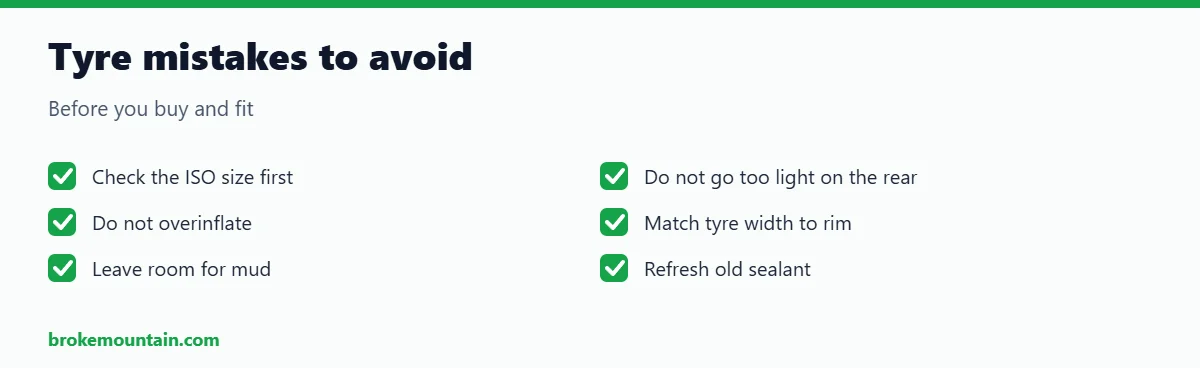
- Buying the wrong size. Check the ISO number on your current tyre before ordering.
- Going too light on the rear. A flimsy rear casing is the most common cause of trailside flats.
- Running too much pressure. Many riders run their tyres harder than they need to, which costs grip and comfort.
- Ignoring rim width. A very wide tyre on a narrow rim can feel unstable and squirmy in corners.
- Forgetting clearance. A tyre that only just fits will rub once mud builds up.
- Leaving old sealant. Dried sealant won’t seal punctures, so top it up every few months.
How to fit new tyres
- Check the direction arrow on the sidewall and fit the tyre the right way round.
- Line up the tyre logo with the valve, which makes it easier to find punctures later.
- For tubeless, make sure the rim tape is in good condition and the valve is tight.
- Seat the beads with a track pump or tubeless inflator, then add sealant.
- Check both beads are seated evenly all the way round before riding.
Frequently asked questions
How often should I replace mountain bike tyres?
When the knobs are worn round or torn, the casing is cut, or grip noticeably drops. Rear tyres usually wear much faster than fronts.
Can I use different tyres front and rear?
Yes, and most riders do: a grippier tyre on the front and a faster-rolling tyre on the rear.
Are expensive tyres worth it?
Tyres are one of the most noticeable upgrades you can make. A quality tyre improves grip, comfort and speed more than many pricier parts.
Will a 2.5-inch tyre fit my bike?
Check your frame and fork clearance and your rim width. Many modern trail bikes fit 2.5-inch tyres, but older and cross-country bikes may not.
Are folding tyres better than wire-bead tyres?
Folding tyres use a Kevlar or aramid bead instead of steel wire. They’re lighter, easier to carry as a spare, and most tubeless-ready tyres are folding. Wire-bead tyres are cheaper and fine for casual riding.
Should I choose 27.5 or 29-inch tyres?
You don’t choose tyre size separately: it must match your wheels. If you’re buying a new bike, 29-inch wheels roll over obstacles more easily, while 27.5-inch wheels feel more agile and suit smaller riders. Some bikes use a 29-inch front and 27.5-inch rear, which is called a mullet or mixed-wheel setup.
What does TPI mean on a tyre?
TPI stands for threads per inch. Higher TPI casings are lighter and more supple; lower TPI casings are usually tougher.
Keep reading

Hi, I am Emam Hasan — founder and editor of BrokeMountain. I oversee this blog’s hiking, camping and outdoor gear guides, making sure every article is well-researched, accurate and genuinely helpful for your time on the trail. Enjoy it!


