Quick answer: the Trek Top Fuel is a short-travel full-suspension mountain bike with 120 mm of rear travel and a 130 mm fork, sitting between Trek’s cross-country race bikes and its longer-travel Fuel EX trail bike. This category is often called “downcountry”. The current Gen 4 Top Fuel climbs very efficiently, has adjustable geometry and in-frame storage, and is fun on descents for its travel. Higher model numbers (5, 7, 8, 9.x) mean better parts, with carbon frames on the 9.x models. It suits riders who want fast climbing and long-ride efficiency with more confidence on descents than a pure XC bike.
BrokeMountain is reader-supported. We may earn a commission when you buy through links on this page, at no extra cost to you. Learn more.
How we put this together: we haven’t ridden the Top Fuel ourselves. This review summarises Trek’s published specifications and hands-on tests from established mountain bike reviewers. Specs and prices change by model year, so always check Trek’s current spec sheet.
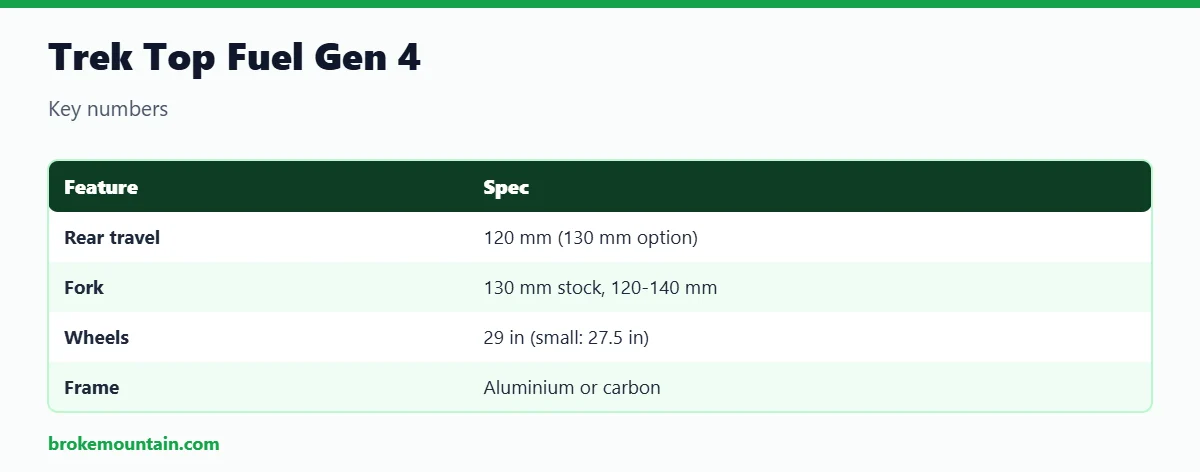
Trek Top Fuel at a glance
| Feature | Gen 4 Top Fuel |
|---|---|
| Rear travel | 120 mm (130 mm with a longer-stroke shock) |
| Fork travel | 130 mm stock; frame rated for 120 to 140 mm |
| Wheels | 29 in (smallest sizes use 27.5 in or mixed wheels) |
| Frame | Alpha Platinum aluminium or OCLV carbon |
| Geometry | Adjustable via Mino Link in the lower shock mount |
| Extras | Down tube storage, dropper post, wide bars |
What’s new on the Gen 4 Top Fuel
The Gen 4 Top Fuel keeps 120 mm of rear travel but adds more ways to adjust the bike. According to BikeRadar’s launch coverage, swapping the stock 180 x 50 mm shock for a 180 x 55 mm version increases travel to 130 mm, and you can also fit a 120 mm fork to make it more race-focused. The four-position Mino Link in the lower shock mount changes both the geometry and how progressive the suspension feels.
Flow Mountain Bike explains that the frame is rated for 120 to 140 mm forks, so you could set it up as a light XC bike at 120/120 mm or a burlier trail bike at 140/130 mm. Flow’s tester called it one of the best short-travel trail bikes they had ridden.
Understanding the Top Fuel models
| Model | Typically | Notes |
|---|---|---|
| Top Fuel 5 | Aluminium frame, entry parts (Shimano Deore, RockShox Recon fork) | Most affordable way into the platform |
| Top Fuel 7 | Aluminium, upgraded fork and drivetrain | Good value |
| Top Fuel 8 | Aluminium, Fox Rhythm 34 fork, Fox Float DPS shock | Popular all-rounder |
| Top Fuel 9.x | OCLV carbon frame, higher-end parts | Lightest and most expensive |
BikeRadar lists the Top Fuel 5 with a RockShox Recon Silver fork, Shimano Deore drivetrain and Shimano MT200 brakes, and the Top Fuel 8 with a Fox Rhythm 34 fork and Fox Performance Float DPS shock. Exact builds vary by country and model year.
How it rides: what the reviews say
Climbing
The Top Fuel’s cross-country roots show on climbs. Reviewers consistently praise its pedalling efficiency, and OutdoorGearLab’s long-term test of the Top Fuel 9.8 GX AXS described it as a bike with climbing and descending ability you might think were mutually exclusive.
Descending
With a slack head angle for its travel and a capable fork, the Top Fuel is more confident downhill than its numbers suggest. mbr praised its outstanding rear suspension and engaging handling, while noting its high price and that it could be even more capable. It’s best on flowing to moderately technical trails; very rough, steep terrain is better suited to a longer-travel bike like the Fuel EX.
Aluminium vs carbon
The aluminium models offer the same geometry and suspension design for much less money. In The Loam Wolf’s long-term review of the aluminium Top Fuel 9, the tester never wished for a carbon frame, though the bike weighed 31.7 lb in size medium and the tester found its stock brakes underpowered. The carbon models save weight and come with higher-end parts.
Sizing and fit
The Top Fuel comes in a wide range of sizes, including an ML (medium-large) size between medium and large. The smallest sizes use 27.5-inch wheels so shorter riders get a better fit, while medium to XL bikes roll on 29-inch wheels. Modern trail geometry means the bikes are longer than older Top Fuels, so check the reach figure on Trek’s geometry chart rather than relying on the frame size you rode before. If you are between sizes, a test ride at a Trek dealer is the best way to decide: a smaller size feels more playful, while a larger one feels more stable at speed.
Suspension setup tips
- Start with the sag Trek recommends for the shock and fork, then fine-tune.
- Use the Mino Link low setting for steeper trails and the high setting for more pedalling clearance.
- Choose the progressive setting if you often bottom out the shock.
- Recheck pressures after the first few rides as seals bed in.
Who should buy a Top Fuel?
- Riders who value climbing speed and all-day efficiency.
- Cross-country riders who want a more fun, confident bike on descents.
- Riders on flowing to moderately technical trails.
- Marathon and endurance riders who want comfort over long distances.
Who should look elsewhere?
- Riders on steep, rough trails: a longer-travel trail bike such as the Trek Fuel EX will be more comfortable and confident.
- XC racers chasing every gram: a dedicated race bike will be lighter.
- Riders on a tight budget: a good hardtail gives better parts for the money; see our hardtail guide.
Top Fuel vs the competition
The Top Fuel competes with other short-travel trail bikes such as the Specialized Epic, Giant Anthem, Santa Cruz Blur, Yeti ASR and Scott Spark. Each brand balances weight, travel and geometry slightly differently, so compare sizing, components and local dealer support. Our guide to full-suspension mountain bikes covers more options, and our mountain bike brands guide explains how the major brands compare.
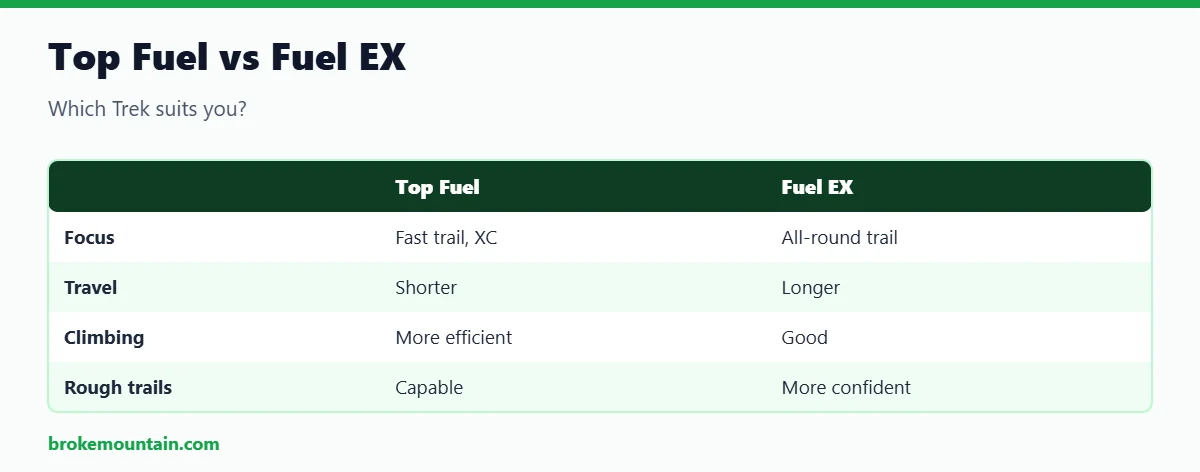
Top Fuel vs Fuel EX
| Top Fuel | Fuel EX | |
|---|---|---|
| Focus | Fast, efficient trail and XC | All-round trail riding |
| Travel | Shorter | Longer |
| Climbing | More efficient | Good |
| Descending | Capable | More confident on rough trails |
Best upgrades for a Top Fuel
- Brakes: some reviewers found the stock brakes on lower models underpowered; stronger four-piston brakes make a big difference.
- Tyres: grippier tyres add confidence on loose trails; see our guide to choosing MTB tyres.
- Dropper post: a longer-travel dropper helps on steep descents; see our dropper post guide.
- Suspension setup: spend time setting sag and rebound, and use a shock pump to fine-tune pressures.
Check shock pump prices on Amazon
Check frame protection kits on Amazon
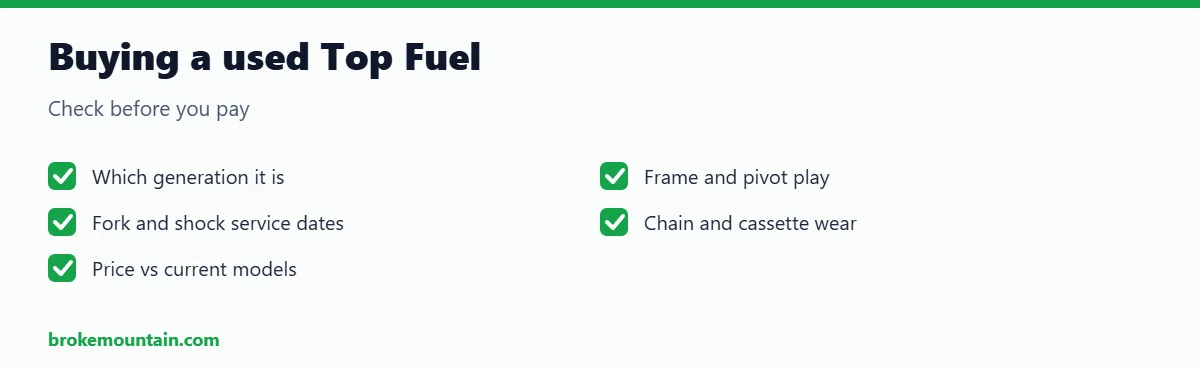
Buying a used Top Fuel
- Check which generation it is: older Top Fuels had less travel and more XC-focused geometry.
- Check the frame and pivots for play, cracks or damage.
- Ask when the shock and fork were last serviced.
- Check drivetrain wear with a chain checker.
- Compare the price with current models’ specs before you buy.
Frequently asked questions
Is the Trek Top Fuel good for beginners?
Yes, if you want efficient full suspension, though a hardtail is cheaper to start with.
Top Fuel vs Fuel EX: what’s the difference?
The Fuel EX has more travel and suits general trail riding on rougher terrain; the Top Fuel is lighter and more efficient.
How much travel does the Trek Top Fuel have?
The Gen 4 has 120 mm of rear travel and a 130 mm fork as standard. A longer-stroke shock increases rear travel to 130 mm.
Is the Top Fuel a cross-country bike?
It started as one, but the Gen 4 is better described as a short-travel trail or “downcountry” bike. It can still be raced with a shorter fork.
What is the difference between the Top Fuel 7 and 8?
The 8 typically has better suspension and drivetrain parts for a higher price. Check the current spec sheet, as builds change each year.
Keep reading

Hi, I am Emam Hasan — founder and editor of BrokeMountain. I oversee this blog’s hiking, camping and outdoor gear guides, making sure every article is well-researched, accurate and genuinely helpful for your time on the trail. Enjoy it!