
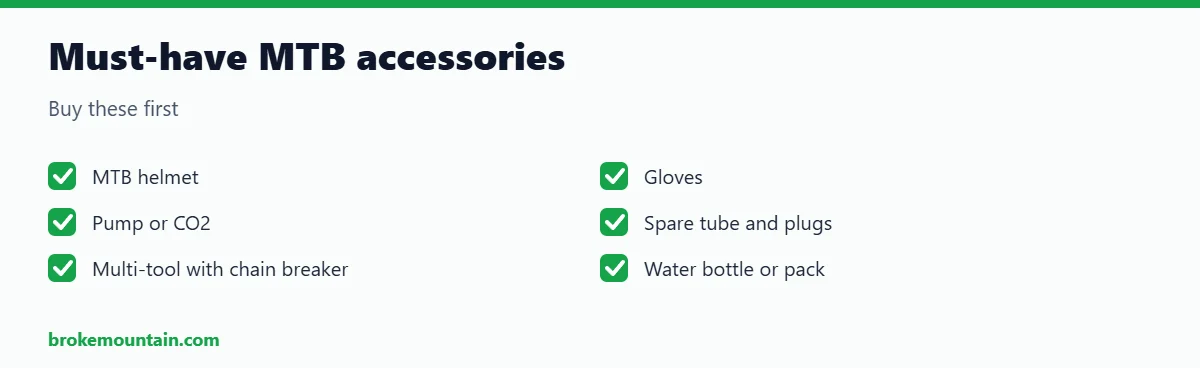
Quick answer: the must-have mountain bike accessories are a well-fitting MTB helmet, gloves, a way to fix flats (pump or CO2, spare tube and tubeless plugs), a multi-tool with a chain breaker, a way to carry water, and lights if you ride near dusk. After those, add knee pads, glasses, a saddle or frame bag for your tools, and comfort upgrades such as better grips and pedals. Buy safety and trail-repair gear first, then add the rest as you ride more.
BrokeMountain is reader-supported. We may earn a commission when you buy through links on this page, at no extra cost to you. Learn more.
How we put this together: we haven’t tested every product mentioned in person. This guide is based on safety standards, independent test data and our wider buying guides. Check current models and prices before you buy.
The essential mountain bike accessories
| Accessory | Why you need it |
|---|---|
| Helmet | The most important piece of kit. Choose an MTB helmet with extended rear coverage. |
| Gloves | Grip, comfort and protection for your hands in falls. |
| Mini pump or CO2 | Reinflate tyres on the trail. |
| Spare tube, tyre levers and tubeless plugs | Get home after a puncture. |
| Multi-tool with chain breaker | Fix loose bolts and broken chains. |
| Water bottle and cage, or hydration pack | Stay hydrated on longer rides. |
| Lights | For dusk, commuting to the trails and night rides. |
1. A mountain bike helmet
A helmet is the one accessory you should never ride without. In the US, every bicycle helmet sold must meet the CPSC bicycle helmet standard, and each helmet must carry a label certifying that it complies. In Europe, look for EN 1078.
Certification is the minimum. Independent testing can help you compare helmets further. The Virginia Tech Helmet Lab rates bike helmets using its STAR system, and according to Bikerumor, the lab tightened its scoring thresholds because helmets have improved so much: under the old system, 167 of 272 helmets rated five stars, while the new thresholds reduced that number to 38.
- Choose a helmet with more rear and side coverage than a road helmet.
- Look for rotational impact protection such as MIPS or similar systems.
- An adjustable visor helps with sun and branches.
- Fit should be snug but comfortable, sitting level about two fingers above your eyebrows.
- For bike parks and downhill, consider a full-face helmet.
- Replace your helmet after any crash where it takes an impact.
Check MTB helmet prices on Amazon
2. Gloves: the next mountain bike accessories to buy
MTB gloves improve grip on wet or sweaty grips, reduce hand fatigue and protect your palms in a fall. Full-finger gloves are standard for trail riding. Thin, well-ventilated gloves suit summer, while padded or insulated gloves suit rough trails and winter.
Check MTB glove prices on Amazon
3. Flat repair kit
Flats are the most common trailside problem, so repair gear is one of the most important mountain bike accessories. Carry a pump or CO2 inflator, tyre levers, a spare tube that fits your wheels, and tubeless plugs if you run tubeless. Our guides to mini pumps and puncture repair kits cover the best options.
Check tubeless plug kits on Amazon
4. Multi-tool
A good multi-tool has the hex keys your bike uses (usually 2 to 8 mm), a Torx T25 for brake rotors and other bolts, and a chain breaker. Add a quick link that matches your chain so you can fix a broken chain in minutes.
Check multi-tool prices on Amazon
5. Water: bottle or hydration pack
Water is easy to overlook among mountain bike accessories. For short rides, a bottle on the frame is light and cool. For long rides, hot weather or remote trails, a hydration pack carries more water plus your tools, food and a jacket. Hip packs are a popular middle ground.
6. Lights
If you start early, finish late or ride on roads to reach the trails, carry lights. For real night riding, you’ll want a powerful handlebar light and a helmet light. See our guides to mountain bike lights and helmet lights.
Nice-to-have mountain bike accessories
Once you have the essentials, these mountain bike accessories make rides safer, more comfortable and easier to plan.
- Knee pads for technical trails; see our knee pad guide.
- Glasses to protect your eyes from dust, mud and branches.
- A saddle bag or frame bag to carry tools without a backpack.
- Better pedals and shoes for grip and control.
- A GPS computer or phone mount for navigation; see our GPS bike computer guide.
- A bike lock for café stops on the way home.
- Chain lube and cleaning gear to keep your drivetrain running; see our chain oil guide.
Mountain bike accessories for home maintenance
Some of the most useful mountain bike accessories never leave your garage. A track pump with an accurate gauge makes setting tyre pressure quick and consistent. A repair stand holds the bike at a comfortable height for cleaning, adjusting gears and fixing brakes; our guide to bike stands and storage covers the options. A torque wrench helps you tighten bolts correctly, which matters on carbon parts. A shock pump lets you set fork and shock pressures, and a chain checker tells you when to replace your chain before it wears out the cassette.
- Track pump with a gauge
- Repair stand
- Torque wrench
- Shock pump
- Chain checker and quick-link pliers
- Bike cleaning brushes and degreaser
Clothing and wearable mountain bike accessories
You do not need special clothing to start mountain biking, but a few pieces make rides more comfortable. Padded liner shorts reduce saddle soreness on longer rides. Baggy MTB shorts are tough and have room for knee pads. A breathable jersey or technical T-shirt dries faster than cotton. A light, packable rain jacket is worth carrying when the weather is unsettled, and a thin windproof layer helps on long descents. In cold weather, layers you can remove as you warm up work better than one thick jacket.
Pedals and shoes
Pedals and shoes are among the best mountain bike accessories for control. Flat pedals with metal pins and sticky-soled shoes give strong grip and let you put a foot down easily, which suits beginners and technical trails. Clipless pedals and shoes lock your feet to the pedals for efficient climbing and racing. Many riders start on flats and try clipless later. Whichever you choose, good shoes with a stiff sole make a noticeable difference compared with everyday trainers.
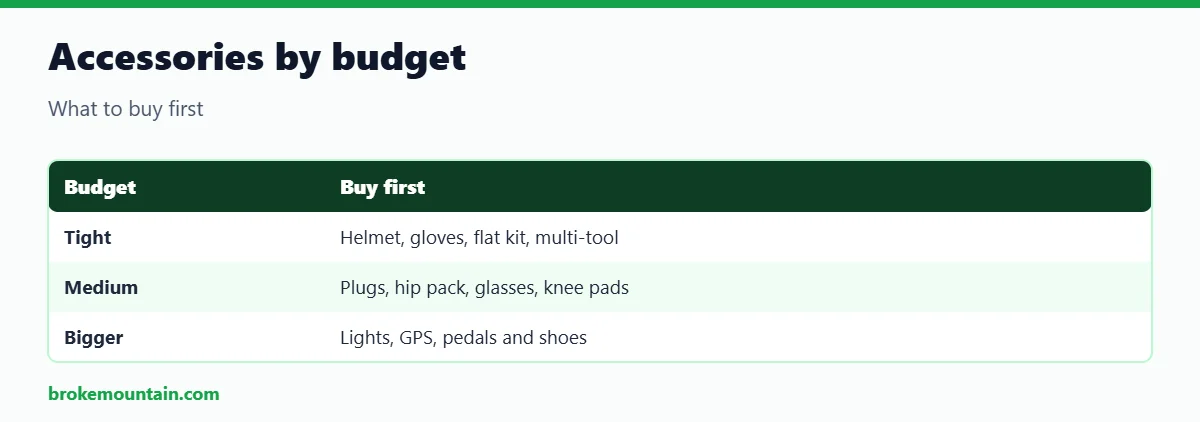
Accessories by budget
| Budget | Buy first |
|---|---|
| Tight | Helmet, gloves, spare tube, tyre levers, mini pump, basic multi-tool |
| Medium | Add tubeless plugs, a hydration pack or hip pack, glasses and knee pads |
| Bigger | Add lights, a GPS computer, better pedals and shoes, and a repair stand |
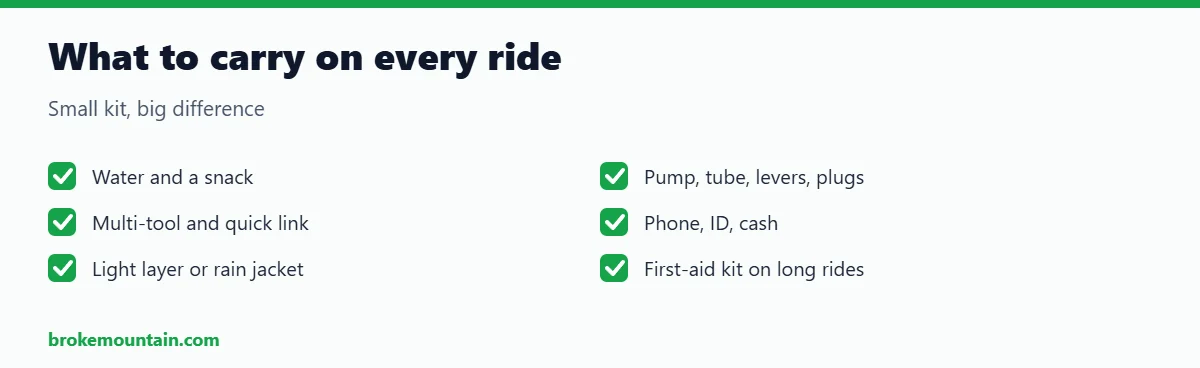
What to carry on every ride
- Water and a snack.
- Pump or CO2, spare tube, tyre levers and tubeless plugs.
- Multi-tool with chain breaker and a quick link.
- Phone, ID and a little cash.
- A light layer or rain jacket, depending on the weather.
- A basic first-aid kit on longer or remote rides.
Accessories for e-mountain bikes
E-bike riders need the same mountain bike accessories as everyone else, plus a few extras. Carry a tool that fits your motor and battery bolts, check your tyres and brakes more often because of the extra weight, and consider a battery cover for wet or cold weather. A strong lock matters too, as e-bikes are a common target for thieves.
For safety-rated picks, see our guide to the best mountain bike helmets.
For season-by-season picks, see our guide to the best mountain bike gloves.
Frequently asked questions
What should I carry on a mountain bike ride?
Water, a snack, a pump, a spare tube or plug kit, tyre levers, a multi-tool, your phone and a light layer.
Do I need special shoes?
Flat-pedal shoes with sticky rubber soles or clipless MTB shoes make a big difference to grip and comfort.
Is a hydration pack better than bottles?
For long rides, yes. For short rides, a bottle on the frame is lighter and cooler.
Do I need a MIPS helmet?
It isn’t required, but rotational impact systems such as MIPS are widely used to help reduce rotational forces in some impacts. Check independent test ratings when comparing helmets.
What are the first mountain bike accessories to buy?
A good helmet, then a flat repair kit and a multi-tool.
Keep reading

Hi, I am Emam Hasan — founder and editor of BrokeMountain. I oversee this blog’s hiking, camping and outdoor gear guides, making sure every article is well-researched, accurate and genuinely helpful for your time on the trail. Enjoy it!


