
Quick answer: the best mountain bike bags for flying are padded soft bags with an internal frame or rigid base, such as the Evoc Bike Travel Bag Pro or Thule RoundTrip MTB. They give the best mix of protection, weight and easy packing. Hard cases protect best but are heavy and bulky, while cardboard bike boxes are cheap but only last a trip or two. Make sure the bag fits your wheel size and wheelbase, and check your airline’s weight limits and fees before you book. E-bike batteries usually can’t fly at all.
BrokeMountain is reader-supported. We may earn a commission when you buy through links on this page, at no extra cost to you. Learn more.
How we chose: we haven’t tested these bags in person. Our picks are based on manufacturer specifications and published, hands-on reviews. Airline rules change often, so always check your airline’s current policy before you fly.
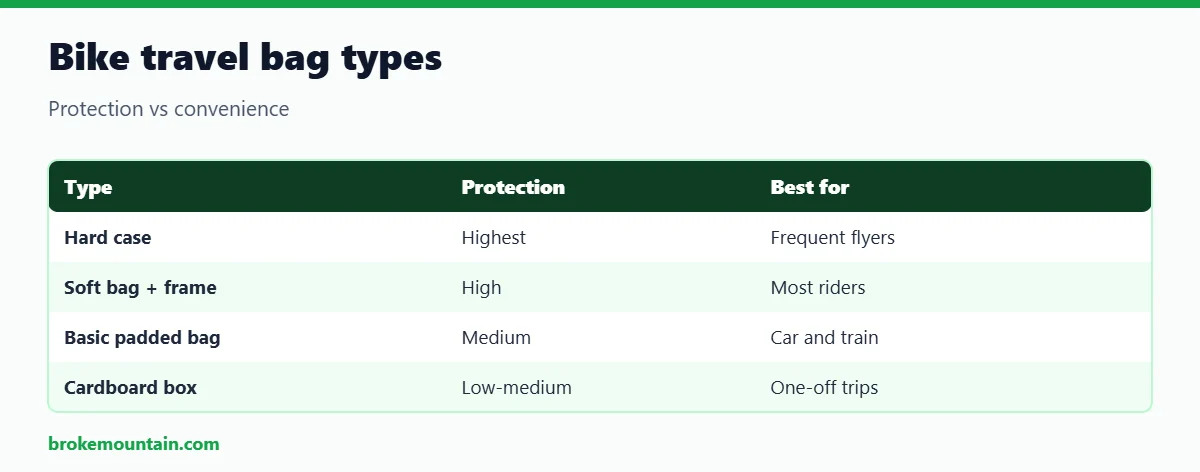
Mountain bike bags and travel case options
| Type | Protection | Weight | Best for |
|---|---|---|---|
| Hard case | Highest | Heavy | Frequent flyers, expensive bikes |
| Padded soft bag with frame or rails | High | Medium (around 8 to 10 kg) | Most riders who fly a few times a year |
| Basic padded bag | Medium | Light | Car, train and careful travel |
| Cardboard bike box | Low to medium | Light | One-off trips; often free from bike shops |
What to look for in mountain bike bags for travel
- Fit: check it takes 29-inch wheels, wide tyres and your bike’s wheelbase. Long-travel and XL bikes need the biggest bags.
- Wheel pockets: separate padded pockets protect rotors and keep wheels from hitting the frame.
- Rigid base and frame mount: keeps the bike in place and protects the rear derailleur.
- Wheels on the bag: essential for moving through airports and train stations.
- Empty weight: a lighter bag leaves more of the airline’s weight allowance for the bike and spares.
- Storage: soft bags fold down at your destination; hard cases don’t.
- Axle compatibility: check the bag’s mounts suit your thru-axle or Boost spacing.
The best mountain bike travel bags
1. Evoc Bike Travel Bag Pro: best overall
The Evoc Pro is one of the most popular bike bags for mountain bikers. It has a rigid base, a frame mount, padded wheel compartments and wheels for rolling through airports. OutdoorGearLab chose it as its best overall bike travel case, praising its mix of protection, ease of use and how well it rolls. It takes everything from cross-country bikes to long, slack 29er enduro bikes.
- Good for: most riders flying with a modern mountain bike.
- Watch out for: premium price; still a large bag to store.
Check Evoc Bike Travel Bag Pro prices on Amazon
2. Thule RoundTrip MTB: best for fast packing
Thule’s RoundTrip MTB uses an internal stand that holds the bike securely. In The Loam Wolf’s year-long review, the tester found it faster and more intuitive to pack than the Evoc Pro, thanks to a simple fork mount and a ratcheting bottom bracket pad, and noted it fits bikes up to a 130 cm wheelbase. The trade-offs are weight and price.
- Good for: riders who want quick, secure packing.
- Watch out for: heavy and expensive.
Check Thule RoundTrip prices on Amazon
3. Scicon AeroComfort MTB: best for minimal disassembly
Scicon’s AeroComfort bags hold the bike on an internal frame so you can leave much of it assembled. Bike Perfect picks the AeroComfort MTB as its best for easy packing, saying you can pack your bike while hardly turning a bolt. That’s handy for riders who don’t want to adjust bars and derailleurs at each end of the trip.
- Good for: riders who want to fly without much mechanical work.
- Watch out for: check fit for very long or large bikes.
Check Scicon AeroComfort prices on Amazon
4. Evoc Bike Travel Bag (standard): best value Evoc
The standard Evoc Bike Travel Bag is a simpler, lighter version of the Pro. It still has a rigid base and padded wheel pockets, and it folds flat for storage. It’s a good choice if you fly a few times a year and want a proven design for less money.
- Good for: occasional flyers who want reliable protection.
- Watch out for: check it fits your bike’s wheelbase and tyre width.
Check Evoc Bike Travel Bag prices on Amazon
5. Budget padded bags: best for car and train travel
Padded bags from brands such as Buds and other budget makers offer basic protection at much lower prices. They’re well suited to car, train and bus travel, and to careful flyers who pad the frame well. They usually lack a rigid frame mount, so pack carefully.
- Good for: riders on a budget and ground travel.
- Watch out for: less protection against heavy impacts.
Check padded bike bag prices on Amazon
Quick comparison
| Bag | Type | Best for | Trade-off |
|---|---|---|---|
| Evoc Bike Travel Bag Pro | Soft, rigid base | Most riders | Price |
| Thule RoundTrip MTB | Soft, internal stand | Fast packing | Heavy, pricey |
| Scicon AeroComfort MTB | Soft, frame mount | Minimal disassembly | Fit for big bikes |
| Evoc Bike Travel Bag | Soft, rigid base | Value | Less protection than Pro |
| Budget padded bags | Soft | Ground travel | Less protection |
Hard cases vs soft mountain bike bags
Hard cases give the most protection against crushing and heavy impacts, which matters if you fly often or travel with an expensive carbon bike. But they’re heavy, awkward to fit in hire cars and can’t be folded away at your hotel or apartment. Soft bags with a rigid base or internal frame have become the most popular choice for mountain bikers because they balance protection, weight and convenience. For one-off trips, a cardboard bike box from a local bike shop is cheap and surprisingly protective if you pad it well, though it won’t survive many journeys.
How to pack your mountain bike
- Clean the bike first. Some countries check for mud and seeds, and a clean bike is easier to pack. Our chain cleaning guide covers the drivetrain.
- Remove the pedals and wheels. Fit thru-axle spacers or dropout protectors in the fork and frame.
- Put a pad spacer between the brake pads so the pistons can’t close if a lever gets squeezed.
- Remove the rear derailleur from the hanger and wrap it, or tape it to the chainstay, to protect the hanger.
- Remove or rotate the handlebar, depending on the bag.
- Remove the rotors or make sure the wheel pockets protect them.
- Wrap frame tubes with the bag’s padding or pipe insulation.
- Pack tools, a shock pump, a spare derailleur hanger and your pedals in a pocket.

Airline fees and weight limits
Many airlines now treat a bike like a normal checked bag. TravelAwaits reports that American, Delta and United dropped their extra oversize fees for bikes, so you pay standard checked bag fees instead, though overweight charges still apply. Weight limits are typically around 23 kg (50 lb) in economy. A bag weighing 8 to 10 kg plus a mountain bike can easily push past that, so weigh everything before you leave. Policies vary a lot between airlines and change often, so check yours before booking.
Flying with an e-mountain bike
E-bike batteries are the big problem. The FAA’s battery rules allow lithium-ion batteries up to 100 Wh, those from 101 to 160 Wh only with airline approval, and forbid batteries over 160 Wh. Most e-MTB batteries are far larger, often 500 Wh or more. In practice, you’ll need to rent a battery at your destination, ship one by approved ground freight, or rent an e-bike when you arrive.

If your bike is damaged in transit
Check the bike as soon as you collect it, before leaving the airport if possible. Take photos of the bag and any damage, and report it at the airline’s baggage desk straight away; most airlines set short time limits for damage claims. Keep your receipts and boarding passes. Photos of the bike packed before the flight make claims much easier.
Other ways to travel with your bike
- Car racks: the simplest option for road trips; see our guide to bike storage, stands and racks.
- Bike shipping services: some companies ship bikes door to door, which avoids airline fees but needs planning.
- Renting at your destination: often easiest for short trips to popular riding areas.
Travel essentials to pack
- A multi-tool and torque wrench for rebuilding the bike.
- A shock pump and a floor or mini pump; our guide to mini pumps covers compact options.
- A spare derailleur hanger for your frame.
- Tubeless plugs and a spare tube; see our puncture repair kit guide.
- Zip ties, tape and a small bottle of sealant (check airline rules on liquids).
Frequently asked questions
Do airlines charge for bike bags?
Most charge a checked bag fee, and some add sports equipment or overweight fees. Check before booking and add the bag online, which is often cheaper.
Is a soft bike bag safe for flying?
A well-padded bag with a rigid base or frame mount is safe for most trips, as long as you pack carefully and protect the derailleur and rotors.
Can I take an e-bike on a plane?
Usually the bike can go, but the battery can’t. Batteries over 160 Wh are forbidden on passenger aircraft, and most e-bike batteries are much bigger.
Should I let air out of my tyres?
It isn’t needed for safety, but some airlines ask for it. Letting a little air out does no harm.
Do I need travel insurance for my bike?
It’s worth checking. Airlines often limit what they’ll pay for damage, and many bag warranties don’t cover damage in transit.
Keep reading
- Best mountain bike storage, stands and racks
- Best puncture repair kits
- Best chain oil and cleaning gear

Hi, I am Emam Hasan — founder and editor of BrokeMountain. I oversee this blog’s hiking, camping and outdoor gear guides, making sure every article is well-researched, accurate and genuinely helpful for your time on the trail. Enjoy it!


