
Quick answer: the best ultralight backpacking tent for most solo hikers is the Durston X-Mid Pro 1, which Backpacker named its top overall ultralight tent in August 2026 at about 1 pound. If you want a tent that stands up without trekking poles, choose the Durston X-Dome 1+. For two people at a very low weight, look at the Zpacks Duplex Classic, and if your budget is tight, the Six Moon Designs Lunar Solo and Lanshan 2 Pro cost a fraction of the Dyneema tents.
BrokeMountain is reader-supported. We may earn a commission when you buy through links on this page, at no extra cost to you. Learn more.
How we put this together: we haven’t tested these tents in person. We compared long-term testing from Backpacker and CleverHiker with maker specifications, and we link each source. Weights and prices vary by version and retailer, so where we could not confirm a figure we say “check listing”.
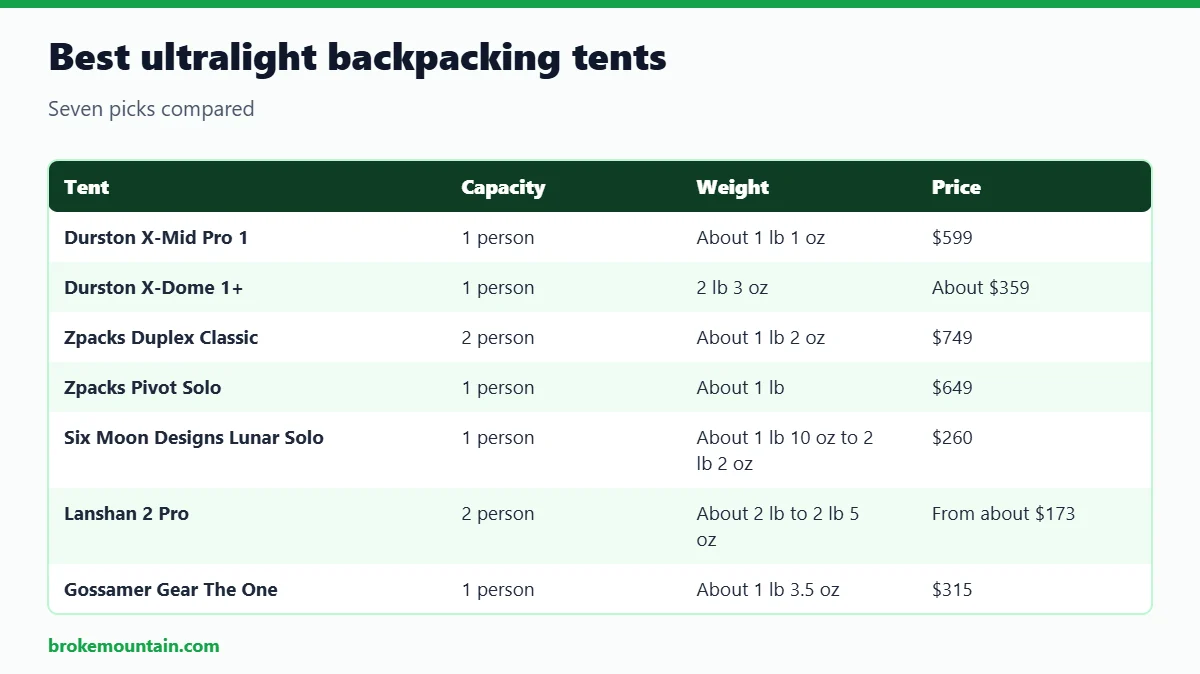
Best ultralight backpacking tents at a glance
| Tent | Capacity | Weight | Pitch | Price | Best for |
|---|---|---|---|---|---|
| Durston X-Mid Pro 1 | 1 person | About 1 lb 1 oz | Trekking poles | $599 | Best overall |
| Durston X-Dome 1+ | 1 person | 2 lb 3 oz | Freestanding | About $359 | Best freestanding |
| Zpacks Duplex Classic | 2 person | About 1 lb 2 oz | Trekking poles | $749 | Lightest for two |
| Zpacks Pivot Solo | 1 person | About 1 lb | Trekking poles | $649 | Comfort and weight |
| Six Moon Designs Lunar Solo | 1 person | About 1 lb 10 oz to 2 lb 2 oz | Trekking pole | $260 | Best value |
| Lanshan 2 Pro | 2 person | About 2 lb to 2 lb 5 oz | Trekking poles | From about $173 | Best budget |
| Gossamer Gear The One | 1 person | About 1 lb 3.5 oz | Trekking pole | $315 | Lightest silnylon solo |
Weights and prices come from Backpacker and CleverHiker, which sometimes measure slightly different figures for the same tent. Outdoor Life also field-tests ultralight shelters from brands like Durston, Tarptent, Gossamer Gear and Zpacks on long trails each year. Check the current listing before you buy.
What makes ultralight backpacking tents different?
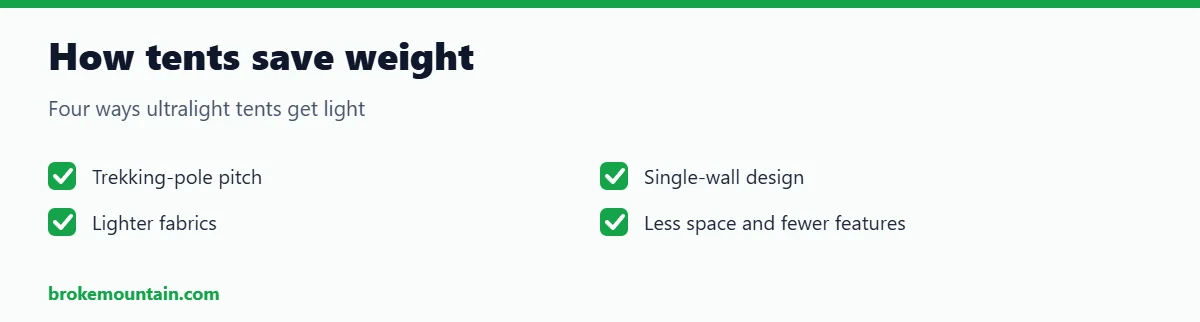
There is no official cut-off, but most hikers call a tent ultralight when the whole shelter weighs about 2 pounds or less per person. Tents get that light in three main ways:
- Trekking-pole pitch: the tent uses your hiking poles instead of dedicated tent poles.
- Single-wall design: one waterproof layer instead of a separate inner tent and rainfly.
- Lighter fabrics: Dyneema Composite Fabric (DCF) or very thin silnylon and silpoly.
- Less space and fewer features: smaller floors, fewer doors and fewer pockets.
Each saving comes with a trade-off. Trekking-pole tents take practice to pitch tight, single-wall tents can collect condensation, and the lightest fabrics cost more or are less durable. If you are new to backpacking, a slightly heavier freestanding tent can be a better first ultralight shelter.
1. Durston X-Mid Pro 1: best overall
Backpacker named the Durston X-Mid Pro 1 its top overall ultralight backpacking tent in August 2026, praising its weight of about one pound, its roomy interior and its storm-worthiness. It lists the tent at $599 and 1 lb 1 oz with a Dyneema floor, or 1 lb 3 oz with a silnylon floor, with 20 square feet of floor, a 22-square-foot vestibule and a 45-inch peak height. CleverHiker also named it the best one-person ultralight tent, highlighting its long interior, weather resistance and quick setup.
The trade-offs: both reviewers say setup has a learning curve, and CleverHiker notes your pack has to sit at the head or foot end. You also need two trekking poles to pitch it; our guide to what hiking sticks are for explains how poles do double duty.
Check the Durston X-Mid on Amazon
Durston sells mainly through its own website, so Amazon availability varies.
2. Durston X-Dome 1+: best freestanding ultralight tent
If you do not hike with trekking poles or often camp on rock and platforms, a freestanding tent is easier. Backpacker named the Durston X-Dome 1+ its best freestanding ultralight tent, citing a beginner-friendly setup, a generous floor plan and good value. It lists the tent at 2 lb 3 oz, with 23 square feet of floor and a 42-inch peak height.
The trade-offs: it is about twice the weight of the X-Mid Pro 1, and Backpacker found storage limited. Price is listed at about $359 to $369, so check the current listing.
Check the Durston X-Dome on Amazon
3. Zpacks Duplex Classic: lightest tent for two
The Zpacks Duplex Classic is a long-time favorite of thru-hikers. Backpacker named it the most livable ultralight tent, praising its space for tall campers, its durability and its large sleeping area, and listed it at $749 and 1 lb 2 oz. CleverHiker calls it very light for a two-person tent, with simple setup and Dyneema fabric that does not absorb water.
The trade-offs: CleverHiker found it cramped for two people and only average in bad weather, and Backpacker notes its large footprint and very high price. Many hikers use it as a roomy solo tent.
4. Zpacks Pivot Solo: best balance of comfort and weight
CleverHiker picked the Zpacks Pivot Solo as its best balance of comfort and weight for one person, at $649 and about 1 lb 0.1 oz. It praises the good floor space, a large peak vent and a mesh foot end, and notes that like all Zpacks tents it is made from Dyneema Composite Fabric.
The trade-offs: CleverHiker found the first setup tricky, the interior pocket small and the fly a little short of the ground, which can let wind and spray in.
Check the Zpacks Pivot Solo on Amazon
5. Six Moon Designs Lunar Solo: best value
Backpacker named the Six Moon Designs Lunar Solo its best value ultralight tent at $260, praising its beginner-friendly setup, small footprint and tall 49-inch peak. CleverHiker calls it the easiest one-person ultralight tent to recommend, noting strong performance for the price and silpoly fabric that will not sag when wet. The two reviewers list slightly different weights, from about 1 lb 10 oz to 2 lb 2 oz.
The trade-offs: limited storage, a pyramid shape that limits headroom at the edges and, according to Backpacker, some condensation.
Check the Lunar Solo on Amazon
6. Lanshan 2 Pro: best budget ultralight tent
The 3F UL Gear Lanshan 2 Pro is the classic budget way into ultralight backpacking. Backpacker named it the best budget buy, listing it from about $173 to $190 depending on the retailer, and praised its low price and spacious interior. CleverHiker also named it the best budget pick, noting good livability, an easy pitch and good stakes included.
The trade-offs: Backpacker found the setup finicky with some ventilation issues, and CleverHiker says the fabric feels cheaper than premium tents. Weight is listed from about 2 lb to 2 lb 5 oz.
Check the Lanshan 2 Pro on Amazon
7. Gossamer Gear The One: lightest silnylon solo tent
CleverHiker picked Gossamer Gear The One as the best super-light one-person silnylon tent, at $315 and about 1 lb 3.5 oz. It praises the easy pitch, good headroom and a large peak vent, and points out it is very light for a silnylon tent.
The trade-offs: a tiny door, a cramped floor and thin 10-denier fabric. CleverHiker notes it is not built for severe storms, so it suits fair-weather trips and experienced hikers who choose campsites carefully.
Check Gossamer Gear The One on Amazon
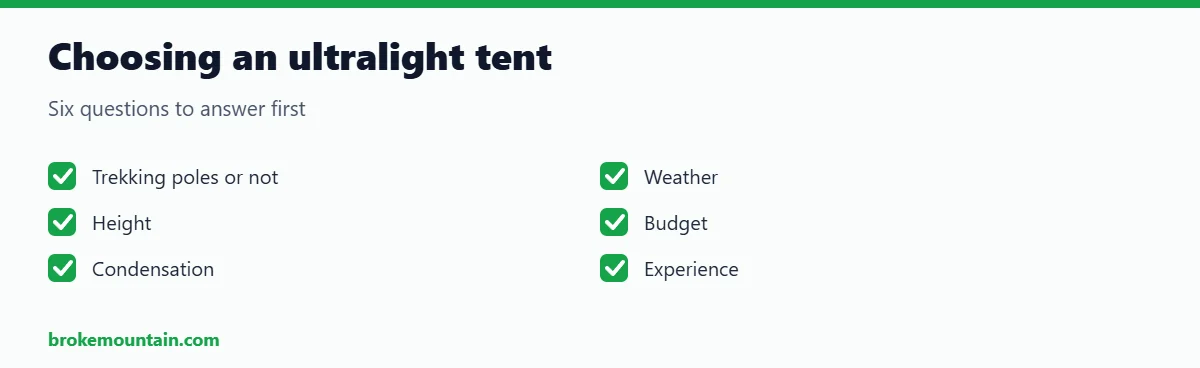
How to choose ultralight backpacking tents
- Trekking poles or not: if you do not hike with poles, choose a freestanding tent like the X-Dome 1+.
- Weather: for wind and storms, choose a proven design like the X-Mid Pro 1 over the thinnest fabrics.
- Height: tall hikers should check floor length and peak height.
- Budget: Dyneema tents cost three to four times more than silnylon and silpoly tents.
- Condensation: single-wall tents need good ventilation and a careful campsite choice.
- Experience: first-time users may prefer a simple pitch over the lowest weight.
Dyneema vs silnylon vs silpoly
Dyneema Composite Fabric (DCF) is the lightest and does not absorb water or sag when wet, which is why Zpacks and Durston use it on their top tents. It is also the most expensive and packs bulkier. Silnylon is cheaper and packs small, but it stretches when wet, so you may need to re-tighten the guylines at night. Silpoly sits in between: it stretches less than silnylon and costs less than Dyneema, which is why value tents like the Lunar Solo use it.
Building a light shelter system
The tent is only part of your sleep system. Pair it with a light pad from our best ultralight sleeping pads guide, and remember that a footprint, extra stakes and guylines add weight. If you would rather have a more conventional tent with more room for two, see our picks for backpacking tents for 2 people or our guide to REI backpacking tents. Saving tent weight also leaves room for essentials like a reliable backpacking water filter.
Frequently asked questions
What is the best ultralight backpacking tent?
For most solo hikers, the Durston X-Mid Pro 1, Backpacker’s top overall ultralight tent in August 2026, at about 1 pound with strong weather resistance.
Are ultralight tents durable?
The best ones are, but thinner fabrics are easier to puncture or tear. Use a careful campsite choice, clear away sharp sticks and stones, and consider a light ground sheet.
Do I need trekking poles for an ultralight tent?
Many ultralight tents pitch with trekking poles. If you do not use poles, choose a freestanding model such as the Durston X-Dome 1+, or buy the tent maker’s optional poles.
What is the best budget ultralight tent?
The Lanshan 2 Pro and Six Moon Designs Lunar Solo are the best-known budget options, both well under $300.
The bottom line
The best ultralight backpacking tents save pounds without leaving you cold or wet. The Durston X-Mid Pro 1 is the best all-rounder for solo hikers, the X-Dome 1+ is the easy freestanding choice, the Zpacks Duplex Classic is the lightest way to sleep two, and the Lunar Solo and Lanshan 2 Pro bring ultralight camping within reach on a budget. Choose the tent that matches your weather, your poles and your experience, then practice pitching it at home before your first trip.
Last checked: November 2026. Tent weights, prices and stock change often, especially for small cottage brands, so check the maker’s current listing before you buy.

Hi, I am Emam Hasan — founder and editor of BrokeMountain. I oversee this blog’s hiking, camping and outdoor gear guides, making sure every article is well-researched, accurate and genuinely helpful for your time on the trail. Enjoy it!


