Quick answer: the best camping lanterns for 2026 are the BioLite AlpenGlow 500 for most car campers, with 500 lumens and many light modes, and the LuminAID PackLite Max 2-in-1 for backpackers who want a light that packs flat and charges by solar. The Coast EAL35R is the low-cost bright pick at about $40, the Goal Zero Lighthouse 600 adds a hand crank, and the Black Diamond Moji and Goal Zero Lighthouse Micro Flash are the small, light options.
BrokeMountain is reader-supported. We may earn a commission when you buy through links on this page, at no extra cost to you. Learn more.
How we put this together: we haven’t tested these products in person. We compared manufacturer specifications with results from independent testers and we link each source. Prices and versions change, so where we could not confirm a figure we say “check listing”.
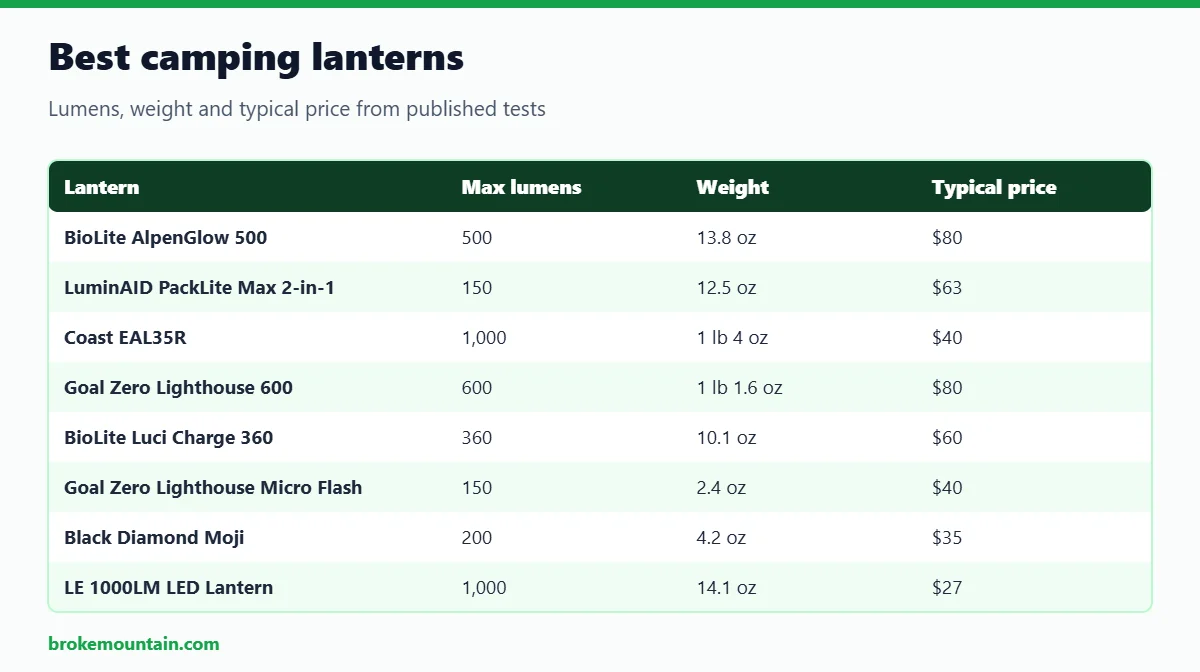
Best camping lanterns at a glance
| Lantern | Max lumens | Weight | Power | Typical price | Best for |
|---|---|---|---|---|---|
| BioLite AlpenGlow 500 | 500 | 13.8 oz | USB rechargeable | $80 | Best overall for car camping |
| LuminAID PackLite Max 2-in-1 | 150 | 12.5 oz | USB-C and solar | $63 | Packs flat; solar |
| Coast EAL35R | 1,000 | 1 lb 4 oz | Rechargeable or alkaline | $40 | Budget brightness |
| Goal Zero Lighthouse 600 | 600 | 1 lb 1.6 oz | USB and hand crank | $80 | Versatile; emergencies |
| BioLite Luci Charge 360 | 360 | 10.1 oz | Rechargeable and solar | $60 | Solar with phone top-up |
| Goal Zero Lighthouse Micro Flash | 150 | 2.4 oz | USB rechargeable | $40 | Backpacking |
| Black Diamond Moji | 200 | 4.2 oz | 3 AAA | $35 | Small tent light |
| LE 1000LM LED Lantern | 1,000 | 14.1 oz | 3 D batteries | $27 | Power cuts and storage |
| Coleman Powerhouse Dual Fuel | 800 | 4 lb 8 oz | Liquid fuel | $115 | Big sites; cold weather |
| UCO Original Candle Lantern | 20 | 6.4 oz | Candle | $36 | Soft glow; no batteries |
Figures come from CleverHiker’s lantern tests and GearJunkie’s lantern guide. Where the two list slightly different weights, we show GearJunkie’s measured figure.
How many lumens do you need?
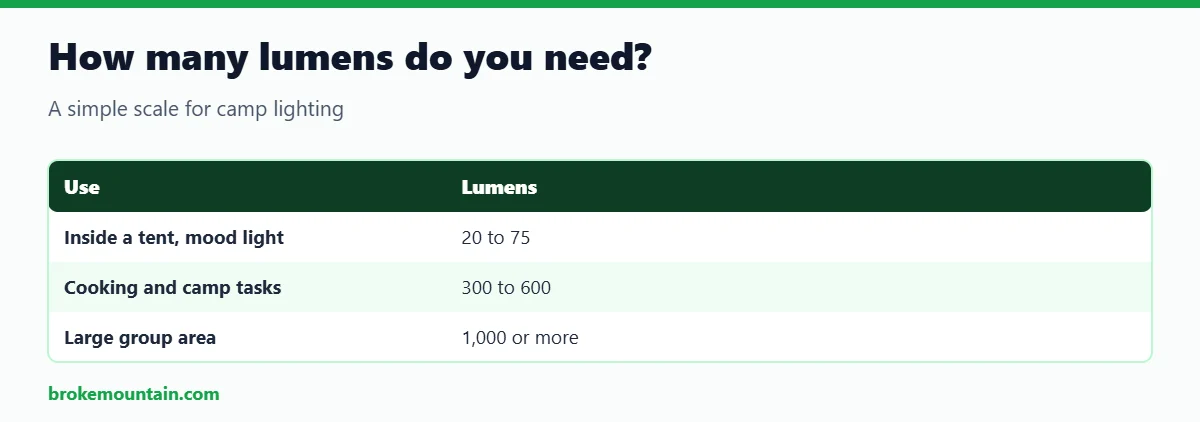
GearJunkie’s guide gives a simple scale.
| Use | Lumens |
|---|---|
| Inside a tent, mood light | 20 to 75 |
| Cooking and camp tasks | 300 to 600 |
| Large group area | 1,000 or more |
More is not always better. A very bright lantern drains quickly, attracts insects and spoils night vision for you and the next campsite. CleverHiker advises putting dimming ahead of raw lumens. A lantern you can turn down to a low glow is more useful than one that only blasts.
1. BioLite AlpenGlow 500: best overall
GearJunkie names the AlpenGlow 500 the best overall camping lantern, scoring it 8.9 out of 10 at $80 and 13.8 oz. It gives 500 lumens, runs up to 200 hours on low and 5 hours on high, and has a 6,400 mAh rechargeable battery. CleverHiker calls it the most feature-rich lantern, rated 4.7 out of 5, with the widest range of colours and brightness levels in its test.
- Good: warm and cool white, colour modes, smooth dimming; can top up a phone.
- Less good: heavy for its size; GearJunkie found the shake-to-change control inconsistent.
- Best for: car camping, picnic tables and back gardens.
Check the BioLite AlpenGlow 500 on Amazon
2. LuminAID PackLite Max 2-in-1: packs flat, charges by solar
CleverHiker’s best lantern overall, rated 4.8 out of 5, at $63 and 12.5 oz. It is an inflatable lantern that collapses flat, charges by USB-C or its own solar panel, and is waterproof. It runs up to 50 hours on its lowest setting and 5 hours on its highest. At 150 lumens it is less bright than most, which suits a tent or a small table.
- Good: packs small; floats; solar back-up; can charge a phone.
- Less good: modest brightness; solar charging is slow.
- Best for: backpacking, paddling and emergency kits.
Check the LuminAID PackLite Max on Amazon
3. Coast EAL35R: budget brightness
GearJunkie’s best budget lantern, scoring 8.3 out of 10 at $40 and 1 lb 4 oz. It puts out 1,000 lumens for up to 16 hours and runs on its rechargeable battery or on alkaline cells, so a flat battery does not leave you in the dark. It also has voice control. Its runtime at full power is short.
Check the Coast EAL35R on Amazon
4. Goal Zero Lighthouse 600: hand-crank back-up
CleverHiker’s most versatile lantern, rated 4.6, at $80 and 1 lb 1.6 oz. Its 600 lumens were much brighter than most lanterns in that test. It charges by USB and has a hand crank, so you can add light without any power source. It is on the heavy side for anything other than car camping.
Check the Goal Zero Lighthouse 600 on Amazon
5. BioLite Luci Charge 360: solar with a phone top-up
GearJunkie’s best solar-powered lantern, scoring 8.5 at $60 and 10.1 oz. It gives 360 lumens, 110 hours on low and 5 hours on high, from a 4,000 mAh battery with a solar panel on top. It is compact and light. The panel and battery are small, so treat solar as a top-up and charge it by USB before you leave.
6. Goal Zero Lighthouse Micro Flash: backpacking
CleverHiker’s most portable pick: 2.4 oz, $40 and 150 lumens. It works as a lantern and as a flashlight and charges by USB. Brightness is limited, and that is the trade for the weight. Many backpackers skip a lantern and hang a headlamp in the tent; see our headlamps for hiking and camping.
7. Black Diamond Moji: small tent light
CleverHiker’s most budget-friendly lantern at $35 and 4.2 oz, with 200 lumens from three AAA batteries. It is weather-resistant and simple. A rechargeable battery pack is sold separately.
Check the Black Diamond Moji on Amazon
8. LE 1000LM LED Lantern: power cuts and storage
CleverHiker’s best lantern for emergencies at $27: 1,000 lumens for up to 12 hours from three D batteries. It is bright and cheap. It is not rechargeable and it is heavy, so it suits a car boot or a cupboard at home.
9. Coleman Powerhouse Dual Fuel: big sites and cold weather
A traditional fuel lantern: 800 lumens, 5 to 20 hours depending on the setting, 4 lb 8 oz and $115 in CleverHiker’s test. It needs no batteries and gives off heat. It needs liquid fuel, the glass is fragile, and it must never be used inside a tent or vehicle because of carbon monoxide and fire risk.
10. UCO Original Candle Lantern: soft glow
GearJunkie’s best candle lantern, at $36 and 6.4 oz, giving about 20 lumens for 9 to 12 hours per candle. It gives a simple, natural light and very little of it. Treat it as an open flame.
Which of the best camping lanterns suits you?
| You are | Sensible choice |
|---|---|
| Car camping with family | BioLite AlpenGlow 500 |
| Backpacking | Goal Zero Lighthouse Micro Flash or Black Diamond Moji |
| Paddling or packing light with solar | LuminAID PackLite Max 2-in-1 |
| On a budget | Coast EAL35R |
| Building an emergency kit | Goal Zero Lighthouse 600 or LE 1000LM |
| Lighting a large group site | Coleman Powerhouse or two bright LED lanterns |
How to choose the best camping lanterns for your trips
Power source
| Type | Good | Less good |
|---|---|---|
| USB rechargeable | Cheap to run; many double as power banks | Needs charging before the trip |
| Solar | Tops up for free on long trips | Slow; small panels |
| Disposable batteries | Long shelf life; easy to swap | Heavy; ongoing cost |
| Dual power | Rechargeable with alkaline back-up | Slightly bulkier |
| Liquid fuel or gas | Very bright; works in the cold | Outdoor use only; fragile mantles and glass |
| Candle | Simple; pleasant light | Dim; open flame |
Runtime
Makers quote the longest runtime at the lowest setting. Look at the figure for the brightness you will really use. The AlpenGlow 500 runs 200 hours on low and 5 hours on high, which is typical.
Weight and size
CleverHiker suggests backpackers choose light, packable models and car campers accept more weight for brightness and features. Collapsible and inflatable lanterns save the most space.
Water resistance
GearJunkie notes that IP67-rated lanterns handle heavy rain better than IPX4 models, which resist splashes only.
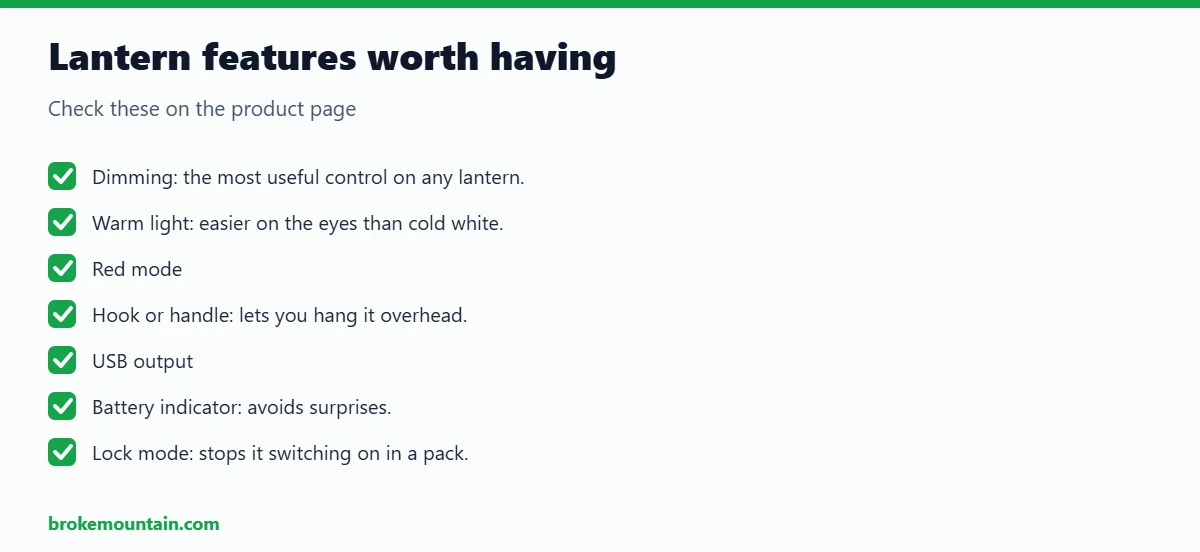
Useful features
- Dimming: the most useful control on any lantern.
- Warm light: easier on the eyes than cold white.
- Red mode: keeps night vision and draws fewer insects.
- Hook or handle: lets you hang it overhead.
- USB output: tops up a phone. For more capacity see our power banks for camping.
- Battery indicator: avoids surprises.
- Lock mode: stops it switching on in a pack.
Where to put a lantern
GearJunkie points out that a lantern at table height casts shadows across your work. Hang it overhead from a branch, a tarp line or a tent loop for cooking. Put a second, dim light on the table for eating and cards. Inside a tent, hang a small lantern from the roof loop and turn it down.
Lantern safety and campsite manners
- Use fuel and candle lanterns outdoors only, on a stable surface, away from tent walls.
- Let a fuel lantern cool before you move or pack it.
- Keep lithium lanterns out of hot cars.
- Dim the light after dark and point it down. Bright light carries a long way.
- Turn lights off when you leave the site.
- In bear country, a lantern is not a deterrent. Store food properly; see bear canisters and bear bags.
General campsite advice is on the National Park Service camping pages, and our guide to how to survive camping covers the basics.
Common mistakes when buying camping lanterns
- Buying on lumens alone. A 1,000-lumen lantern at full power can be flat in a few hours.
- Ignoring the low setting. Most evenings need 50 to 150 lumens.
- One lantern for everything. A large lantern for the table and a small one for the tent work better than one in between.
- Trusting the solar panel. Charge by USB at home and use solar as a top-up.
- Forgetting spare power. Carry spare cells for battery lanterns or a power bank for rechargeable ones.
- Storing it flat. Top up a rechargeable lantern every few months so the battery stays healthy.
How many lanterns do you need?
| Group | Suggested lighting |
|---|---|
| Solo backpacker | Headlamp, plus a 2 to 4 oz lantern if you like |
| Couple car camping | One 300 to 500 lumen lantern and a small tent light |
| Family of four | One bright table lantern, one overhead or string light, a small light per tent |
| Large group site | Two bright lanterns or an overhead light, plus headlamps |
Everyone still needs a headlamp for walking to the toilet block and for hands-free jobs.
Caring for a camping lantern
- Charge rechargeable models to about half before long storage and top up every few months.
- Remove disposable batteries before storing, since they can leak.
- Wipe off dirt and dry the lantern before packing it away.
- Carry spare mantles for a fuel lantern and check the seals each season.
- Keep the charging port cover closed in rain and dust.
Frequently asked questions
How many lumens is good for a camping lantern?
300 to 600 lumens covers cooking and a picnic table. 20 to 75 is enough inside a tent.
Are solar lanterns worth it?
Yes as a back-up on longer trips. Charge by USB first, since small panels take a full day of sun or more.
Are rechargeable lanterns better than battery lanterns?
For regular camping, yes: they cost less to run. Battery lanterns are better for long storage in an emergency kit.
Can I use a lantern inside a tent?
LED lanterns, yes. Never use fuel or candle lanterns inside a tent.
What is the best lantern for backpacking?
A small USB light such as the Goal Zero Lighthouse Micro Flash at 2.4 oz, or simply a headlamp.
How long do LED lanterns last on a charge?
About 5 hours on high for most rechargeable models, and 50 to 200 hours on the lowest setting.
Last checked: November 2026. Prices, specifications and availability change, so confirm details on the maker’s or retailer’s page before you buy.

Hi, I am Emam Hasan — founder and editor of BrokeMountain. I oversee this blog’s hiking, camping and outdoor gear guides, making sure every article is well-researched, accurate and genuinely helpful for your time on the trail. Enjoy it!