
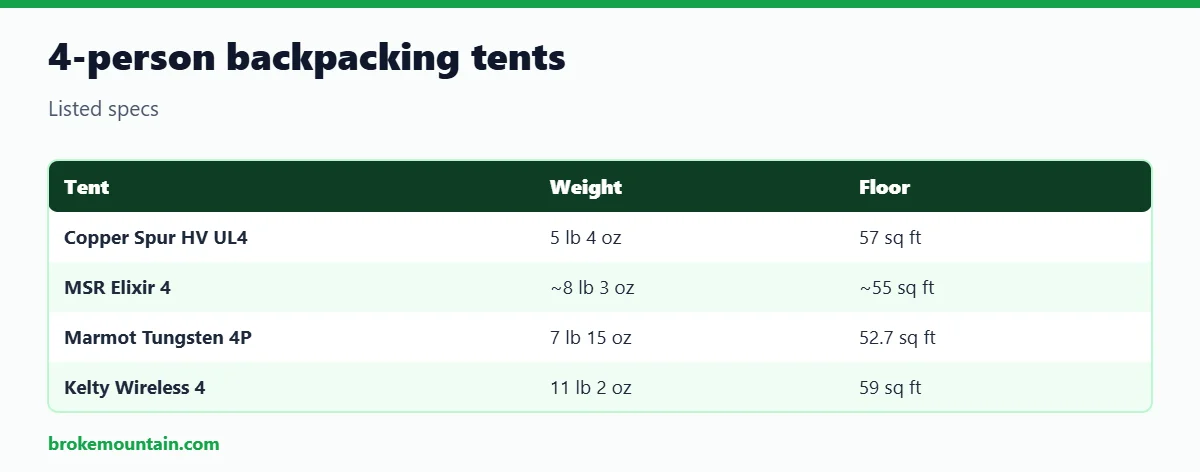
Quick answer: the best 4-person backpacking tent for most groups is a freestanding, three-season, two-door tent with roughly 52 to 57 square feet of floor space. In our research, the Big Agnes Copper Spur HV UL4 is the lightest full-featured choice at about 5 lb 4 oz, the MSR Elixir 4 and Marmot Tungsten 4P are tougher, cheaper options at around 8 lb, and the Kelty Wireless 4 is a budget pick best kept for short walk-ins.
BrokeMountain is reader-supported. We may earn a commission when you buy through links on this page, at no extra cost to you. Learn more.
How we put this together: we haven’t tested these tents in person. We compared manufacturer and retailer specifications, independent reviews from outlets such as CleverHiker and Switchback Travel, and buying advice from REI. Prices and versions change often, so check the current details before you buy.
Best 4-person backpacking tents at a glance
| Tent | Minimum weight | Floor area | Peak height | Best for |
|---|---|---|---|---|
| Big Agnes Copper Spur HV UL4 | 5 lb 4 oz | 57 sq ft | 50 in | Lowest weight |
| MSR Elixir 4 | About 8 lb 3 oz | About 55 sq ft | 48 in | Durability and value |
| Marmot Tungsten 4P | 7 lb 15 oz | 52.7 sq ft | 52.8 in | Backpacking and car camping |
| Kelty Wireless 4 | 11 lb 2 oz | 59 sq ft | 59 in | Tight budgets, short walk-ins |
Weights and sizes are manufacturer or retailer figures and vary by model year.
| Big Agnes Copper Spur HV UL4 | Check latest price |
| MSR Elixir 4 | Check latest price |
| Marmot Tungsten 4P | Check latest price |
| Kelty Wireless 4 | Check latest price |
Is a 4-person backpacking tent the right choice?
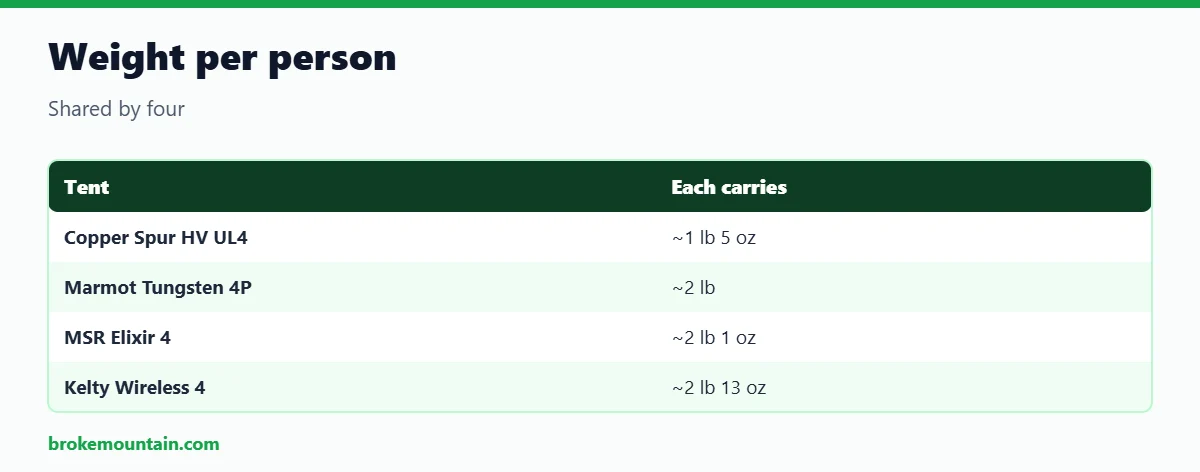
A 4-person backpacking tent makes sense for families with young children, groups of friends who want to share weight, and couples who want a lot of room for a dog and gear. Split between four packs, even an 8 lb tent works out to about 2 lb each, which is less than most people carry in a solo shelter.
There are trade-offs. A big tent needs a big, flat pitch, which can be hard to find in the mountains or in forest. If one person leaves the trip, the others still have to carry the whole tent. And four adults in a “4-person” backpacking tent is a tight fit: most are about 86 to 90 inches wide, enough for four standard 20-inch sleeping pads side by side with nothing to spare. Many groups of four adults are more comfortable in two 2-person tents; see our guide to 2-person backpacking tents.
The best 4-person backpacking tents reviewed
1. Big Agnes Copper Spur HV UL4: best lightweight 4-person backpacking tent
The Copper Spur is one of the best-known ultralight tent lines, and the four-person version keeps the same recipe: a freestanding, double-wall tent with two doors, two vestibules and steep walls for headroom. REI lists a minimum trail weight of 5 lb 4 oz, a 96 x 86 inch floor (57 square feet), two 14-square-foot vestibules and a 50-inch peak height. Shared between four people, that is only about 1 lb 5 oz each.
The weight saving comes from thin fabrics, so this tent needs care. A footprint is sold separately and is worth adding to protect the floor. It is also the most expensive tent here by a wide margin, with a list price of about $800.
- Pros: very light for its size, two doors and vestibules, good headroom, packs small.
- Cons: expensive; thin fabrics need careful handling; footprint not included.
2. MSR Elixir 4: best for durability and value
The Elixir 4 is MSR’s tougher, more affordable backpacking tent. It uses heavier 68- and 70-denier fabrics and 7000-series aluminium poles, and it comes with a footprint in the box. REI lists the current version at $489.95 with a minimum trail weight of 8 lb 3 oz, a 90 x 88 inch floor and a 48-inch peak height. It has two doors, two vestibules and a mix of mesh and solid fabric panels for ventilation and privacy.
At roughly 2 lb per person when shared by four, it is still very reasonable to carry. The fly and footprint can also be pitched without the inner tent for a lighter shelter. It is a sound choice for family backpacking, canoe trips and scouts, where durability matters more than saving every ounce.
- Pros: durable fabrics, footprint included, good weather protection, fair price.
- Cons: about 3 lb heavier than the Copper Spur; lower peak height.
3. Marmot Tungsten 4P: best crossover for backpacking and car camping
The Tungsten 4P sits between a backpacking tent and a car-camping tent. REI lists it at $449 with a 7 lb 15 oz minimum trail weight, a 52.7-square-foot floor and a 52.8-inch peak height, and a footprint is included. CleverHiker’s review described the fit as luxurious for two, comfortable for three and tight for four, and praised its weather resistance and easy pitch while noting few pockets and no guylines in the box.
That honest “tight for four” verdict applies to every tent in this guide, but the Tungsten’s pre-bent poles and near-vertical walls make good use of the space. It suits people who want one tent for both campground weekends and occasional backpacking trips.
- Pros: tall for a backpacking tent, footprint included, sturdy in wind and rain.
- Cons: bulky packed size; limited internal storage; extra stakes and guylines needed.
4. Kelty Wireless 4: best on a tight budget (for short walk-ins)
The Kelty Wireless 4 costs far less than the other tents here, at around $190 to $200, and offers the most room: a 59-square-foot floor, a 59-inch peak height, two doors and two vestibules. The catch is weight. Retailers list its minimum weight at 11 lb 2 oz, and it uses fibreglass poles, which are heavier and less durable than aluminium.
We include it because many people searching for a 4-person backpacking tent have a limited budget. It is fine for car camping and walk-in sites a mile or two from the car, with the weight shared. For longer trips, save for one of the lighter tents above or look at our best budget backpacking tents.
- Pros: low price, roomy, simple setup.
- Cons: too heavy for long hikes; fibreglass poles; footprint not included.
How to choose a 4-person backpacking tent
Weight per person
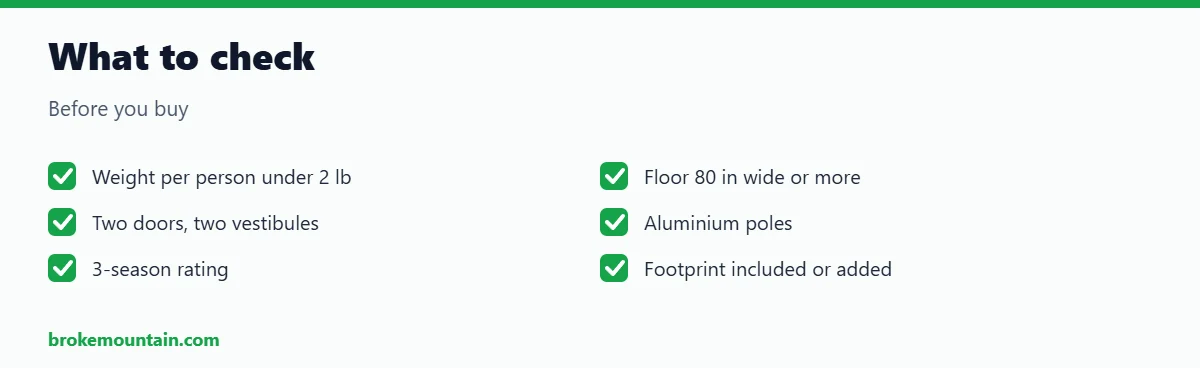
Divide the minimum trail weight by the number of people carrying it. Under 2 lb per person is good; under 1.5 lb is excellent. Remember that “minimum weight” usually covers only the tent body, fly and poles. Stakes, guylines, stuff sacks and a footprint add to the packed weight.
Floor area and layout
Most 4-person backpacking tents have 52 to 57 square feet of floor, or about 13 to 14 square feet each. Check the floor dimensions rather than just the area: you need about 80 inches of width for four 20-inch pads, and more if anyone uses a wide pad. Taller hikers should look for a floor length of 90 inches or more.
Seasons
According to REI’s buying advice, your main choice is between a 3-season and a 4-season tent, and most backpackers choose a 3-season model. Three-season tents are designed for spring, summer and autumn. They handle rain and moderate wind and use plenty of mesh for airflow. Four-season tents add poles and heavier fabric for snow and strong wind, but they are heavier and can feel stuffy in warm weather. All four tents in this guide are 3-season designs.
Doors and vestibules
With four people, two doors are close to essential, so nobody has to climb over three sleepers at night. Vestibules matter just as much, because there is no spare floor space for packs and boots. Look for two vestibules of at least 10 square feet each.
Peak height and wall shape
Peak height tells you whether you can sit up, but wall shape decides how usable the space is. Tents with pre-bent poles or hubbed designs have steeper walls, so people at the edges can sit up too. If standing room matters more than weight, see our guide to standing-room tents.
Ventilation and condensation
Four people breathe out a lot of moisture overnight. Mesh panels, fly vents and a gap between the inner tent and fly all help to reduce condensation. In still, cool conditions, leave vestibule zips partly open at the top if rain allows.
Poles, fabrics and footprint
Aluminium poles are lighter and stronger than fibreglass. Thinner fabrics (15 to 20 denier) save weight but need more care; 68- to 75-denier fabrics are heavier and tougher. A footprint protects the floor from abrasion and punctures and is worth using with any lightweight tent.
Tips for sharing a tent between four
- Split the load: one person carries the tent body, one the fly, one the poles and stakes, one the footprint.
- Practise pitching at home so everyone knows the routine in bad weather.
- Sleep head-to-toe if the floor is narrow, to give shoulders more room.
- Keep packs in the vestibules and only sleeping gear inside.
- Choose a pitch on durable ground at least 200 feet from water, and check for dead branches overhead.
- Dry the tent fully before storing it to prevent mildew.
Which 4-person backpacking tent should you buy?
- You hike long days and count every ounce: the Big Agnes Copper Spur HV UL4 is the clear pick, if the price fits.
- You want one tent to last for years of family trips: the MSR Elixir 4, with its heavier fabrics and included footprint.
- You split your time between campgrounds and the trail: the Marmot Tungsten 4P, which is taller inside and still light enough to carry.
- You camp close to the car and money is tight: the Kelty Wireless 4, accepting the extra weight.
If none of these fits, consider a 3-person backpacking tent for two adults and one or two small children. It will be lighter and easier to pitch, and children grow into their own tent sooner than you expect. Our guide to lightweight backpacking tents covers smaller options.
Pitching and caring for a large tent
A big tent catches more wind than a small one, so pitching it well matters. Point the lowest, narrowest end into the wind, stake every corner before you raise the poles, and use all the guylines when the forecast is unsettled. In rain, pitch the fly and footprint first if your tent allows it, then clip in the inner tent underneath to keep it dry.
At home, shake out grit, wipe the floor with a damp cloth and hang the tent until it is completely dry. Store it loosely in a cool, dry place rather than tightly packed in its stuff sack. Re-seal seams and refresh the water-repellent coating on the fly when water stops beading. Looked after this way, a good tent should last for many seasons.
Frequently asked questions
How much does a 4-person backpacking tent weigh?
Ultralight models weigh about 5 to 6 lb. Mid-priced backpacking tents are around 8 lb, and budget tents can exceed 11 lb.
Can four adults fit in a 4-person backpacking tent?
Yes, but it is tight. Expect four standard pads edge to edge with gear stored in the vestibules. For more comfort, treat a 4-person tent as roomy for three.
Is one 4-person tent better than two 2-person tents?
One large tent is usually lighter per person and more sociable, which suits families. Two small tents are easier to pitch on small sites and give more privacy and flexibility.
Do I need a footprint?
It is not essential, but it extends the life of the tent floor, especially with thin ultralight fabrics. Some tents, such as the MSR Elixir 4 and Marmot Tungsten 4P, include one.
Can I use a 3-season tent in winter?
Only in mild, sheltered conditions without heavy snow. For snow loading and strong winter winds, choose a 4-season tent.
Keep reading
- Best budget backpacking tents
- Lightweight backpacking tents
- 2-person backpacking tents
- Best backpacking stoves
Last checked: November 2026. Prices and specifications change, so confirm details with the retailer before you buy.

Hi, I am Emam Hasan — founder and editor of BrokeMountain. I oversee this blog’s hiking, camping and outdoor gear guides, making sure every article is well-researched, accurate and genuinely helpful for your time on the trail. Enjoy it!


