
Quick answer: start by identifying your brake, because disc brake pads are shaped for specific calipers and won’t swap between brands or models. Then pick a compound. Organic (resin) pads bite hard and run quietly in the dry but wear faster. Sintered (metal) pads last longer and cope better with heat, mud and wet weather, but they’re noisier. Semi-metallic pads sit in between. Rim (V-brake) pads are simpler and fit most V-brakes with a threaded post.
BrokeMountain is reader-supported. We may earn a commission when you buy through links on this page, at no extra cost to you. Learn more.
How we chose: we haven’t tested these pads in person. This guide is based on manufacturer guidance, published workshop advice and the trade-offs between pad compounds. Always check that a pad is listed for your exact brake model before you buy.
Step 1: identify your brake
Disc brake pads come in dozens of shapes. A pad for a Shimano Deore two-piston caliper won’t fit a SRAM Code four-piston caliper, and even brakes from the same brand can use different pads. Find your brake model printed on the caliper or lever, or look it up in your bike’s spec sheet, then buy pads listed for that model. Many brands, including Shimano, SRAM and SwissStop, publish compatibility charts.
We have model-specific guides for some of the most common brakes:
- Brake pads for Shimano Deore
- Brake pads for Shimano XT
- Brake pads for SRAM Guide RSC
- Brake pads for SRAM Code R
Step 2: choose a pad compound
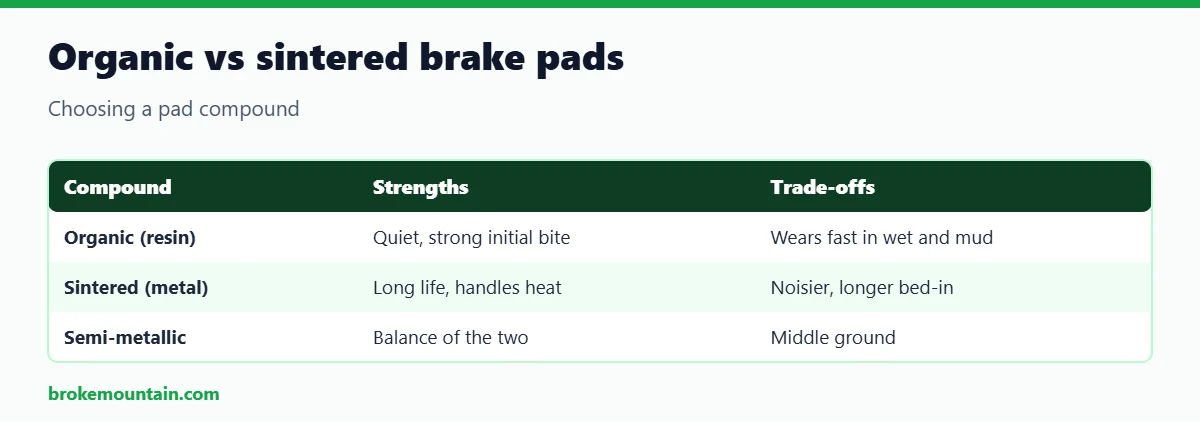
Most disc pads come in two or three compounds. BikeRadar’s guide to disc brake pads describes organic pads as a mix of fibres such as Kevlar, rubber and silica held together with resin, while sintered pads are made from metal particles fused under heat and pressure.
| Organic (resin) | Semi-metallic | Sintered (metal) | |
|---|---|---|---|
| Initial bite | Strong and immediate | Good | Builds as the pad warms |
| Feel | Smooth, progressive | Balanced | More on/off |
| Noise | Quiet | Moderate | Can squeal, especially when wet |
| Wet and muddy conditions | Weaker, wears quickly | Fair | Best |
| Heat on long descents | Can fade | Fair | Best |
| Pad life | Shortest | Medium | Longest |
| Rotor wear | Lowest | Medium | Highest |
Organic pads: best for dry trail riding
Organic pads are what many bikes come with from the factory. They grab hard as soon as you pull the lever, feel smooth, and are usually quiet. Their weaknesses are heat and grit. On long, steep descents they can fade, and in mud the grit grinds the softer material away quickly. They suit lighter riders, dry climates and cross-country or trail riding.
Sintered pads: best for mud, heat and heavy riders
Sintered pads last much longer and keep working when they’re hot, wet or caked in mud. That makes them a popular choice for enduro, downhill, e-bikes, heavier riders and wet climates. The trade-offs are noise, a longer bedding-in period and faster rotor wear. They also pass more heat to the brake fluid than organic pads, so on very long descents finned pads or bigger rotors help.
Semi-metallic pads: the middle ground
Semi-metallic pads add some metal to an organic-style compound. They last longer than organic pads and are quieter than sintered pads, which makes them a good all-round choice if you ride in mixed weather. Many aftermarket brands now offer them.
Mixing compounds
You don’t have to run the same pads front and rear. A common set-up is an organic or semi-metallic pad at the front, where bite and feel matter most, and a longer-lasting sintered pad at the rear, which picks up more spray and dirt.
The best mountain bike brake pads
1. Your brake maker’s own pads: best for guaranteed fit
Shimano and SRAM both sell organic (Shimano calls it resin) and sintered (metal) pads for each of their brakes, often with finned versions that help shed heat. Original pads are the safest choice for fit and are widely stocked. They’re a sensible default unless you have a specific problem, such as noise or short pad life, that an aftermarket compound solves.
- Good for: anyone who wants a pad that’s sure to fit and behave like the original.
- Watch out for: finned pads cost more; check that your caliper has room for the fins.
Check Shimano brake pad prices on Amazon · Check SRAM brake pad prices on Amazon
2. SwissStop semi-metallic pads: best for mixed conditions
SwissStop is a long-established Swiss brake specialist, and its semi-metallic EXOTherm2 pads are a popular upgrade for riders who want longer life than organic pads without the noise of sintered ones. They’re made in shapes for most major brakes.
- Good for: riders in changeable weather who want quiet, consistent brakes.
- Watch out for: they cost more than basic replacement pads.
Check SwissStop pad prices on Amazon
3. Jagwire and other aftermarket pads: best value
Aftermarket brands such as Jagwire make pads in organic, semi-metallic and sintered compounds to fit popular Shimano and SRAM brakes, usually at a lower price than the originals. They’re a good way to stock up on spares, especially if you ride often and wear through pads quickly.
- Good for: riders who go through pads fast and want to keep spares on hand.
- Watch out for: quality varies between brands and compounds; buy from known names and check the fitment carefully.
Check Jagwire pad prices on Amazon
4. Sintered pads for e-bikes and heavy riders
E-bikes are heavier and faster, which puts more heat and wear into the brakes. Many pad makers offer e-bike-specific or heavy-duty sintered compounds for this reason. If you ride an e-MTB or carry a lot of weight, start with a sintered or e-bike pad and consider larger rotors too.
- Good for: e-MTB riders, heavier riders and anyone with long, steep descents.
- Watch out for: extra noise and faster rotor wear.
Check e-bike brake pad prices on Amazon
5. Rim brake (V-brake) pads
Many entry-level and older mountain bikes still use V-brakes. Replacement rim pads usually fit any V-brake with a threaded post, and cartridge-style pads let you replace just the rubber insert. Kool-Stop’s salmon-coloured compound has a long-standing reputation for grip in the wet.
- Good for: older and budget bikes with rim brakes.
- Watch out for: rim pads wear the rim itself over time; check your rims for a wear indicator.
Check V-brake pad prices on Amazon
Backing plates and cooling fins
Besides the compound, pads differ in what the friction material is bonded to:
- Steel backing: the most common and the cheapest. Steel is strong and handles heat well.
- Alloy backing: lighter and better at shedding heat, but usually more expensive.
- Finned pads: some pads, including versions from Shimano, add aluminium cooling fins that stick out of the caliper. They help keep pad and fluid temperatures down on long descents, which reduces fade. They’re worth it for heavy riders, e-bikes and big mountain descents, but they don’t fit every caliper.
For most trail riders, standard steel-backed pads in the right compound are all you need. Finned or alloy-backed pads are an upgrade for riders who regularly push their brakes hard.
When to replace brake pads
Check your pads regularly, especially after muddy rides. SRAM recommends inspecting disc pads every month, or more often in sandy or dirty conditions, and replacing them when the backing plate and pad material together measure 3 mm or less. Shimano’s guidance is based on the friction material alone: replace the pads before it wears below about 0.5 mm. Many mechanics replace pads at around 1 mm of material to keep the brake feeling firm.
Other signs that pads need attention:
- The lever pulls further toward the bar than usual.
- Braking power feels weaker, or the brakes squeal and grind.
- You hear metal-on-metal scraping, which means the pad is worn down to its backing plate and is damaging the rotor. Stop riding and replace the pads right away.
- The pads are glazed or contaminated with oil or brake fluid. Contaminated pads usually can’t be saved.
Rotors wear too. SRAM says to replace a rotor when it’s thinner than 1.55 mm, and other brands give similar figures, usually printed on the rotor itself.
How to fit new disc brake pads
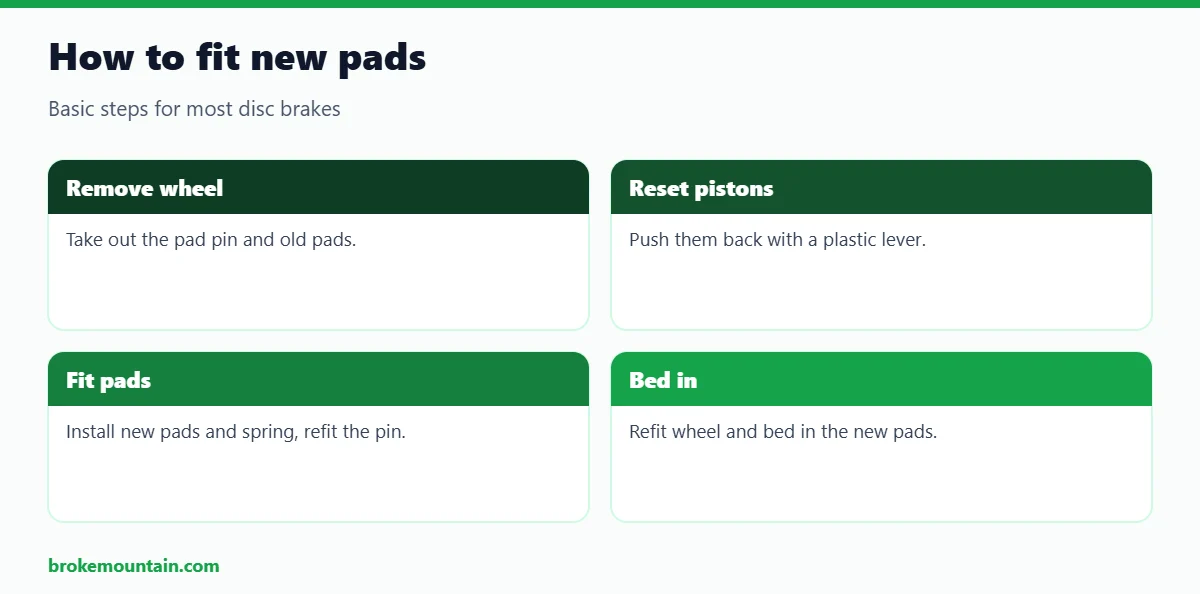
- Remove the wheel and take out the pad retaining pin or bolt.
- Slide out the old pads and spring, noting how the spring sits between them.
- Push the pistons back into the caliper with a plastic tyre lever or piston press. Never use a screwdriver, which can damage the pistons.
- Fit the new pads and spring together as one unit, then replace the pin and its clip.
- Refit the wheel, pump the lever several times to bring the pads out, and check that the wheel spins freely.
- Bed in the pads before you ride anywhere steep.
The basic tools are covered in our guide to mountain bike tool kits, and The Pro’s Closet has a clear step-by-step guide with photos.
How to bed in new pads
New pads need bedding in to transfer a thin, even layer of pad material onto the rotor. Without it, brakes can feel weak and noisy. On a flat, safe stretch of road or trail:
- Ride at a moderate speed and brake firmly, without locking the wheel, until you’re almost at walking pace. Repeat 10 to 20 times.
- Then do a few harder stops from a slightly higher speed.
- Let the brakes cool before riding properly.
Sintered pads usually take longer to bed in than organic ones. Bed in again whenever you fit a new rotor, and if you switch compounds, clean the rotor thoroughly first so the old pad material doesn’t interfere.
Fixing noisy or weak brakes
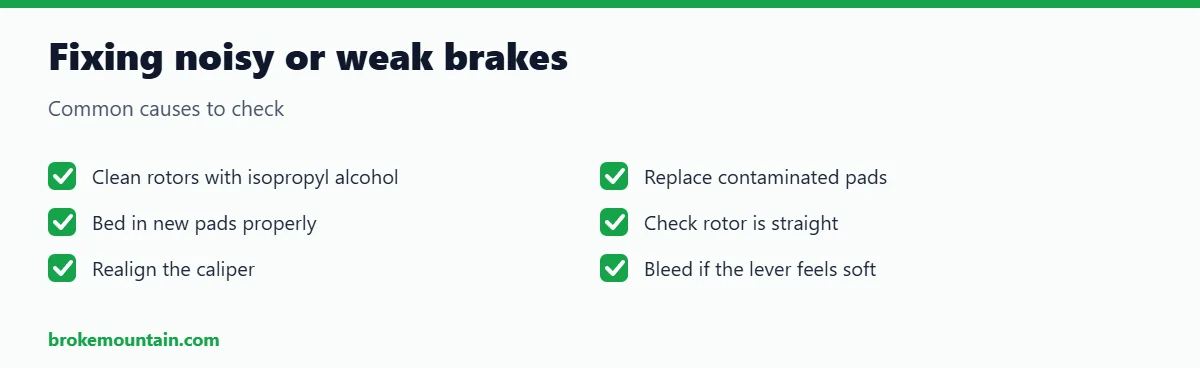
- Contamination: oil, chain lube or brake fluid on the pads or rotor is the most common cause. Clean the rotor with isopropyl alcohol and replace contaminated pads. Keep spray lube away from your brakes.
- Misaligned caliper: loosen the caliper bolts, squeeze the lever, and retighten them so the pads sit evenly on the rotor.
- Bent rotor: a rotor that rubs in one spot can often be trued with a rotor truing tool.
- Wrong compound: if organic pads wear out in weeks, try sintered. If sintered pads squeal constantly in dry weather, try semi-metallic or organic.
- Air in the system: a spongy lever that keeps getting worse may need a brake bleed. That’s a job for a bike shop if you haven’t done one before.
If you’re thinking about a full brake upgrade, see our guide to hydraulic disc brakes for mountain bikes.
Frequently asked questions
Are organic or sintered pads better for mountain biking?
It depends on where and how you ride. Organic pads suit dry trails and lighter riders; sintered pads suit mud, wet weather, long descents, e-bikes and heavier riders.
Can I switch from organic to sintered pads?
Usually, yes, as long as the pad shape fits your caliper. Some lightweight rotors are only rated for organic pads, so check the marking on your rotor first.
How long do mountain bike brake pads last?
It varies hugely. In dry conditions, pads can last many months; in wet, gritty conditions, organic pads can wear out in a few rides. Check them often rather than relying on a set distance.
Why do my new brake pads squeal?
They may not be bedded in yet, or the pads or rotor may be contaminated. Sintered pads are also naturally louder, particularly in the wet.
Can I use car brake cleaner on my bike?
Isopropyl alcohol or a bike-specific disc brake cleaner is safer. Some car products leave residues or can damage seals.
Do I need to replace the rotor when I change pads?
Not usually. Replace the rotor if it’s worn below the minimum thickness printed on it, or if it’s cracked or badly warped. Otherwise, clean it and bed in the new pads.
Should I carry spare pads on long rides?
On multi-day trips or wet, muddy rides, yes. A spare pair weighs very little, and muddy conditions can wear out pads in a single long day.
Keep reading
- Best hydraulic disc brakes for mountain bikes
- Best mountain bike tool kits
- Best chain oil for mountain bikes

Hi, I am Emam Hasan — founder and editor of BrokeMountain. I oversee this blog’s hiking, camping and outdoor gear guides, making sure every article is well-researched, accurate and genuinely helpful for your time on the trail. Enjoy it!


