Quick answer: the best electric bikes for mountain biking in 2026 are mid-drive, pedal-assist e-MTBs from established bike brands. The Aventon Ramblas ADV ($2,899) is the best-value hardtail, and the Aventon Current ADV is the lowest-cost full-suspension pick in major tests. The Specialized Turbo Levo is the long-standing benchmark, from about $5,500 in aluminium. The Amflow PX Carbon Pro (about $10,000) is the top premium choice at OutdoorGearLab, and the Specialized Turbo Levo SL and Santa Cruz Heckler SL lead the lightweight class. Cheap “1000W” hub-motor bikes sold online are not real mountain bikes and are often not allowed on trails.
BrokeMountain is reader-supported. We may earn a commission when you buy through links on this page, at no extra cost to you. Learn more.
How we put this together: we haven’t tested these bikes in person. Picks, prices and specifications come from independent tests and price round-ups published in 2026, linked in the text. Prices and specs change by trim and model year, and trail-access rules vary by place, so check both before you buy.
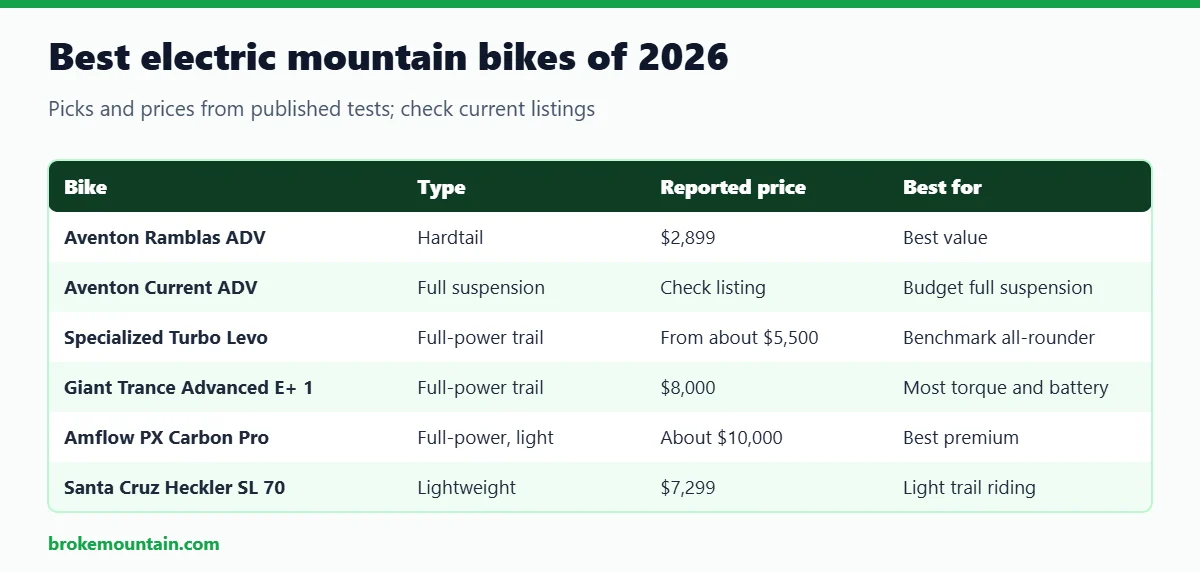
Best electric bikes for mountain biking at a glance
| Bike | Type | Reported price | Best for |
|---|---|---|---|
| Aventon Ramblas ADV | Hardtail, mid-drive | $2,899 | Best value |
| Aventon Current ADV | Full suspension | Check listing | Lowest-cost full suspension from a known brand |
| Specialized Turbo Levo | Full-power trail | From about $5,500 (alloy) | Benchmark all-rounder |
| Giant Trance Advanced E+ 1 | Full-power trail | $8,000 | Most torque and battery |
| Amflow PX Carbon Pro | Full-power, light | About $10,000 | Best premium |
| Specialized Turbo Levo SL Comp | Lightweight | Check listing | Natural ride feel |
| Santa Cruz Heckler SL 70 | Lightweight | $7,299 | Light trail riding |
| Atherton S.170E.2 | Enduro | Check listing | BikeRadar’s 2026 MTB of the Year |
What makes an e-bike a real electric mountain bike?
- Mid-drive motor. The motor sits at the cranks and drives through the gears, so it climbs steep trails efficiently and keeps weight low and central.
- Torque sensor. Assistance matches how hard you pedal, which gives control on technical ground.
- Pedal assist only. No throttle on most true e-MTBs, which matters for trail access.
- Mountain bike frame, suspension and brakes. Proper geometry, air suspension and four-piston brakes built for a 45 to 55 lb bike.
Many cheap “electric mountain bikes” sold online have a rear hub motor, a throttle and basic bicycle parts. They are fine for paths and gravel roads. They are not built for trail riding.
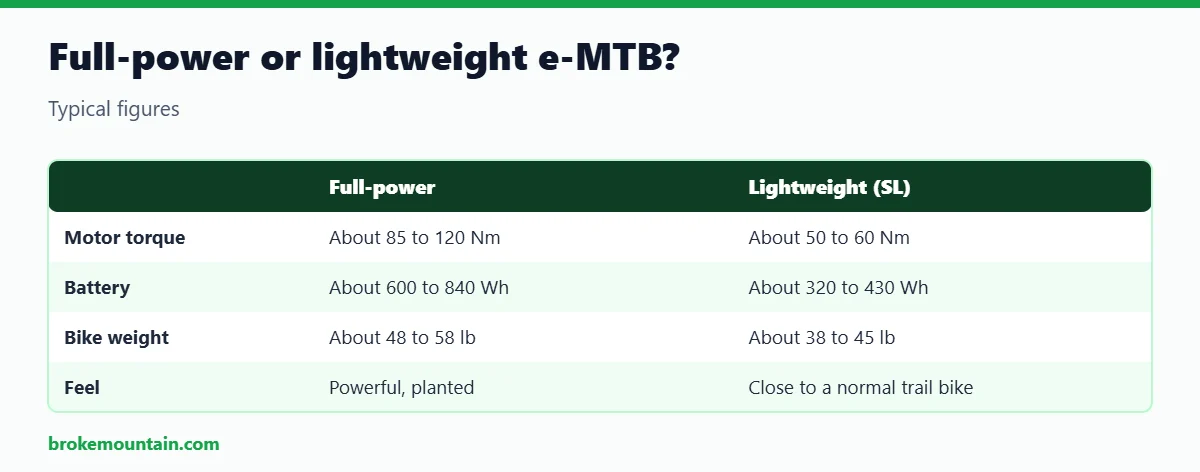
Full-power or lightweight e-MTB?
| Full-power | Lightweight (SL) | |
|---|---|---|
| Motor torque | About 85 to 120 Nm | About 50 to 60 Nm |
| Battery | About 600 to 840 Wh | About 320 to 430 Wh |
| Bike weight | About 48 to 58 lb | About 38 to 45 lb |
| Feel | Powerful; planted on descents | Close to a normal trail bike |
| Best for | Big days, steep climbs, heavier riders | Fit riders who want a little help |
The ranges are typical figures. A US price round-up by Bikes4Sale found 2026 e-MTBs running from 60 Nm to 120 Nm of torque and from 420 Wh to 840 Wh of battery, at prices from $2,599 for a hardtail to $13,968 for a carbon trail bike.
The best electric mountain bikes in detail
Aventon Ramblas ADV: best value
OutdoorGearLab gives the Ramblas ADV its Best Buy award at a list price of $2,899. It is a hardtail with a mid-drive motor, which is rare at this price. It suits fire roads, flow trails and moderate singletrack.
- Good: real e-MTB motor at a low price.
- Less good: hardtail; heavy for rough descents.
Aventon Current ADV: budget full suspension
OutdoorGearLab names the Current ADV its best electric mountain bike for most people, and GearJunkie lists it as its best budget electric mountain bike and the most economic full-suspension e-MTB it tested, with a 7/10 rating. Check the listing for the current price.
Specialized Turbo Levo: the benchmark
The Turbo Levo has defined the full-power trail e-MTB for years. GearJunkie rates the top S-Works Turbo Levo 4 its best overall electric mountain bike at 9.2/10. One 2026 price guide lists the range at about $5,500 for the alloy model, $8,500 for the carbon Comp and $13,500 for the S-Works. The alloy model gives you the same motor system for far less.
Giant Trance Advanced E+ 1: most power and range
Bikes4Sale lists it at $8,000 with 120 Nm of torque and an 840 Wh battery, the highest figures in its comparison. That suits long days and steep terrain.
OutdoorGearLab calls the Amflow PX Carbon Pro the best electric mountain bike it has tested for riders with about $10,000 to spend, describing it as lighter, more powerful and quieter than the rest. It uses the Avinox drive system. BikeRadar’s 2026 Mountain Bike of the Year, the Atherton S.170E.2, is also Avinox-powered, and was praised for its controllable high-power motor and suspension.
Specialized Turbo Levo SL and Santa Cruz Heckler SL: lightweight
OutdoorGearLab picks the Turbo Levo SL Comp as its best lightweight e-mountain bike. Bikes4Sale names the Santa Cruz Heckler SL 70 its best lightweight option at $7,299 and 19.95 kg (about 44 lb). Both give modest assistance and ride much like a normal trail bike.
Which electric mountain bike suits you?
| You are | Sensible choice | Why |
|---|---|---|
| New to e-MTBs, moderate trails | Aventon Ramblas ADV | Real mid-drive motor at the lowest price |
| Wanting full suspension on a budget | Aventon Current ADV | Cheapest full-suspension pick in major tests |
| Riding all kinds of trails | Specialized Turbo Levo (alloy) | Proven platform with wide dealer support |
| Doing long days with lots of climbing | Giant Trance Advanced E+ 1 | Largest battery and most torque here |
| Fit, and wanting a natural feel | Turbo Levo SL or Heckler SL | Light, with modest assistance |
| Spending for the best | Amflow PX Carbon Pro | Top-rated premium bike |
Hardtail or full-suspension e-MTB?
An electric hardtail costs $1,500 to $2,500 less and is simpler to maintain. The extra weight and speed of an e-bike make rough trails harder on a hardtail than on an unpowered one, though, because the rear wheel hits obstacles with more force. If you ride rocky or rooty trails regularly, full suspension is worth saving for. For fire roads, flow trails and mixed commuting, a hardtail is a sound choice.
Battery care and safety
- Charge with the maker’s charger, on a hard surface, away from anything flammable.
- Do not charge unattended overnight, and unplug when full.
- Store the battery indoors at about half charge if you will not ride for weeks.
- Keep it out of freezing temperatures and direct summer heat.
- Stop using a battery that is swollen, cracked, hot or smells odd, and have it checked.
- Clean the bike with a low-pressure hose, not a pressure washer aimed at the motor or battery.
Common mistakes when buying
- Judging by watts. Peak-watt claims on cheap bikes say little. Torque, sensor type and motor brand tell you more.
- Buying before checking trail rules. A bike you cannot legally ride on your local trails is the wrong bike.
- Ignoring weight. Check that you can lift it and that your rack can carry it.
- Overlooking service. Without a dealer for your motor brand, a small fault can keep the bike off the trail for weeks.
- Skimping on brakes and tyres. A heavy bike needs strong brakes and tough tyres.
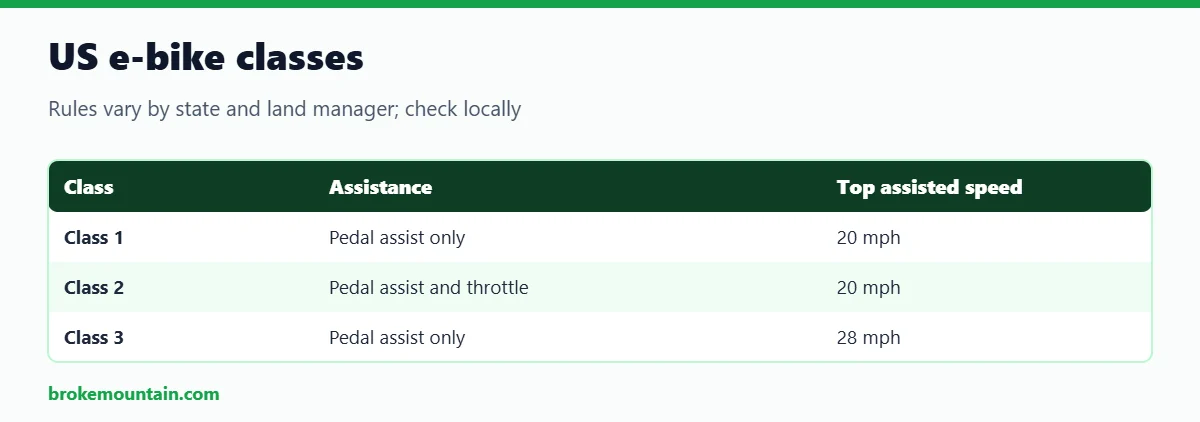
E-bike classes and where you can ride
In the United States, most states use a three-class system.
| Class | Assistance | Top assisted speed | Typical trail access |
|---|---|---|---|
| Class 1 | Pedal assist only | 20 mph | Most widely accepted on mountain bike trails that allow e-bikes |
| Class 2 | Pedal assist and throttle | 20 mph | Often restricted on natural-surface trails |
| Class 3 | Pedal assist only | 28 mph | Usually roads and bike lanes only |
Rules differ by state, land manager and trail system, and they change. Many non-motorised trails do not allow any e-bikes. Check with the land manager before you ride. In the UK and EU, pedal-assist bikes limited to 250 W continuous power and 25 km/h are generally treated as bicycles; more powerful or throttle-driven bikes are not.
Bikes advertised with 1000 W or more and speeds over 28 mph usually fall outside these classes. They may be legal only on private land.
What to look for in electric bikes for mountain biking
Motor
Look at torque in newton metres, not only watts. About 85 Nm is the full-power standard; 50 to 60 Nm is typical for lightweight bikes. Well-supported systems include Bosch, Shimano, Specialized, Brose, Yamaha, SRAM and Avinox.
Battery and range
Capacity is given in watt-hours. Range depends on rider weight, assistance level, climbing and temperature, so treat any single range figure with caution. As a rough guide, 600 to 700 Wh suits a few hours of full-power trail riding.
Suspension and travel
About 130 to 150 mm for trail riding and 160 to 170 mm for enduro. E-MTBs are heavy, so good damping matters more than on an unpowered bike.
Brakes, tyres and wheels
Four-piston brakes with 200 mm or larger rotors, tough-casing tyres and strong wheels. See hydraulic disc brakes for MTB and enduro tyres.
Weight
You will lift the bike onto racks and over obstacles. Check that your rack is rated for it; see hitch bike racks for mountain bikes.
Service and support
Motors and batteries need dealer diagnostics and warranty support. A local shop that services your motor brand is worth a lot.
What about cheap electric mountain bikes on Amazon?
Bikes priced from about $500 to $1,500 with “1000W peak” hub motors are common online. Be clear about what they are.
- Fine for: commuting, paths, gravel and gentle dirt roads.
- Not suited to: technical singletrack, jumps or steep descents. Frames, forks and brakes are basic.
- Check: the e-bike class, whether the battery and charger carry a recognised safety certification such as UL 2849 or UL 2271, and where you would get it serviced.
- Access: throttle bikes are often barred from mountain bike trails.
Costs beyond the bike
- Faster wear on chains, cassettes, brake pads and tyres.
- A replacement battery after several years, often $600 to $1,200.
- A rack rated for the weight.
- A good helmet and pads; see knee pads.
For e-bike certified helmets, see our guide to the best mountain bike helmets.
Frequently asked questions
What is the best electric mountain bike for the money?
The Aventon Ramblas ADV at $2,899 is the best-value hardtail in major tests. For full suspension, the Aventon Current ADV is the budget pick.
How much does a good electric mountain bike cost?
About $2,600 to $3,500 for a real mid-drive hardtail, $4,500 to $8,000 for most full-suspension bikes, and $10,000 or more for top models.
Are electric mountain bikes allowed on trails?
It depends on the trail. Class 1 pedal-assist bikes have the widest access, but many trails ban all e-bikes. Check local rules.
How far can an e-MTB go on one charge?
It varies widely with terrain, rider weight and assist level. Full-power bikes with 600 to 800 Wh batteries usually cover a few hours of hilly trail riding.
Is an e-MTB cheating?
No. You still pedal and still need skill. Most riders use the assistance to ride further and climb more.
Last checked: November 2026. Prices, specifications and access rules change, so confirm them before you buy or ride.

Hi, I am Emam Hasan — founder and editor of BrokeMountain. I oversee this blog’s hiking, camping and outdoor gear guides, making sure every article is well-researched, accurate and genuinely helpful for your time on the trail. Enjoy it!