As an Amazon Associate, BrokeMountain earns from qualifying purchases. We did not test these racks in person; this guide is based on maker specifications, independent reviews and rider feedback.
Getting your mountain bike to the trailhead should be the easy part of the ride. A good hitch bike rack holds the bike by its wheels, keeps it off your paint, swings or tilts out of the way so you can open the tailgate, and stays rock-solid on rough forest roads. A poor one wobbles, rubs your frame and makes loading a two-person job.
Mountain bikes are harder to carry than road bikes. They are heavier, have long wheelbases and wide tires, and full-suspension frames often have odd shapes that do not suit hanging racks. This guide compares the best hitch bike racks for mountain bikes, explains what to check before you buy, and shows how to load a bike safely.
Quick Picks
- Best overall: Thule T2 Pro XTR
- Best premium: Kuat Piston Pro X
- Most durable: 1Up USA Heavy Duty Double
- Best for heavy e-MTBs: 1Up USA Super Duty
- Best value platform rack: RockyMounts MonoRail
- Also great: Thule Verse
1. Thule T2 Pro XTR
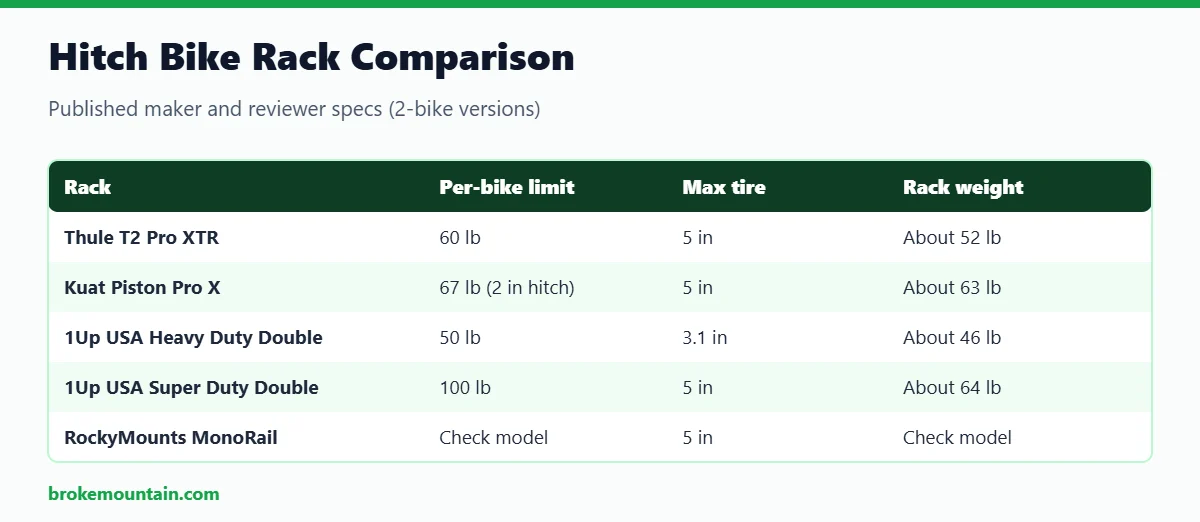
Best overall. The T2 Pro XTR is one of the most widely recommended platform racks for riders who own a mix of bikes. It carries two bikes (four with an add-on), holds up to 60 pounds per bike, accepts tires up to 5 inches wide and wheels from 20 to 29 inches, and fits a wheelbase of up to 50 inches. It comes in both 1.25-inch and 2-inch receiver versions, and it has built-in wheels so you can roll it into the garage instead of carrying it.
Switchback Travel’s long-term review calls it the best hitch rack the team has used, while noting it is pricey and, at about 52 pounds, on the heavier side. The bike holds use a ratcheting arm on the front wheel and a strap on the rear, with no frame contact.
Pros: fits nearly every mountain bike, easy to use, add-on capable, roll-around wheels.
Cons: heavy to lift on and off; 50-inch wheelbase limit can be tight for long enduro bikes.
Check the Thule T2 Pro XTR on Amazon
2. Kuat Piston Pro X
Best premium. If you want the nicest loading experience money can buy, the Piston Pro X is the rack reviewers keep pointing to. Its hydraulic-damped arms close onto the front tire with one hand, and it supports up to 67 pounds per bike on the 2-inch version, tires up to 5 inches and a wheelbase of up to 53 inches. It also has integrated lights. OutdoorGearLab notes the per-bike limit drops when you add trays: 50 pounds per bike with three and 40 pounds with four.
The downsides are weight and price. Reviewers list the rack at roughly 63 to 64 pounds, and it costs far more than most rivals. One reviewer also flagged that the open trays can collect water and dirt in the rain.
Pros: fastest, easiest one-hand loading; very high weight limit; integrated lights; fits long modern MTBs.
Cons: very expensive; heavy to install and remove.
Check the Kuat Piston Pro X on Amazon
3. 1Up USA Heavy Duty Double
Most durable. 1Up racks are known for all-aluminum, rust-free construction and a simple design that lasts for years. The Heavy Duty Double weighs around 46 pounds, lighter than many platform racks, and holds the bike with arms that clamp both tires. Its modular design means you can buy a single tray and add more later.
Check the fit before you buy: OutdoorGearLab lists a 3.1-inch maximum tire width, so it suits trail and enduro tires but not fat bikes. It accepts wheels from 16 to 29 inches and a long 54-inch wheelbase, and reviewers list about 50 pounds per bike.
Pros: very durable, lighter than rivals, modular, fits long wheelbases.
Cons: not for fat tires; lower per-bike limit than Thule or Kuat.
Check the 1Up USA Heavy Duty Double on Amazon
4. 1Up USA Super Duty
Best for heavy e-MTBs and off-road driving. Electric mountain bikes can weigh 50 to 60 pounds or more, which pushes many racks to their limit. Bikerumor lists the Super Duty at 100 pounds per bike, a wheelbase of up to 58 inches, tires up to 5 inches, and 2-inch and 2.5-inch receiver options, and praises its stability on rough roads and fully rebuildable all-metal build. The double version weighs about 64 pounds.
Pair it with a sturdy hitch: even if the rack can carry heavy bikes, your hitch’s tongue weight rating sets the real limit. If you are shopping for an e-bike, see our guide to the best electric bikes for mountain biking.
Pros: huge weight limit, very stable, fits very long bikes, rebuildable.
Cons: heavy and expensive; locks are not included by default.
Check the 1Up USA Super Duty on Amazon
5. RockyMounts MonoRail
Best value platform rack. Bikerumor and OutdoorGearLab both name the MonoRail as a top budget choice. It is a single-rail platform rack that fits wheels from 20 to 29 inches, tires up to 5 inches and a wheelbase of up to 50 inches. It secures the front wheel with a ratcheting arm, so there is no frame contact, and its simple design keeps the price well below premium racks.
Pros: affordable, fat-tire compatible, no frame contact.
Cons: fewer premium features; check the per-bike weight limit for your model and receiver size.
Check the RockyMounts MonoRail on Amazon
6. Thule Verse
Also great. The newer Thule Verse earned “best overall” in recent guides from both Bikerumor and GearJunkie. It carries two bikes (three with an add-on on 2-inch hitches) with no frame or rim contact, and reviewers praise its versatility across bike types. It is a strong alternative to the T2 Pro XTR if you want Thule’s latest design.
Check the Thule Verse on Amazon
Why a Platform Rack Is Best for Mountain Bikes
There are two main types of hitch rack. Hanging racks hold the bike by its top tube on two arms. They are cheaper and lighter, but many full-suspension mountain bikes have sloping or curved top tubes that do not hang well, bikes can swing into each other, and frame contact can scratch paint. Platform (tray) racks hold the bike by its wheels in trays. They are easier to load, keep bikes apart, and avoid frame contact entirely, which matters for carbon frames and expensive suspension.
For most mountain bikers, a platform rack is worth the extra cost. Vertical racks, which hang bikes by the front wheel, are another option for shuttle crews carrying four or more bikes on a pickup truck.
What to Check Before You Buy
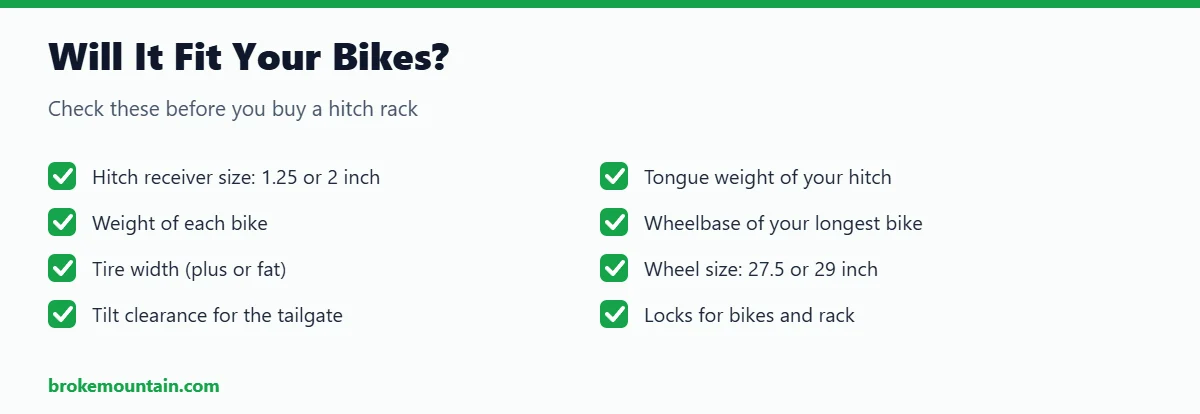
- Receiver size: 2-inch receivers carry more weight and support add-ons; many racks have lower limits on 1.25-inch hitches.
- Hitch tongue weight: add the rack’s weight and your bikes’ weight. The total must stay under your hitch’s tongue weight rating.
- Per-bike weight limit: weigh your heaviest bike, especially if it is an e-bike.
- Maximum wheelbase: long, slack enduro and downhill bikes can exceed 50 inches. Measure axle to axle.
- Tire width and wheel size: check that the trays fit plus-size or fat tires and 29-inch wheels.
- Tilt and swing-away: a tilting rack lets you open the tailgate or rear hatch without unloading.
- Security: look for a locking hitch pin and integrated cable locks for the bikes.
- Anti-wobble system: a threaded hitch pin or expanding wedge keeps the rack from rattling.
How to Load a Mountain Bike Safely
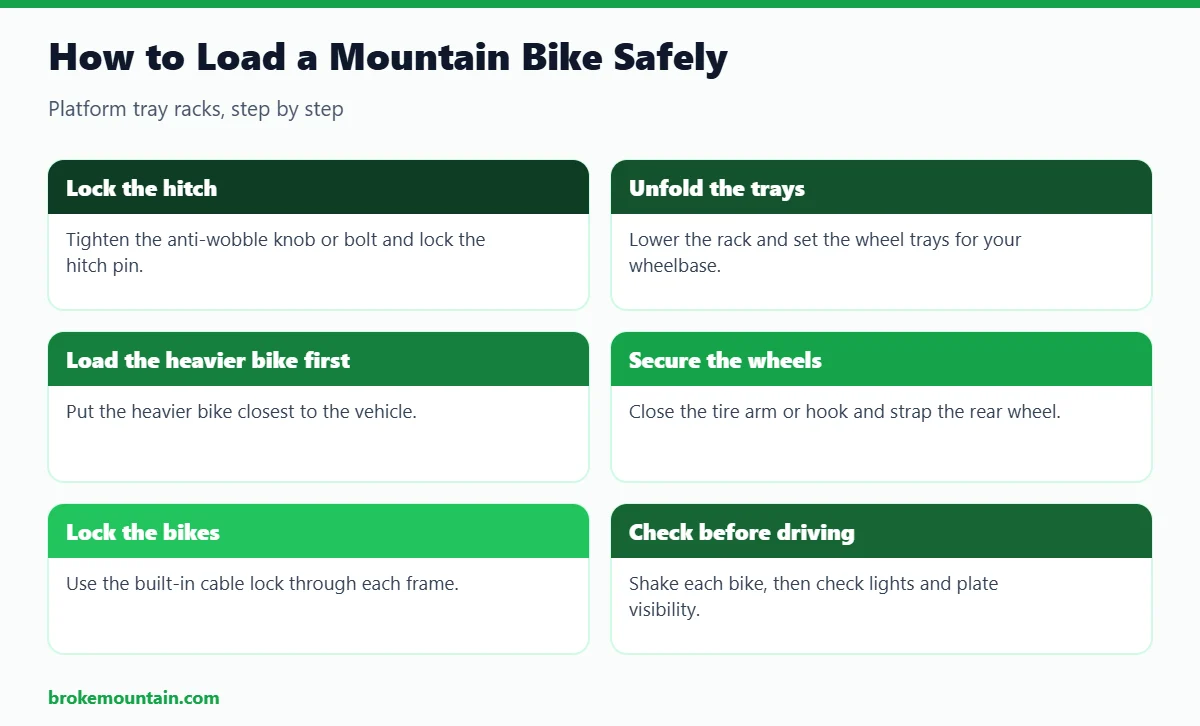
- Lock and tighten the hitch. Make sure the anti-wobble system is snug and the hitch pin is locked.
- Set up the trays. Slide the trays or wheel holders to fit your bike’s wheelbase.
- Load the heaviest bike closest to the vehicle. This reduces leverage on the hitch.
- Alternate directions if your rack allows, so handlebars do not hit each other.
- Secure the front wheel, then strap the rear. Pull straps tight and tuck loose ends.
- Lock each bike with the built-in cable, and remove loose items such as bottles, lights and computers.
- Shake test and check. Make sure nothing moves, and that your plate and lights are still visible.
Driving Tips with a Loaded Rack
- Remember the extra length: a loaded rack adds a few feet behind your vehicle. Take care when reversing and parking.
- Watch steep driveways and dips: long racks can scrape when you enter or leave a steep slope.
- Re-check after the first few miles: straps and arms can settle once the bike starts moving.
- Slow down on rough roads: potholes and washboard roads put big loads on the hitch and rack.
- Remove the rack when not in use: this reduces wear and prevents theft.
Storing the Rack and Your Bikes
Platform racks are heavy and bulky. Racks with built-in wheels, such as the Thule T2 Pro XTR, can be rolled into the garage, while others need a wall hook or a spot on the floor. Once you are home, see our guide to the best mountain bike garage storage to keep your bikes and gear organized.
Hitch Rack vs Roof Rack vs Tailgate Pad
Hitch racks are the most popular choice for mountain bikers. Loading at waist height is much easier than lifting a heavy bike onto a roof, they have little effect on fuel economy, and you will not hit a garage roof or drive-through with bikes on top. Their downsides are cost, the weight of the rack itself and the need for a hitch receiver.
Roof racks leave your hatch and rear view clear and work on cars without a hitch. However, lifting a 35-pound trail bike, or a much heavier e-bike, overhead is hard work, wind noise and fuel use go up, and low clearances become a real risk.
Tailgate pads drape over a pickup’s tailgate and hold several bikes by the down tube. They are cheap and quick for shuttle runs with friends, but they only work on trucks and the bikes can touch each other. Many shuttle crews use a pad for short trips and a hitch rack for long drives.
Useful Accessories
- Hitch lock and cable lock: some racks include them; if yours does not, add a locking hitch pin. See locking hitch pins.
- Hitch extender: lets you open a rear-mounted spare tire or swing door, but it reduces the weight you can safely carry. Check the rack maker’s guidance first.
- Frame adapter bar: needed only for hanging racks with full-suspension or step-through frames.
- Light board: in some areas, a rack that blocks your lights or plate needs an auxiliary light board.
- Cover: a bike cover keeps road grime and rain off drivetrains on long highway drives.
Before each drive, take valuables off your bike, including your GPS bike computer, lights and bottles. Small parts can shake loose at highway speeds. Riders with long, slack bikes, such as those in our guide to the best full-suspension downhill mountain bikes, should check the wheelbase limits above carefully.
Frequently Asked Questions
Can a hitch rack carry a full-suspension mountain bike?
Yes. Platform racks hold bikes by the wheels, so the frame shape does not matter. Hanging racks often need a top-tube adapter bar for full-suspension frames.
Do I need a 2-inch hitch?
Not always, but a 2-inch receiver usually supports higher weight limits and add-on trays. Check the rack’s limits for your receiver size.
Will a hitch rack fit a 29er with a long wheelbase?
Most platform racks fit 29-inch wheels, but measure your wheelbase. Long enduro bikes can exceed a 50-inch limit, so look at the Kuat Piston Pro X or 1Up racks for longer bikes.
Can I carry an e-MTB on a hitch rack?
Yes, if the rack’s per-bike limit and your hitch’s tongue weight allow it. Remove the e-bike battery before loading to save weight and protect it.
Are hitch racks better than roof racks for mountain bikes?
For most riders, yes. Hitch racks are easier to load, have little effect on fuel economy, and avoid the risk of driving into a garage with bikes on the roof.
Final Verdict
The Thule T2 Pro XTR is the best hitch bike rack for most mountain bikers: it fits almost every bike and is easy to use. Choose the Kuat Piston Pro X for the best loading experience and the highest per-bike limit among premium trays, the 1Up USA Heavy Duty Double for long-lasting durability, the 1Up USA Super Duty for heavy e-MTBs and rough roads, and the RockyMounts MonoRail for a platform rack on a tighter budget. For more expert testing, see OutdoorGearLab’s hitch rack tests.
Browse platform hitch bike racks on Amazon

Hi, I am Emam Hasan — founder and editor of BrokeMountain. I oversee this blog’s hiking, camping and outdoor gear guides, making sure every article is well-researched, accurate and genuinely helpful for your time on the trail. Enjoy it!