Quick answer: the best hiking first aid kits for 2026 start with the Adventure Medical Kits Ultralight/Watertight .7, which both CleverHiker and GearJunkie rank first: about 5.8 oz, $45 and waterproof inside. The HART Outdoor Day Hike is the budget kit for short walks at $17, the Adventure Medical Kits Mountain Series Hiker suits long day hikes, the Mountain Series Backpacker covers several people for up to four days, and the HART Outdoor Extended is the base camp kit.
BrokeMountain is reader-supported. We may earn a commission when you buy through links on this page, at no extra cost to you. Learn more.
How we put this together: we haven’t tested these kits in person. We compared manufacturer contents lists with results from independent testers and we link each source. This is general information and is not medical advice. A first aid course teaches far more than any kit can.
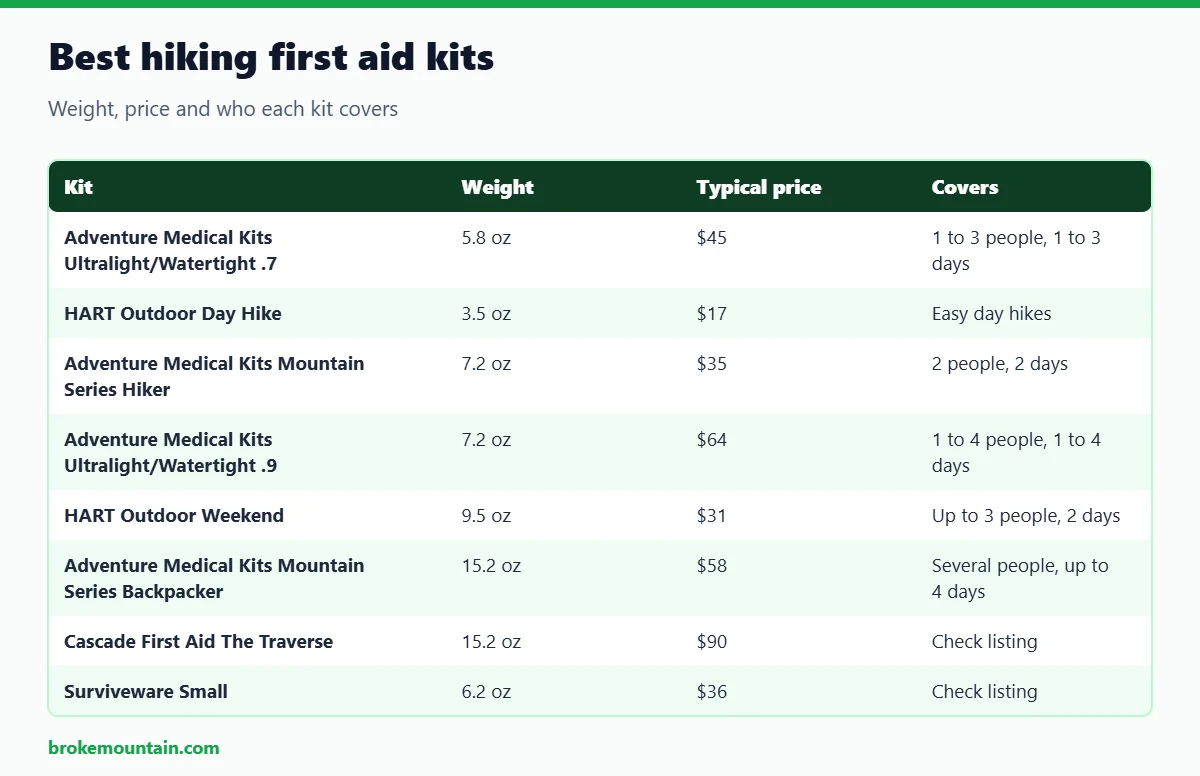
Best hiking first aid kits at a glance
| Kit | Weight | Typical price | Covers | Best for |
|---|---|---|---|---|
| Adventure Medical Kits Ultralight/Watertight .7 | 5.8 oz | $45 | 1 to 3 people, 1 to 3 days | Best overall |
| HART Outdoor Day Hike | 3.5 oz | $17 | Easy day hikes | Budget day kit |
| Adventure Medical Kits Mountain Series Hiker | 7.2 oz | $35 | 2 people, 2 days | Long day hikes |
| Adventure Medical Kits Ultralight/Watertight .9 | 7.2 oz | $64 | 1 to 4 people, 1 to 4 days | Light group kit |
| HART Outdoor Weekend | 9.5 oz | $31 | Up to 3 people, 2 days | Easy weekends |
| Adventure Medical Kits Mountain Series Backpacker | 15.2 oz | $58 | Several people, up to 4 days | Backpacking |
| Cascade First Aid The Traverse | 15.2 oz | $90 | Check listing | Wet trips |
| Surviveware Small | 6.2 oz | $36 | Check listing | Building your own |
| HART Outdoor Extended | 1 lb 4 oz | $70 | Groups | Base camp |
Weights, prices and coverage come from CleverHiker’s first aid kit tests and GearJunkie’s first-aid kit guide.
What a hiking first aid kit is for
Most trail problems are small: blisters, cuts, grazes, splinters, stings, headaches, sore joints and sprains. A good kit lets you deal with those and keep walking. For serious injuries its job is to help you control bleeding, protect the wound and keep the person stable while you get help. First aid supplies are one of the ten essentials listed by the National Park Service.
1. Adventure Medical Kits Ultralight/Watertight .7: best overall
CleverHiker gives it a perfect 5.0 and names it the best first aid kit overall, at $45 and 5.8 oz. GearJunkie also ranks it first, scoring it 9.3 out of 10 and rating it for 1 to 3 people over 1 to 3 days. The supplies sit in a waterproof inner bag inside a light outer pouch.
- Good: very light; contents stay dry; bright pouch is easy to find in a pack.
- Less good: few trauma supplies; not enough for large groups.
- Best for: day hikes and short backpacking trips for one to three people.
Check the Ultralight/Watertight .7 on Amazon
2. HART Outdoor Day Hike: budget day kit
CleverHiker’s best budget kit at $17 and 3.5 oz, and the most compact kit in its test. It covers small cuts and blisters on easy day hikes. It has no trauma supplies and is not water-resistant, so keep it in a zip bag.
Check the HART Outdoor Day Hike kit on Amazon
3. Adventure Medical Kits Mountain Series Hiker: long day hikes
At $35 and 7.2 oz, it is rated for two people over two days. CleverHiker picks it for extended day hikes and GearJunkie names it best for day hikes, scoring it 7.6 and praising its organised, good-quality supplies. It is not waterproof, has no trauma supplies and includes few gloves.
Check the Mountain Series Hiker on Amazon
4. Adventure Medical Kits Ultralight/Watertight .9: light group kit
GearJunkie’s best kit for group backpacking, scoring 8.1 at $64 and 7.2 oz, rated for 1 to 4 people over 1 to 4 days. It has a strong selection of medication in the same waterproof design as the .7. Quantities of some key items are small, so top it up for a full group.
5. HART Outdoor Weekend: easy weekends
GearJunkie’s best budget kit, scoring 7.3, and CleverHiker’s pick for easy weekends: $31 and 9.5 oz, for up to three people over two days. Testers liked its logical layout and clear labels. Some items are thinly supplied, and it is bulkier than the lightest kits.
6. Adventure Medical Kits Mountain Series Backpacker: backpacking
CleverHiker’s best kit for backpacking, rated 4.7, at $58 and 15.2 oz. It covers several people for up to four days and is well organised by injury type. It is not water-resistant.
Check the Mountain Series Backpacker on Amazon
7. Cascade First Aid The Traverse: wet trips
CleverHiker’s best waterproof kit at $90 and 15.2 oz, rated 4.6. It suits paddling and rainy climates. It lacks some trauma supplies.
8. Surviveware Small: building your own
CleverHiker calls it the most customisable kit: $36, 6.2 oz, highly organised and clearly labelled. It includes no medication, so add your own. GearJunkie rates Surviveware’s larger Comprehensive kit, at $45 and 1 lb, as its best comprehensive option for 1 to 4 people over up to a week.
9. HART Outdoor Extended: base camp and groups
CleverHiker’s best kit for base camp at $70 and 1 lb 4 oz, rated 4.5 and smartly organised. It is large, so it suits group trips, car camping and trip leaders.
Which of the best hiking first aid kits suits your trip?
| Trip | Sensible choice |
|---|---|
| Short local walk | HART Outdoor Day Hike |
| Full day hike, one or two people | Ultralight/Watertight .7 or Mountain Series Hiker |
| Weekend backpacking, two or three people | Ultralight/Watertight .7 or HART Outdoor Weekend |
| Three or four days with a group | Ultralight/Watertight .9 or Mountain Series Backpacker |
| Canoe or kayak trip | Cascade First Aid The Traverse |
| Base camp, car camping or leading a group | HART Outdoor Extended |
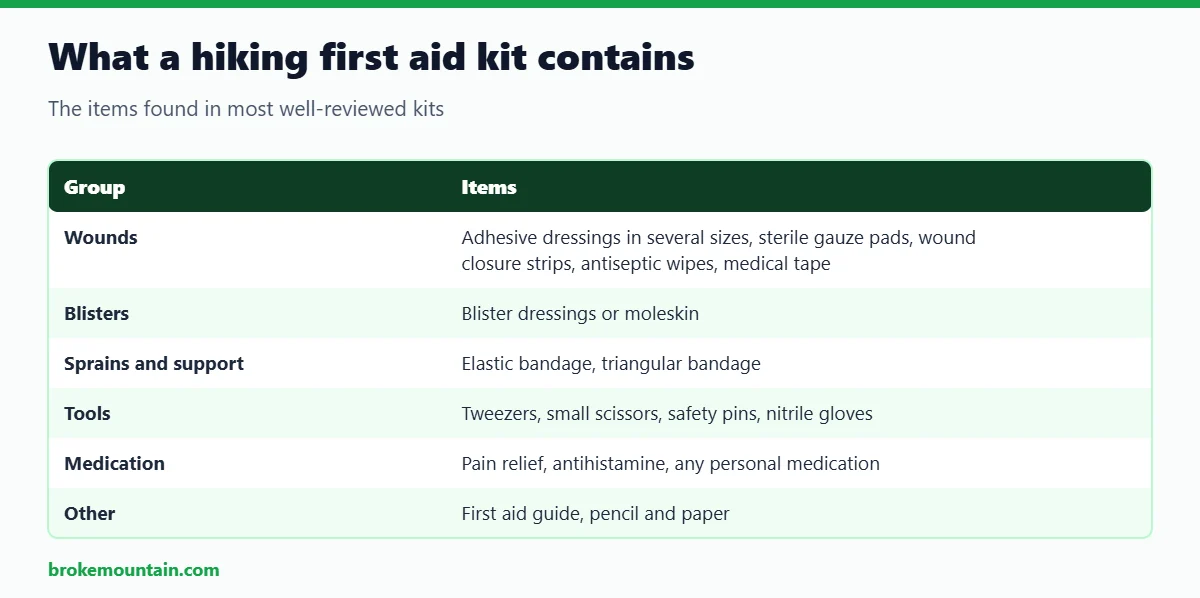
What should a hiking first aid kit contain?
Lists vary. These are the items that appear in most well-reviewed kits.
| Group | Items |
|---|---|
| Wounds | Adhesive dressings in several sizes, sterile gauze pads, wound closure strips, antiseptic wipes, medical tape |
| Blisters | Blister dressings or moleskin |
| Sprains and support | Elastic bandage, triangular bandage |
| Tools | Tweezers, small scissors, safety pins, nitrile gloves |
| Medication | Pain relief, antihistamine, any personal medication |
| Other | First aid guide, pencil and paper |
What to add to a bought kit
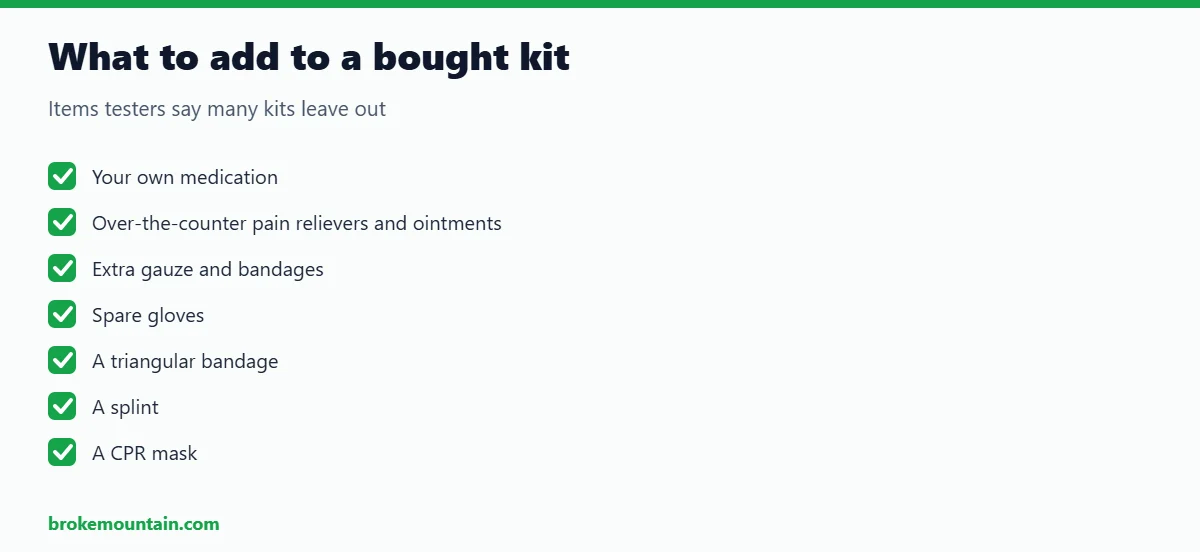
CleverHiker’s testers recommend adding these, since many kits leave them out:
- Your own medication
- Over-the-counter pain relievers and ointments
- Extra gauze and bandages
- Spare gloves
- A triangular bandage
- A splint
- A CPR mask
Adjust for where you hike. Add a tick remover in tick country, wide elastic bandages where there are venomous snakes, and extra blister care on long trips. Speak to your doctor or pharmacist about medication that suits you.
How to choose from the best hiking first aid kits
- Group size and days: GearJunkie advises matching these first. Most kits state both on the pack.
- Weight: CleverHiker’s day-hiking favourites weigh about 3.5 to 7.5 oz. Larger groups can split supplies between packs.
- Waterproofing: choose a waterproof kit for paddling and wet climates, or put any kit in a dry bag.
- Quantities: look at how many dressings and how much tape you get, not the headline item count.
- Medication: many kits include none. Check, and leave room for your own.
- Organisation: labelled pockets save time when you are stressed.
Bought kit or build your own?
| Bought kit | Built yourself | |
|---|---|---|
| Cost | Usually cheaper for the basics | Higher unless you have supplies at home |
| Time | Ready at once | Takes planning |
| Fit to your needs | General | Exact |
| Knowing the contents | You must study it | You packed it, so you know it |
A good middle path is to buy a light kit, empty it at home, learn what each item is for, then add what you need.
Keeping the kit ready
- Check it before every season and after every trip.
- Replace anything you used the same day you get home.
- GearJunkie suggests checking medication expiry dates every few months.
- Keep it at the top of your pack and tell your group where it is.
- Store it somewhere cool and dry between trips.
Training matters more than the kit
Both test teams recommend formal training. A wilderness first aid course teaches you how to assess an injury, when to walk out and when to call for help. Carry a way to call; see satellite messengers for hiking. The National Park Service hiking safety page covers planning. Our own packing guide is what to bring when you go hiking, and blister prevention starts with fit: see how should hiking boots fit and merino wool hiking socks.
Common trail problems and what you use
This table shows why the contents matter. It is a guide to what the items are for and is no substitute for training.
| Problem | Items you reach for |
|---|---|
| Hot spot or blister | Blister dressing or moleskin, tape |
| Small cut or graze | Antiseptic wipe, adhesive dressing |
| Deeper cut | Gauze pad, pressure, wound closure strips, tape |
| Twisted ankle | Elastic bandage, rest, trekking poles for support |
| Splinter or tick | Tweezers or tick remover, antiseptic wipe |
| Insect sting or mild allergy | Antihistamine, cold water |
| Headache or sore muscles | Pain relief, water, food, rest |
| Possible fracture | Splint, triangular bandage, call for help |
For anything serious, such as heavy bleeding, chest pain, a head injury, trouble breathing or a suspected broken bone, call for help early.
Common mistakes with hiking first aid kits
- Never opening it at home. Learn what is inside before you need it.
- Trusting the item count. A 100-piece kit can be mostly small plasters.
- Leaving out personal medication. Carry what you need for an extra day.
- Letting it run down. Used dressings and expired tablets are common in old kits.
- Burying it. Keep it at the top of the pack or in an outside pocket.
- Carrying only one kit in a group. If the person with the kit is the one who is hurt or lost, nobody has supplies.
- Skipping blister care. Blisters are among the most common hiking problems and the easiest to treat early.
Small extras that earn their place
- A few feet of duct tape wrapped round a water bottle or trekking pole
- An emergency blanket or bivvy; see our emergency bivvy sacks
- A whistle
- Electrolyte sachets
- Hand sanitiser
- A head torch, since injuries slow you down and walks run late
Frequently asked questions
What is the best first aid kit for day hiking?
The Adventure Medical Kits Ultralight/Watertight .7 leads both tests cited here. The HART Outdoor Day Hike is the low-cost option.
How heavy should a hiking first aid kit be?
About 3.5 to 7.5 oz for day hikes. Group and multi-day kits weigh 1 lb or more.
Do first aid kits expire?
Medication, ointments and some sterile items do. Check dates every few months.
Do I need a tourniquet for hiking?
Most hiking kits do not include one. Get trained before you carry trauma equipment.
Is one kit enough for a group?
Carry one main kit and give each person a few dressings and blister plasters.
Should I take a first aid course?
Yes. Skills matter more than supplies.
Last checked: November 2026. Prices, specifications and availability change, so confirm details on the maker’s or retailer’s page before you buy.

Hi, I am Emam Hasan — founder and editor of BrokeMountain. I oversee this blog’s hiking, camping and outdoor gear guides, making sure every article is well-researched, accurate and genuinely helpful for your time on the trail. Enjoy it!