
Quick answer: first identify your brake type: disc brakes need pads shaped for your exact caliper, while rim (V-brake) pads fit most V-brakes with a threaded post. For disc brakes, organic (resin) pads give strong bite and quiet braking in the dry; sintered (metal) pads last longer and handle heat, mud and wet weather better. Semi-metallic pads sit between the two. For V-brakes, cartridge or dual-compound pads such as Kool-Stop improve wet-weather stopping.
BrokeMountain is reader-supported. We may earn a commission when you buy through links on this page, at no extra cost to you. Learn more.
Disc pad compounds compared
| Compound | Bite | Wear life | Wet / mud | Heat | Noise |
|---|---|---|---|---|---|
| Organic (resin) | Strong, immediate | Short | Fair | Can fade | Quiet |
| Semi-metallic | Good | Medium | Good | Good | Some |
| Sintered (metal) | Needs warming up | Long | Excellent | Excellent | Can squeal |
Which compound should you choose?
- Dry climate, XC and lighter riders: organic.
- Mixed conditions, all-round trail: semi-metallic, or organic front with sintered rear.
- Wet, muddy winters, long descents, heavier riders, e-bikes: sintered.
Finding the right shape
Disc pads are not universal. Shimano, SRAM, Tektro, Magura, Hayes and other brakes each use specific shapes, and even within a brand 2-piston and 4-piston calipers differ. Remove an old pad to compare, or check the pad code in your brake’s manual. Many aftermarket packs list which brakes they fit.
Rim brake pads
V-brake pads come as one-piece or cartridge designs (where you replace only the rubber insert). Look for pads with water-clearing grooves and compounds designed for wet weather. Toe the pads in slightly so the front edge touches the rim first to reduce squeal.
Our picks


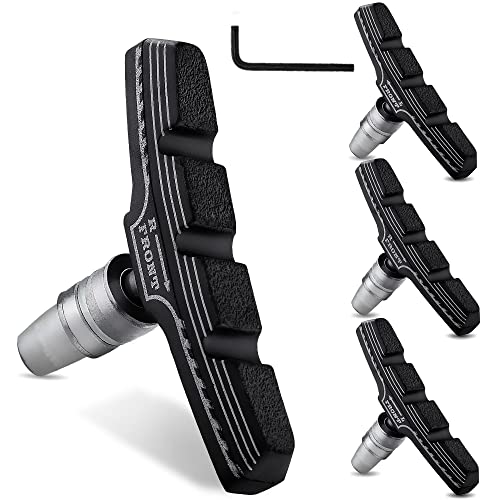


These picks include Kool-Stop’s well-known dual-compound V-brake pads, budget V-brake and disc pad sets, and semi-metallic disc pads from Corki Cycles. Check each listing’s compatibility list against your brake model before ordering. For brake-specific advice, see our guides to pads for Shimano Deore, Shimano XT, SRAM Guide RSC and SRAM Code R.
Bedding in new disc pads
- Ride at moderate speed and brake firmly down to walking pace, 10–20 times.
- Then do a few harder stops from higher speed.
- Don’t lock the wheel or drag the brakes on a long descent while bedding in.
Frequently asked questions
How do I know when brake pads are worn?
Disc pads: replace when the friction material is about 1 mm thick. V-brake pads: replace when the grooves are worn away.
Can I mix organic and sintered pads?
Yes, between front and rear. Use the same compound on both sides of one caliper.
Why do sintered pads squeal?
They can be noisier, especially in the wet. Proper bedding in, clean rotors and correct alignment help.
Keep reading
- Brake Pads for Shimano Deore
- Brake Pads for Shimano XT
- Brake Pads for SRAM Guide RSC
- Brake Pads for SRAM Code R
- Best Hydraulic Disc Brakes

Hi, I am Emam Hasan — founder and editor of BrokeMountain. I oversee this blog’s hiking, camping and outdoor gear guides, making sure every article is well-researched, accurate and genuinely helpful for your time on the trail. Enjoy it!


