Quick answer: the best sleeping bag liners for 2026 are the Sea to Summit Reactor for three-season warmth, the Sea to Summit Reactor Fleece or Snugpak Fleece liner for cold trips, and a silk liner such as the Cocoon Silk MummyLiner for light weight and travel. The Decathlon polyester liner is the cheapest good option at about $13, and a cotton liner suits hostels, huts and summer camping. Expect a liner to add a few degrees of warmth, and treat bigger claims with care.
BrokeMountain is reader-supported. We may earn a commission when you buy through links on this page, at no extra cost to you. Learn more.
How we put this together: we haven’t tested these products in person. We compared manufacturer specifications with results from independent testers and we link each source. Prices and versions change, so where we could not confirm a figure we say “check listing”.
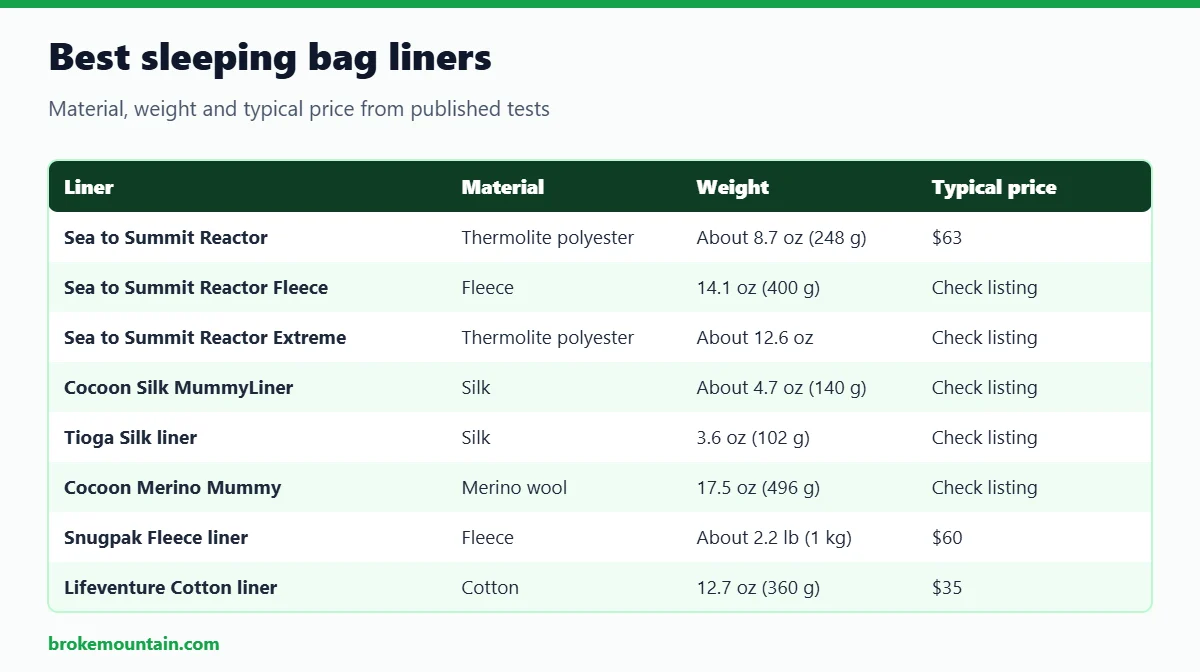
Best sleeping bag liners at a glance
| Liner | Material | Weight | Typical price | Best for |
|---|---|---|---|---|
| Sea to Summit Reactor | Thermolite polyester | About 8.7 oz (248 g) | $63 | Best overall |
| Sea to Summit Reactor Fleece | Fleece | 14.1 oz (400 g) | Check listing | Warmth on cold trips |
| Sea to Summit Reactor Extreme | Thermolite polyester | About 12.6 oz | Check listing | Warmest synthetic |
| Cocoon Silk MummyLiner | Silk | About 4.7 oz (140 g) | Check listing | Travel and light packs |
| Tioga Silk liner | Silk | 3.6 oz (102 g) | Check listing | Ultralight |
| Cocoon Merino Mummy | Merino wool | 17.5 oz (496 g) | Check listing | Odour control |
| Snugpak Fleece liner | Fleece | About 2.2 lb (1 kg) | $60 | Car camping in winter |
| Lifeventure Cotton liner | Cotton | 12.7 oz (360 g) | $35 | Hostels and huts |
| Decathlon polyester liner | Polyester | 9.2 oz (260 g) | $12.99 | Lowest price |
Figures come from Advnture’s liner tests and BikeHikeSafari’s liner guide. Sea to Summit sells several Reactor versions and the names have changed over the years, so check the weight and fabric on the listing.
What does a sleeping bag liner do?
- Keeps the bag clean. The liner takes the sweat, sunscreen and dirt, and it goes in the washing machine. A down bag is slow and risky to wash, so this is the main benefit.
- Adds some warmth. How much depends on the material.
- Feels better against skin than a nylon bag lining.
- Works alone on hot nights, in huts and in hostels.
How much warmth does a liner really add?
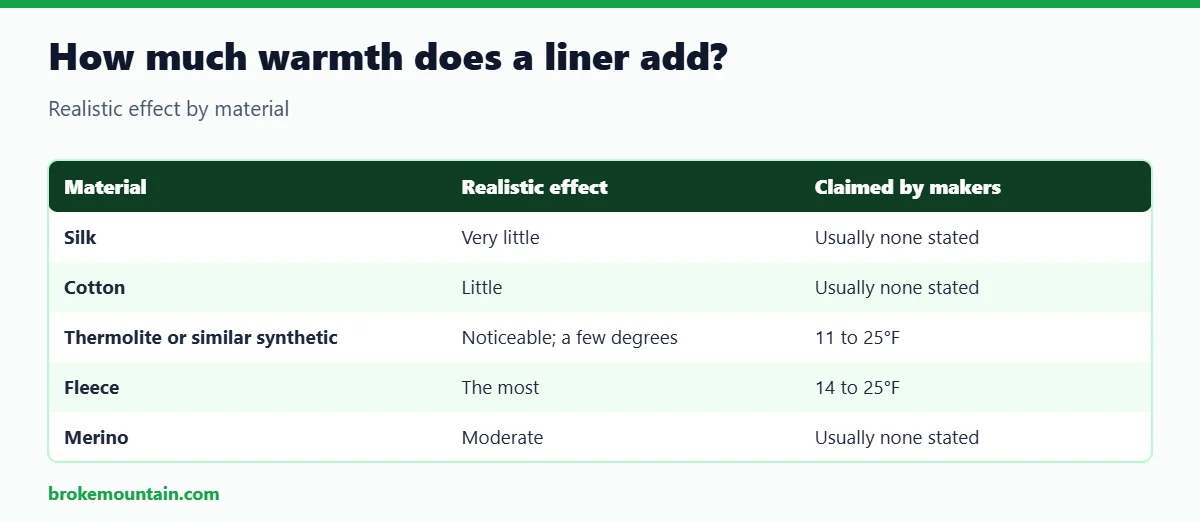
Less than most labels suggest. BikeHikeSafari calls manufacturers’ figures best-case numbers, with real results depending on your bag, the fit and your own metabolism. Advnture also warns that brands often overstate the effect, and says fleece and Thermolite give more noticeable warmth than silk.
| Material | Realistic effect | Claimed by makers |
|---|---|---|
| Silk | Very little | Usually none stated |
| Cotton | Little | Usually none stated |
| Thermolite or similar synthetic | Noticeable; a few degrees | 11 to 25°F |
| Fleece | The most | 14 to 25°F |
| Merino | Moderate | Usually none stated |
A liner is a good way to stretch a bag a little into the shoulder season. It will not turn a summer bag into a winter one. If you are regularly cold, a warmer bag or a better-insulated pad will do more; see our backpacking sleeping bags and ultralight sleeping pads.
1. Sea to Summit Reactor: best overall
Advnture’s best overall liner at $63 and 248 g, praised for reliable added warmth and marked down only for being too warm in summer. BikeHikeSafari’s top pick is the Reactor Midweight, at 12.2 oz with a claimed 11°F gain, which the reviewer uses as a three-season liner on long hikes. It breathes and wicks sweat. It is heavier and bulkier than a silk liner.
- Good: real warmth for the weight; stretchy; quick to dry.
- Less good: too warm for hot nights; not the smallest in a pack.
- Best for: three-season backpacking with a bag that is slightly too light.
Check the Sea to Summit Reactor on Amazon
2. Sea to Summit Reactor Fleece: warmth on cold trips
BikeHikeSafari’s warmest liner overall: 14.1 oz of stretchy fleece with a claimed gain of up to 14°F. It is comfortable and bulky. Carry it when warmth matters more than pack space.
3. Sea to Summit Reactor Extreme: warmest synthetic
A thicker Thermolite liner, listed at about 12.6 oz. Sea to Summit’s claim for it is up to 25°F (15°C), the highest of any liner here. Treat that as a best case.
Check the Sea to Summit Reactor Extreme on Amazon
4. Cocoon Silk MummyLiner: travel and light packs
BikeHikeSafari’s best travel silk liner at about 4.7 oz. Silk is light, packs to the size of a fist and feels cool in the heat. It adds almost no warmth and is often out of stock.
Check the Cocoon Silk MummyLiner on Amazon
5. Tioga Silk liner: ultralight
BikeHikeSafari’s best ultralight silk liner at 3.6 oz. It gives only marginal warmth and is machine-washable with care. Choose it to protect a down bag on summer trips.
6. Cocoon Merino Mummy: odour control
BikeHikeSafari’s best merino liner. Wool resists body odour over several nights and feels comfortable across a range of temperatures. At 17.5 oz it is heavy and it is not cheap, so it suits hut trips and shorter walks.
7. Snugpak Fleece liner: car camping in winter
Advnture’s best liner for warmth at $60. It weighs about 1 kg, far more than the others tested, so it stays in the car. In a roomy rectangular bag it makes a clear difference.
8. Lifeventure Cotton liner: hostels and huts
Advnture’s most versatile liner at $35 and 360 g, with an odour-control treatment and two shapes. Cotton feels like a bed sheet. It is not light, and it is slow to dry.
9. Decathlon polyester liner: lowest price
Advnture’s best value at $12.99 and 260 g. It gives a fair amount of insulation for the price. It does not breathe well, so it can feel clammy on warm nights.
Which of the best sleeping bag liners suits your trip?
| Trip | Sensible choice |
|---|---|
| Summer backpacking with a down bag | Silk liner |
| Three-season backpacking, bag slightly too cold | Sea to Summit Reactor |
| Winter or cold shoulder season | Reactor Fleece or Reactor Extreme |
| Huts, hostels and travel | Silk or cotton liner |
| Several nights without washing | Merino liner |
| Car camping in the cold | Snugpak Fleece liner |
| Tight budget | Decathlon polyester liner |
How to choose from the best sleeping bag liners
Material
| Material | Good | Less good |
|---|---|---|
| Silk | Lightest; small; cool in heat | Little warmth; delicate; price |
| Cotton | Soft; cheap; easy to wash | Heavy; slow to dry; cold when damp |
| Polyester | Cheap; dries fast | Can feel clammy |
| Thermolite-type synthetic | Good warmth for weight; wicks | Bulkier than silk |
| Fleece | Warmest | Heavy and bulky |
| Merino | Resists odour; comfortable | Heavy; expensive |
Shape
Match the liner to the bag. Advnture notes that mummy liners are usually warmer and restrict movement, while rectangular liners give room and trap less heat. A rectangular liner bunches up inside a mummy bag.
Features
- Hood and drawcord: BikeHikeSafari recommends these for cold sleepers, because heat escapes at the head and shoulders.
- Stretch panels: make it easier to turn over.
- Side opening or zip: easier to get in and out.
- Pillow pocket: useful in hostels.
- Insect treatment: some travel liners have it.
- Length: check it against your height.
Weight and pack size
BikeHikeSafari’s advice is to decide the season first, since the material matters more than the claimed number. Silk liners weigh about 100 to 140 g. Synthetic warm liners weigh 250 to 400 g. Thick fleece can reach 1 kg.

How to use a liner without getting tangled
- Put the liner inside the bag before you get in, then climb into both.
- Tie or clip the liner’s foot to the loops inside your bag if it has them.
- Turn with the liner, not inside it.
- A stretchy liner twists less than a woven one.
- On warm nights, sleep in the liner on top of the bag.
Washing and care
- Wash after every trip. That is the point of it.
- Use a gentle cycle and no fabric conditioner, as Advnture advises, then air-dry.
- Hand-wash silk or use a mesh laundry bag.
- Store it dry and loose.
Liner or warmer clothes?
Dry base layers, socks and a hat add warmth too, and you can wear them around camp. A liner keeps the bag cleaner and adds an even layer with no gaps. Many hikers use both. For clothing, see what to wear when hiking. General advice on planning nights outdoors is on the National Park Service camping pages.
Common mistakes
- Believing the biggest number on the pack. Plan on a few degrees.
- Buying fleece for backpacking. It can take as much room as the sleeping bag.
- Putting a rectangular liner in a mummy bag.
- Choosing cotton for wet or cold trips.
- Using a liner to fix a cold pad. Cold from below needs more insulation under you.
Liners for travel, huts and hostels
Many mountain huts and hostels supply blankets and ask guests to bring a sheet liner. For this use:
- Silk is the lightest and packs smallest, which suits long trips.
- Cotton feels most like a bed sheet and costs least.
- A rectangular shape is more comfortable in a bed than a mummy shape.
- A pillow pocket keeps a borrowed pillow covered.
- A treated travel liner can help in places with biting insects.
Check what the hut or hostel requires before you go, since some specify a sheet sleeping bag.
Do liners work with quilts?
Yes, with limits. A liner under a quilt adds a layer between you and the pad and keeps the quilt cleaner. It does little for draughts at the edges, which are the main cause of cold spots with a quilt. A mummy liner with a hood helps most, because a quilt has no hood of its own.
What a liner weighs against what it saves
| Choice | Extra weight | What you gain |
|---|---|---|
| Silk liner | About 4 oz | Clean bag; cooler skin feel |
| Thermal synthetic liner | 9 to 13 oz | A few degrees; clean bag |
| Fleece liner | 14 oz to 2 lb | The most warmth; bulk |
| Moving to a warmer down bag | Often 4 to 8 oz more than your current bag | More warmth for less weight than a fleece liner |
If you already own the bag, a liner is the cheap way to extend it. If you are buying new, put the money into the right bag first.
Frequently asked questions
Do sleeping bag liners really add warmth?
Fleece and thermal synthetic liners add a noticeable amount. Silk and cotton add very little.
What is the warmest sleeping bag liner?
Fleece and thick Thermolite liners, such as the Sea to Summit Reactor Fleece and Reactor Extreme.
Is a silk liner worth it?
Yes, to keep a bag clean on warm trips and for travel, at about 4 oz.
Can I use a liner on its own?
Yes, on hot nights and indoors in huts and hostels.
Do I need a liner with a down sleeping bag?
It is strongly worth having. It cuts how often you need to wash the bag, which helps the down last.
How often should I wash a liner?
After each trip, or every few nights on a long one.
Last checked: November 2026. Prices, specifications and availability change, so confirm details on the maker’s or retailer’s page before you buy.

Hi, I am Emam Hasan — founder and editor of BrokeMountain. I oversee this blog’s hiking, camping and outdoor gear guides, making sure every article is well-researched, accurate and genuinely helpful for your time on the trail. Enjoy it!