
Quick answer: before buying a suspension fork, match five things to your bike: wheel size, steerer tube (straight 1 1/8″ or tapered), axle standard (quick release, 15×100 or Boost 15×110), brake mount and travel (keep within about 10–20 mm of the original). Air forks are lighter and adjustable for your weight; coil forks are simpler and cheaper. Budget forks like the ones below can be a big upgrade on an entry-level bike, while trail riders should look at RockShox, Fox, Marzocchi, Manitou or SR Suntour’s higher-end forks.
BrokeMountain is reader-supported. We may earn a commission when you buy through links on this page, at no extra cost to you. Learn more.
Compatibility checklist
| Spec | Options | How to check |
|---|---|---|
| Wheel size | 26, 27.5, 29 in | Tyre sidewall |
| Steerer | Straight 1 1/8″ or tapered 1 1/8″–1.5″ | Head tube size or frame spec |
| Steerer length | Must be cut to fit | Measure old steerer |
| Axle | QR 9 mm, 15×100, 15×110 Boost | Front hub and old fork |
| Brake | Post mount, max rotor size | Fork spec |
| Travel | Within ~20 mm of original | Frame maker’s maximum |
Fitting a fork with much longer travel than the frame was designed for changes the geometry and may void the frame warranty or overload the head tube.
Air vs coil
| Air spring | Coil spring | |
|---|---|---|
| Weight | Lighter | Heavier |
| Adjustment | Set pressure to your weight | Change spring to adjust |
| Feel | Progressive, supportive | Very smooth, consistent |
| Price | Usually more | Usually less |
Damping and adjustments
- Lockout: stiffens the fork for road climbs.
- Rebound: controls how fast the fork returns; essential for control.
- Compression: controls how easily the fork moves into its travel.
- Forks with only preload adjustment and no proper damping feel bouncy on trails.
Our picks
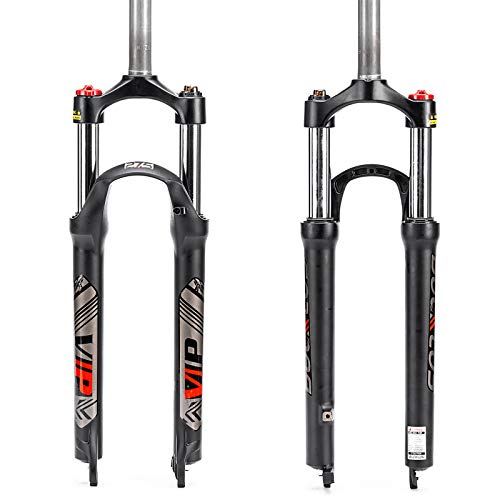


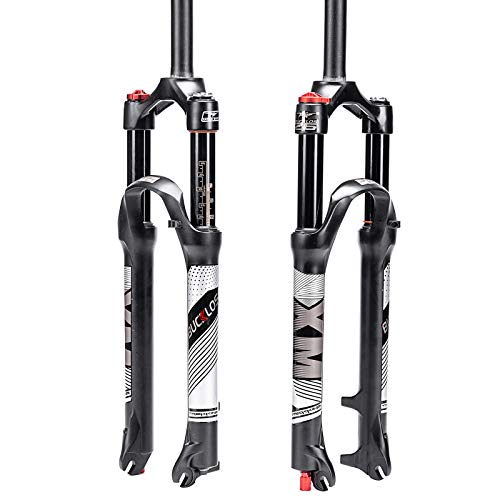
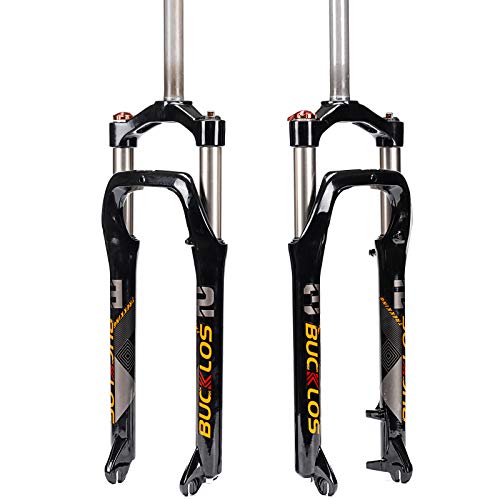


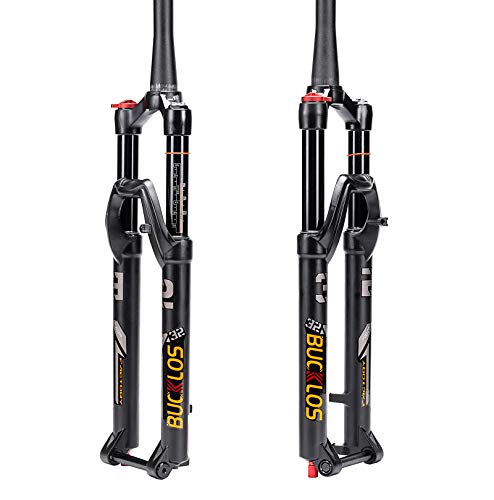
These are budget air and coil forks that suit riders upgrading an entry-level bike or replacing a worn fork. They usually offer lockout and some rebound adjustment at a low price, though their damping and durability are basic compared with forks from RockShox, Fox, Marzocchi and Manitou. Check the steerer type, axle and travel carefully before ordering.
Fitting tips
- Cut the steerer to length with a guide, leaving room for spacers.
- Install the crown race and star nut (or expansion plug) correctly.
- Set air pressure for 20–25% sag.
- Set rebound so the fork returns quickly but doesn’t kick back.
- If you’re unsure, have a bike shop fit the fork.
Frequently asked questions
Are cheap air forks worth it?
They can be a big upgrade over basic coil forks on department-store bikes, but quality varies. Choose sellers with good reviews and warranty support.
Can I put a 29-inch fork on a 27.5 bike?
Sometimes, with a 27.5 front wheel, but it changes geometry. Stick to the size your frame was designed for.
How often should a fork be serviced?
A lower-leg service every 50 hours of riding and a full service every 100–200 hours is typical.
Keep reading

Hi, I am Emam Hasan — founder and editor of BrokeMountain. I oversee this blog’s hiking, camping and outdoor gear guides, making sure every article is well-researched, accurate and genuinely helpful for your time on the trail. Enjoy it!


