Quick answer: the best tent footprints and ground tarps depend on how you camp. For backpacking, a sheet of Tyvek is the most durable light option at about 3 to 4 oz for a two-person tent, and polycryo is the lightest at 1 to 2 oz. A fitted footprint from your tent’s maker is the easiest to use and costs $40 to $100. For car camping, a universal polyester footprint or a cheap poly tarp folded to size does the job. Whatever you choose, it must be slightly smaller than the tent floor.
BrokeMountain is reader-supported. We may earn a commission when you buy through links on this page, at no extra cost to you. Learn more.
How we put this together: we haven’t tested these footprints in person. We compared manufacturer specifications with guidance from independent outdoor publications and we link each source. Footprint weights and prices depend on the tent model, so check the listing for yours.
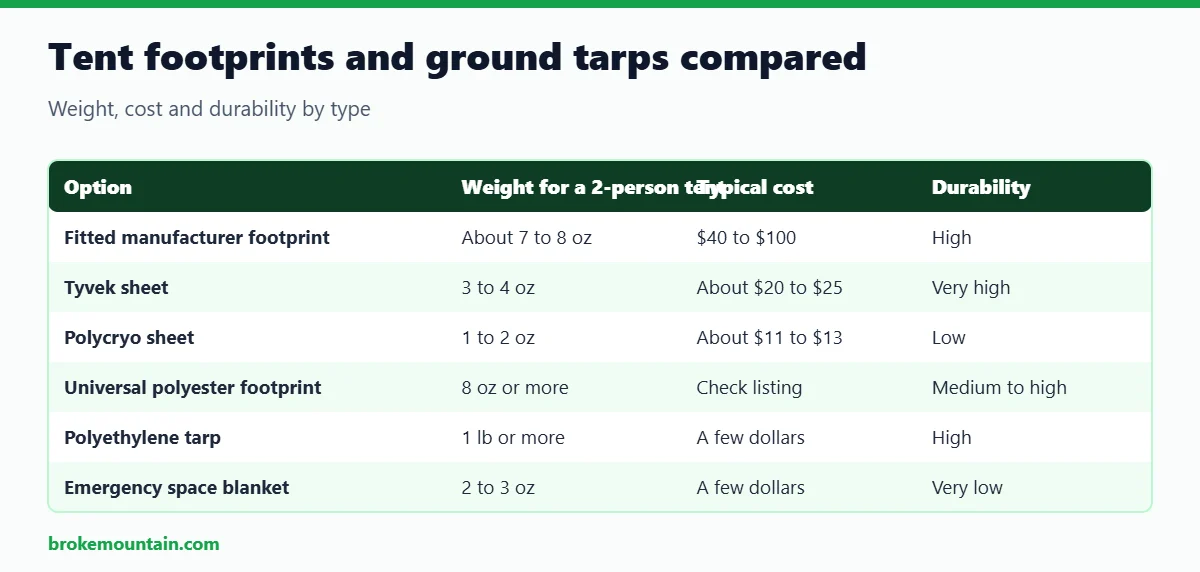
Best tent footprints and ground tarps at a glance
| Option | Weight for a 2-person tent | Typical cost | Durability | Best for |
|---|---|---|---|---|
| Fitted manufacturer footprint | About 7 to 8 oz | $40 to $100 | High | Convenience and exact fit |
| Tyvek sheet | 3 to 4 oz | About $20 to $25 | Very high | Regular backpacking |
| Polycryo sheet | 1 to 2 oz | About $11 to $13 | Low | Ultralight trips |
| Universal polyester footprint | 8 oz or more | Check listing | Medium to high | Budget; any tent |
| Polyethylene tarp | 1 lb or more | A few dollars | High | Car camping |
| Emergency space blanket | 2 to 3 oz | A few dollars | Very low | Occasional use |
Figures come from CleverHiker’s footprint guide, Switchback Travel and Garage Grown Gear’s Tyvek and polycryo comparison.
What a footprint does, and what it does not
A footprint is a sheet that goes between the tent floor and the ground.
- It takes the abrasion from grit, roots and stones.
- It keeps mud and tree sap off the floor, so the tent packs away cleaner.
- It gives you a clean surface for packing up.
CleverHiker makes one point clearly: a footprint does not add waterproofing, because modern tent floors are already waterproof. Its job is protection.
Do you need one?
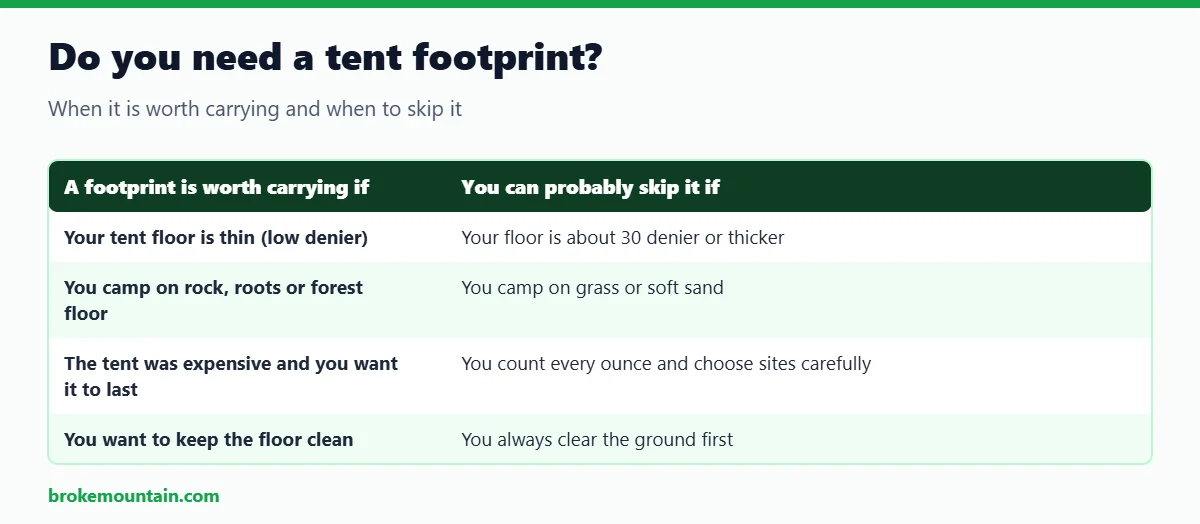
Switchback Travel’s verdict is that there is no single answer. CleverHiker’s guidance splits it this way:
| A footprint is worth carrying if | You can probably skip it if |
|---|---|
| Your tent floor is thin (low denier) | Your floor is about 30 denier or thicker |
| You camp on rock, roots or forest floor | You camp on grass or soft sand |
| The tent was expensive and you want it to last | You count every ounce and choose sites carefully |
| You want to keep the floor clean | You always clear the ground first |
Denier is the thickness of the thread in the fabric. Higher numbers are tougher. Switchback Travel gives two examples: the Big Agnes Tiger Wall has a 15D floor and the Marmot Tungsten a 68D floor. The first benefits from a footprint far more than the second. CleverHiker also notes the weight cost: in its example a footprint added more than 15% to the weight of a shelter.
1. Fitted manufacturer footprint: convenience and exact fit
Made by the tent brand for one tent model. Switchback Travel lists the advantages: a close fit that stops water pooling, grommets that clip to the tent poles, and thicker, longer-lasting fabric. Many let you pitch the fly alone on the footprint for a light shelter.
- Good: right size; quick to attach; durable.
- Less good: $60 to $100 is typical; heavy. Switchback’s example is the NEMO Dragonfly Osmo 2P footprint at 7.8 oz and $90, and CleverHiker’s is the NEMO Hornet 2P footprint at 6.9 oz.
- Best for: people who want no cutting and no guesswork.
Greenbelly advises buying the fitted footprint at the same time as the tent, since tent models change slightly from year to year.
2. Tyvek: regular backpacking
Tyvek is the white house wrap used on building sites. CleverHiker describes it as virtually indestructible. Switchback Travel gives its weight as 0.14 oz per square foot, or 3 to 4 oz for an average two-person tent, and the cost as about $20 to $25 for a 3 by 7 foot piece. Ready-cut sheets are sold by small ultralight brands.
- Good: tough; waterproof; cheap; doubles as a sit mat.
- Less good: stiff and noisy when new; bulkier than polycryo.
- Best for: most backpackers. Garage Grown Gear’s reviewer prefers it to polycryo for ease of use.
Tip: put new Tyvek through a cold wash with no detergent to soften it.
Check Tyvek ground sheets on Amazon
3. Polycryo: ultralight trips
Polycryo is the clear plastic film sold for insulating windows. CleverHiker lists it at 0.55 oz per square yard, against 1.85 for Tyvek. A sheet for a small tent weighs 1 to 2 oz and packs to the size of a handkerchief.
- Good: lightest option; cheap; waterproof.
- Less good: CleverHiker rates it far less durable than Tyvek; it blows about in wind and is fiddly to lay out.
- Best for: ultralight hikers and short trips on chosen ground.
Check polycryo ground sheets on Amazon
4. Universal polyester footprint: budget for any tent
Brands such as Clostnature sell coated polyester sheets with corner loops in standard sizes. They cost less than fitted footprints and work under many tents. Pick the size just under your floor dimensions, or fold the excess under.
Check universal tent footprints on Amazon
5. Polyethylene tarp: car camping
The blue or green hardware-store tarp. It is heavy, bulky, tough and very cheap. Fold it so no edge sticks out past the tent. It also works as a clean surface for sorting gear or as a picnic sheet.
6. Emergency space blanket: occasional use
Outdoor Life notes that a space blanket is waterproof and gives some protection, though it is not durable. It can serve for a night or two if you already carry one.
Which of the best tent footprints and ground tarps suits you?
| You are | Sensible choice |
|---|---|
| Backpacking often | Tyvek |
| Going ultralight | Polycryo |
| Wanting the simplest setup | Fitted manufacturer footprint |
| Car camping | Universal footprint or poly tarp |
| Using a thin-floored ultralight tent on rough ground | Tyvek or fitted footprint |
| Using a thick-floored budget tent on grass | No footprint needed |
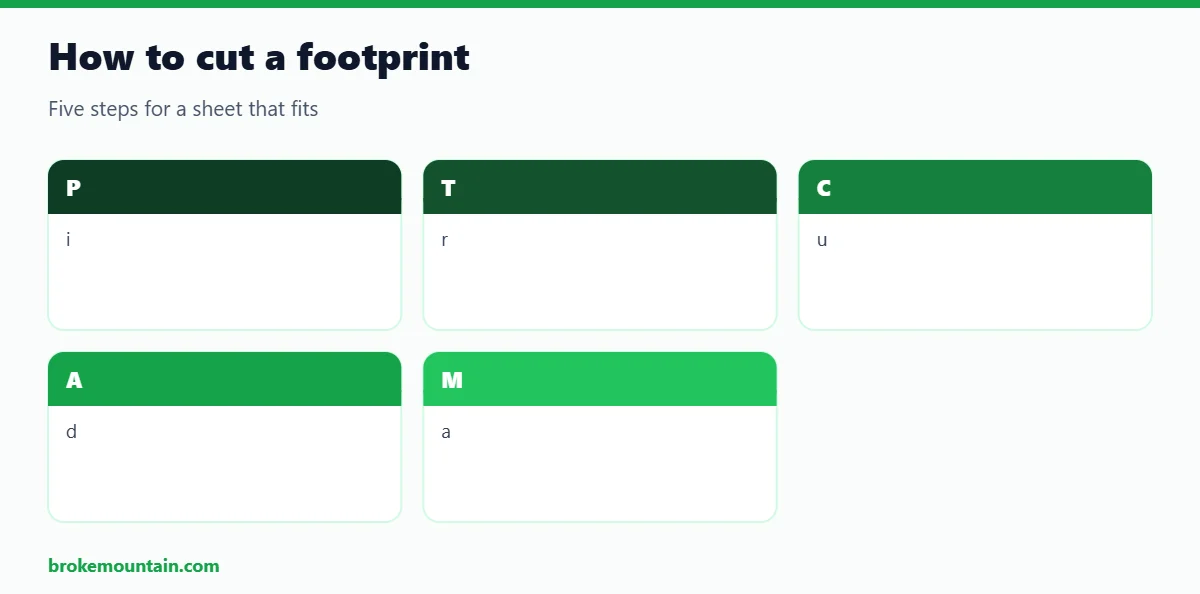
How to size and cut tent footprints and ground tarps
- Pitch the tent or lay the inner flat on the sheet.
- Trace the floor outline with a marker.
- Cut about one inch inside the line all round, as CleverHiker advises.
- Add small tape loops at the corners if you want to stake it.
- Mark which side faces up, so the dirty side stays down.
Size is the one rule that matters. Both CleverHiker and Switchback Travel warn that any material sticking out from under the tent catches rain and channels it under the floor. Outdoor Life gives the same advice: fit it closely to the shape of the tent.
Using a footprint well
- Clear sticks, cones and stones first, with or without a footprint.
- Lay it flat, then pitch the tent on top.
- Check the edges after the fly is on, and tuck in anything showing.
- On sloping ground, put the footprint slightly uphill so water runs past.
- Shake it off and fold it dirty side in when you pack.
- Patch small holes in the tent floor with repair tape. CleverHiker recommends Tenacious Tape.
Footprints under tarps and floorless shelters
With a tarp or floorless shelter, the groundsheet is your floor. Tyvek and polycryo are the standard choices here, cut a little larger than your sleeping pad. For more on tarps, see lightweight backpacking tents and our guide to budget backpacking tents.
Care
- Rinse off mud and dry the sheet before storing it.
- Store it folded loosely with the tent.
- Replace polycryo when it tears along the folds.
- Tyvek lasts for years. Wash it when it gets grimy.
Related gear
A footprint protects the floor. The rest of the shelter matters more; see 2 person backpacking tents and 2 person tents under $200. Pad choice affects warmth far more than any groundsheet; see ultralight sleeping pads.
Common mistakes
- Cutting it the same size as the floor or larger. Water pools on it.
- Assuming it fixes a leaking floor. Re-coat or replace the floor instead.
- Carrying a 1 lb tarp backpacking. Tyvek does the job at a quarter of the weight.
- Leaving it behind on rocky sites with a 15D floor.
- Packing it wet against the tent.
Cost and weight over a season
| Choice | Cost | Added weight | Likely lifespan |
|---|---|---|---|
| No footprint | Nothing | None | The floor wears faster on rough ground |
| Polycryo | About $12 | 1 to 2 oz | About a season of regular use |
| Tyvek | About $20 to $25 | 3 to 4 oz | Several years |
| Fitted footprint | $40 to $100 | 7 to 8 oz | Several years |
A replacement tent floor is rarely sold on its own, so a worn floor usually means a new tent or a repair. For a $400 ultralight tent with a 15D floor, a $20 sheet of Tyvek is cheap protection. For a $130 tent with a thick floor, a footprint matters less.
Footprints for car camping tents
Large family tents have tough floors, and the main reasons to put something underneath are cleanliness and comfort when packing up.
- A poly tarp folded to just inside the floor outline works well.
- On gravel pads, a footprint also protects against sharp stones.
- A doormat or a second small sheet at the entrance keeps grit out of the tent.
- Dry and brush the sheet before it goes back in the car.
Fast-fly pitching with a fitted footprint
Many fitted footprints have grommets that take the pole tips, so you can leave the inner tent at home and pitch only the poles, footprint and rainfly. This saves weight on trips without insects. It is also useful in rain: pitch the fly first, then clip the inner up underneath so it stays dry. Check your tent’s instructions, since not every model supports it.
Frequently asked questions
Is a tent footprint worth it?
For thin-floored tents and rough ground, yes. For thick floors on grass, it is optional.
What can I use instead of a tent footprint?
Tyvek, polycryo window film, a poly tarp or a universal footprint.
Should a footprint be bigger than the tent?
No. Cut it about an inch smaller on every side.
Does a footprint keep the tent warmer?
Not noticeably. Insulation comes from your sleeping pad.
Does a footprint stop water coming through the floor?
It does not add waterproofing. Tent floors are already waterproof.
Tyvek or polycryo?
Tyvek for durability and ease of use. Polycryo for the lowest weight.
Last checked: November 2026. Prices, specifications and availability change, so confirm details on the maker’s or retailer’s page before you buy.

Hi, I am Emam Hasan — founder and editor of BrokeMountain. I oversee this blog’s hiking, camping and outdoor gear guides, making sure every article is well-researched, accurate and genuinely helpful for your time on the trail. Enjoy it!