Quick answer: the best power banks for camping and backpacking in 2026 are the Nitecore NB10000 Gen4 for most backpackers, at about 5 oz for 10,000 mAh, and the Nitecore NB Air for ultralight overnight trips. The Nitecore NB20000 Gen 3 suits week-long hikes. The INIU 10,000 and 20,000 mAh banks are the low-cost picks, the NESTOUT 15000 is the rugged choice and the Anker 737 or UGREEN 145W will charge a laptop at a campsite. A 10,000 mAh bank gives about two phone charges.
BrokeMountain is reader-supported. We may earn a commission when you buy through links on this page, at no extra cost to you. Learn more.
How we put this together: we haven’t tested these power banks in person. We compared manufacturer specifications with results from independent testers who measure capacity and weight, and we link each source. Prices and versions change often, so check the listing before you buy.
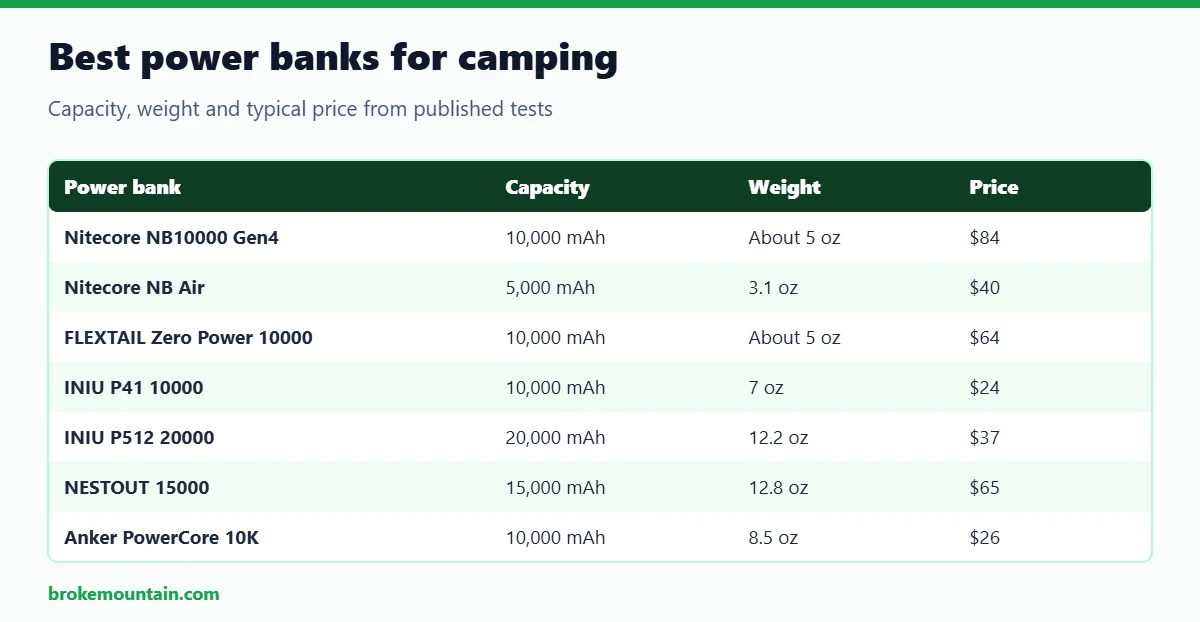
Best power banks for camping at a glance
| Power bank | Capacity | Weight | Typical price | Best for |
|---|---|---|---|---|
| Nitecore NB10000 Gen4 | 10,000 mAh | About 5 oz | $84 | Best overall for backpacking |
| Nitecore NB Air | 5,000 mAh | 3.1 oz | $40 | Overnight and ultralight |
| FLEXTAIL Zero Power 10000 | 10,000 mAh | About 5 oz | $64 | Slim, light alternative |
| Nitecore NB20000 Gen 3 | 20,000 mAh | 10.2 oz | Check listing | Week-long trips |
| INIU P41 10000 | 10,000 mAh | 7 oz | $24 | Budget, three ports |
| INIU P512 20000 | 20,000 mAh | 12.2 oz | $37 | Budget 20,000 mAh |
| NESTOUT 15000 | 15,000 mAh | 12.8 oz | $65 | Rough use and cold |
| Anker PowerCore 10K | 10,000 mAh | 8.5 oz | $26 | Simple and dependable |
| Anker 737 | 24,000 mAh | 1 lb 5.4 oz | Check listing | Laptops at the campsite |
How much capacity do you need?
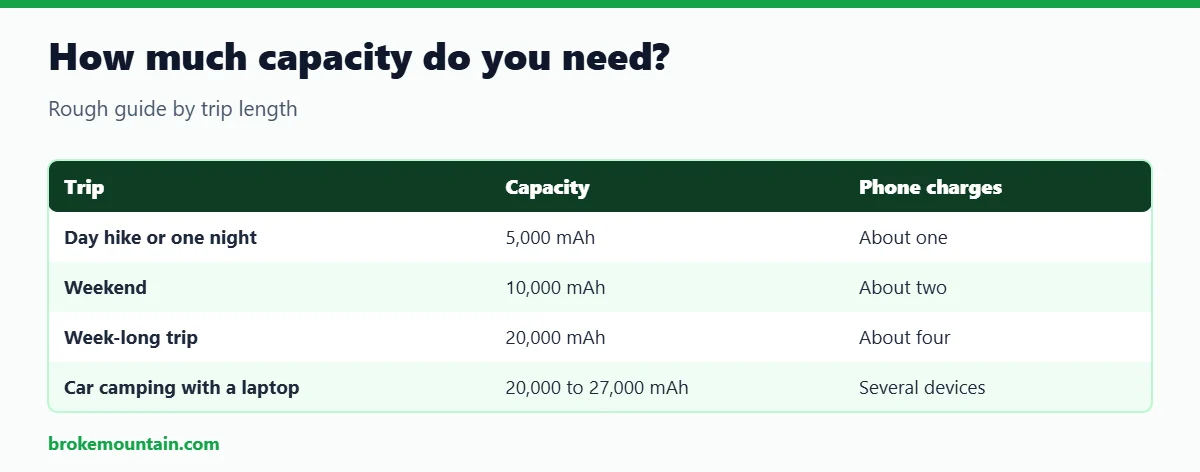
Start from how many phone charges you need, then add your other devices.
| Trip | Suggested capacity | Roughly gives |
|---|---|---|
| Day hike or one night | 5,000 mAh | About one phone charge |
| Weekend, 2 to 3 days | 10,000 mAh | About two phone charges |
| Week-long trip | 20,000 mAh | About four phone charges |
| Car camping, several people or a laptop | 20,000 to 27,000 mAh, or a power station | Phones, lights and a laptop top-up |
Those charge counts come from CleverHiker’s power bank tests and BikeHikeSafari’s guide. You never get the full number printed on the case. Energy is lost converting the cell’s voltage to USB voltage, and as heat. BikeHikeSafari notes that the NB10000 Gen4 lists a rated output of 6,800 mAh from its 10,000 mAh cell. Plan on about two thirds of the label.
Add a margin if you also charge a headlamp, a watch or a satellite messenger. See our guides to headlamps for hiking and camping and satellite messengers for hiking.
1. Nitecore NB10000 Gen4: best overall for backpacking
CleverHiker names it the best power bank overall, rating it 4.8 out of 5 at $84 and 5.2 oz, and reports that it delivered the most watt-hours per gram in its test. BikeHikeSafari also ranks it first, listing 143 g, two USB-C ports, an IPX7 water rating and 22.5 W input.
- Good: very light for 10,000 mAh; efficient; recharges in about three hours; two USB-C ports allow pass-through charging.
- Less good: the most expensive 10,000 mAh bank here; no USB-A port; loses capacity in the cold in CleverHiker’s test.
- Best for: weekend and multi-day backpacking where weight matters.
Check the Nitecore NB10000 on Amazon
2. Nitecore NB Air: overnight and ultralight
CleverHiker’s best 5,000 mAh bank, rated 4.7, at $40 and 3.1 oz. It measured about 16 watt-hours of usable capacity and was the fastest in the test to recharge, at 1 hour 38 minutes. BikeHikeSafari notes an IPX7 rating and a low-current mode for watches and earbuds. It has one port, so you cannot charge it and a phone at the same time.
Check the Nitecore NB Air on Amazon
3. FLEXTAIL Zero Power 10000: slim, light alternative
CleverHiker’s best ultralight pick, rated 4.6 at $64 and 5 oz, close to the Nitecore for capacity per gram and with a built-in cord. BikeHikeSafari lists the 10000C version at 9.9 mm thick with an IPX4 splash rating. CleverHiker found its charge indicator hard to read.
4. Nitecore NB20000 Gen 3: week-long trips
BikeHikeSafari’s pick for thru-hiking: 20,000 mAh at 10.2 oz, with two USB-C ports and one USB-A, about four phone charges and pass-through charging. It is rated IPX5 and takes about 4.5 to 5 hours to recharge, which matters on a short town stop.
Check the Nitecore NB20000 on Amazon
5. INIU P41 10000: budget with three ports
CleverHiker rates it 4.3 at $24 and 7 oz. It has two USB-A ports and one USB-C, charges up to three devices, has a clear charge indicator and a small flashlight. It is 2 oz heavier than the Nitecore, and the tester found the flashlight can switch on by accident in a pack.
Check INIU 10,000 mAh power banks on Amazon
6. INIU P512 20000: budget 20,000 mAh
CleverHiker’s best 20,000 mAh bank at $37 and 12.2 oz, with about 71 watt-hours of usable capacity measured and a large display. It is bulky and lost efficiency in the cold test. For family car camping it is good value.
7. NESTOUT 15000: rough use and cold
CleverHiker’s most durable pick, at $65 and 12.8 oz, with IP6X dust and IPX7 water ratings, two USB-A ports and one USB-C. It lost only about 1% in the cold test. It is heavy and less efficient for its size, so it suits canoe trips, winter camping and car camping more than long hikes.
8. Anker PowerCore 10K: simple and dependable
CleverHiker describes it as incredibly reliable, at $26 and 8.5 oz, with a trickle mode for small devices. It is the heaviest 10,000 mAh bank in that test and has no pass-through charging. It remains a sound choice for camping where an extra 3 oz does not matter.
Check the Anker PowerCore 10K on Amazon
9. Anker 737 and UGREEN 145W: laptops at the campsite
BikeHikeSafari lists the Anker 737 at 24,000 mAh and 1 lb 5.4 oz with 140 W output, enough to charge a laptop, and notes it stays under the 100 Wh airline limit. CleverHiker’s pick for large devices is the UGREEN 145W: 25,000 mAh, 1 lb 1.8 oz and $110. Both are too heavy for backpacking. For more power than this, see portable power stations for camping.
Which power bank for which trip?
| You are | Sensible choice |
|---|---|
| Backpacking for a weekend | Nitecore NB10000 Gen4 or FLEXTAIL Zero Power |
| Out for one night, counting grams | Nitecore NB Air |
| Hiking for a week between towns | Nitecore NB20000 Gen 3 |
| On a tight budget | INIU P41 10000 or Anker PowerCore 10K |
| Car camping with family | INIU P512 20000 |
| Paddling or winter camping | NESTOUT 15000 |
| Working from camp with a laptop | Anker 737 or UGREEN 145W |
What to look for in the best power banks for camping
Capacity for weight
For backpacking this is the main measure. CleverHiker finds that many people settle in the 5 to 8 oz range. The lightest 10,000 mAh banks weigh about 5 oz and the cheapest weigh 7 to 8.5 oz.
Ports and charging speed
- USB-C Power Delivery: charges phones quickly and recharges the bank quickly.
- Two USB-C ports: BikeHikeSafari recommends this layout because it allows pass-through charging, where the wall charges the bank while the bank charges your phone.
- USB-A: still useful for older headlamps and watches.
- Input wattage: higher input means less time waiting at a cafe or campsite outlet.
- 100 W or more: needed only for laptops.
- Low-current mode: stops the bank shutting off when charging earbuds or a watch.
Water and dust ratings
| Rating | Meaning |
|---|---|
| None | Keep it in a dry bag |
| IPX4 | Splashes |
| IPX5 | Low-pressure water jets |
| IPX7 | Immersion to 1 m for 30 minutes |
| IPX8 | Continuous immersion |
| IP6X | Dust-tight |
Cold weather
Lithium cells give less in the cold. Most banks lost efficiency in CleverHiker’s fridge test. Keep the bank in an inside pocket by day and in your sleeping bag at night, and warm it before charging a phone.
Common mistakes when buying power banks for camping
- Buying on mAh alone. A heavy 20,000 mAh bank is wasted weight on a weekend hike. Match capacity to the trip.
- Expecting the full label capacity. Plan on about two thirds.
- Forgetting recharge time. A large bank with slow input can need a whole night on the wall.
- Bringing the wrong cables. Check every device, and carry one spare.
- Trusting a built-in solar panel. The small panels on solar banks add very little charge per day.
- Leaving it in the cold. A bank left in a freezing tent pocket delivers less in the morning.
- Taking an untested bank. Charge and drain a new bank once at home before a trip.
Flying with a power bank
The US Federal Aviation Administration requires power banks to travel in carry-on bags only, never in checked luggage. Batteries up to 100 Wh need no approval. With airline approval you may carry up to two between 101 and 160 Wh. Airlines can set stricter limits, so check yours.
To find watt-hours, multiply amp-hours by the cell voltage, usually 3.7 V. A 10,000 mAh bank is about 37 Wh. A 20,000 mAh bank is about 74 Wh. About 27,000 mAh reaches the 100 Wh limit.
How to make a power bank last longer on a trip
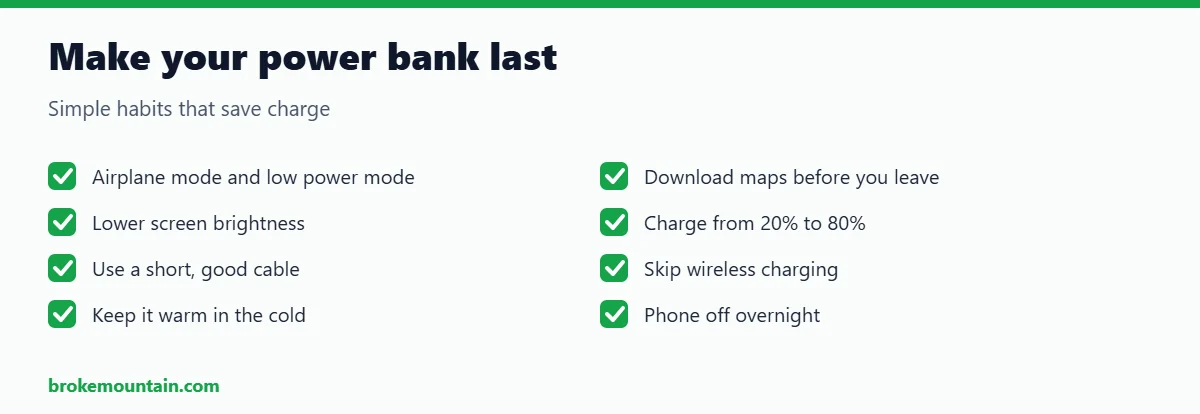
- Put your phone in airplane mode and low power mode.
- Download maps before you leave.
- Lower the screen brightness.
- Charge your phone from about 20% to 80%. The last 20% is the slowest and least efficient.
- Use a short, good-quality cable.
- Avoid wireless charging in the backcountry. BikeHikeSafari notes it loses more energy than a cable.
- Keep everything warm in cold weather.
- Turn the phone off overnight.
Power bank or solar panel?
For trips of up to a week, a power bank is lighter, cheaper and more dependable than a solar panel. Solar starts to make sense on longer trips in open, sunny country with no resupply, and it works best charging a power bank during the day, with the bank charging your devices at night. In forest or poor weather, carry a larger bank.
Safety and care
- Do not use a bank that is swollen, dented or has been soaked without a water rating.
- Do not leave it in a hot car or in direct sun.
- Store it at about half charge if unused for months.
- Recharge it at least every few months.
- Pack it where it will not be crushed, and cover the ports in sand or dust.
More packing help: what to bring when you go hiking and how to lighten your hiking pack.
Frequently asked questions
How many mAh do I need for a 3-day camping trip?
10,000 mAh covers one phone for a weekend with careful use. Take 20,000 mAh for two people or extra devices.
How many times will a 10,000 mAh power bank charge a phone?
About twice. Large phones and cold weather reduce that.
Can I take a 20,000 mAh power bank on a plane?
Yes, in carry-on only. It is about 74 Wh, under the 100 Wh limit. Check your airline’s own rules.
Are solar power banks worth it?
Banks with a small built-in panel charge very slowly. A separate folding panel with a normal power bank works better.
Can I charge a power bank and a phone at the same time?
Yes, if the bank supports pass-through charging. Banks with two USB-C ports usually do. Single-port banks do not.
How long does a power bank hold its charge?
Good banks lose only a little each month. Top yours up before each trip.
What is the lightest 10,000 mAh power bank?
In the tests cited here, the Nitecore NB10000 Gen4 and FLEXTAIL Zero Power 10000, at about 5 oz each.
Last checked: November 2026. Prices, versions and airline rules change, so confirm details on the maker’s, retailer’s or airline’s page.

Hi, I am Emam Hasan — founder and editor of BrokeMountain. I oversee this blog’s hiking, camping and outdoor gear guides, making sure every article is well-researched, accurate and genuinely helpful for your time on the trail. Enjoy it!