As an Amazon Associate, BrokeMountain earns from qualifying purchases. We did not test these units in person; this guide is based on maker specifications, independent test results and camper feedback.
A portable power station is a big rechargeable battery with wall-style AC outlets, USB ports and a 12V car socket. For camping, it means charged phones and cameras, lights, fans, a camp fridge or a CPAP machine without running a noisy gas generator or draining your car battery. Pair one with a solar panel and you can stay off-grid for days.
This guide compares the best portable power stations for camping, from small units for tent trips to 1,000Wh models that run a fridge, and shows how to work out what size you need.
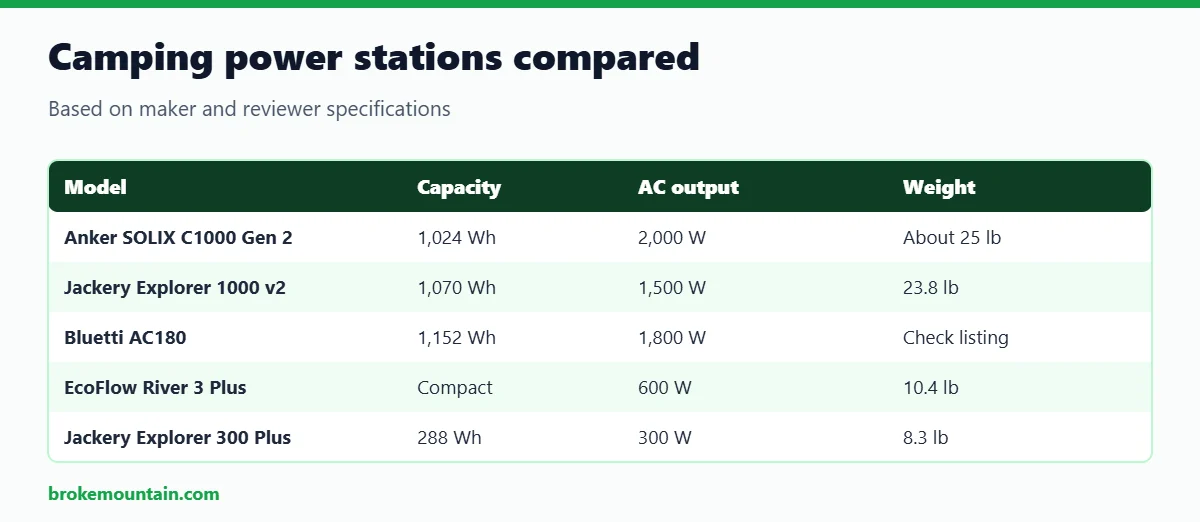
Quick Picks
- Best overall: Anker SOLIX C1000 Gen 2
- Best for family car camping: Jackery Explorer 1000 v2
- Best for CPAP users: Bluetti AC180
- Best compact and expandable: EcoFlow River 3 Plus
- Best ultralight for tent camping: Jackery Explorer 300 Plus
1. Anker SOLIX C1000 Gen 2
Best overall. The second-generation C1000 is one of the most recommended 1kWh-class power stations. Reviewers list a 1,024Wh LiFePO4 battery, 2,000W continuous AC output with a 3,000W peak, and a full recharge from the wall in about 49 minutes. That fast charging is a real advantage on car-camping trips where you might only have a short stop at a campsite with power. It weighs about 25 pounds and is not expandable with extra batteries.
Anker’s earlier C1000 performed well in independent testing: Outdoor Life measured about 950Wh of usable energy from its 1,056Wh battery at a roughly 380W draw, around 90% of the rated capacity.
Pros: very fast recharge, high output for coffee makers and electric kettles, long-life LiFePO4 battery.
Cons: heavy for carrying far; no expansion battery option.
Check the Anker SOLIX C1000 Gen 2 on Amazon
For more independent testing across brands, see Gear Patrol’s power station awards, which compare popular models from Anker, Jackery, EcoFlow and others.
2. Jackery Explorer 1000 v2
Best for family car camping. Jackery helped create this product category, and the Explorer 1000 v2 is its popular all-rounder. Reviewers list a 1,070Wh LiFePO4 battery, 1,500W AC output with a 3,000W surge, a weight of about 23.8 pounds and up to 400W of solar input. BackupPowerHub estimates about 20 hours of runtime for a 45W camping fridge and about three nights of CPAP use. An app-controlled fast-charge mode tops it up in about an hour.
Pros: light for its capacity, easy to use, strong brand support, good solar input.
Cons: lower AC output than the Anker; fast charging needs the app.
Check the Jackery Explorer 1000 v2 on Amazon
3. Bluetti AC180
Best for CPAP users. The AC180 offers 1,152Wh of LiFePO4 capacity and 1,800W of output, and BackupPowerHub highlights its regulated 12V outlet as a plus for CPAP campers. Running a CPAP from a 12V DC outlet (with the right adapter) avoids the energy lost when converting to AC, which stretches runtime over multiple nights.
Pros: large capacity for the price, regulated 12V output, strong output for its class.
Cons: heavier than compact models; check weight and dimensions for your vehicle.
Check the Bluetti AC180 on Amazon
4. EcoFlow River 3 Plus
Best compact and expandable. The River 3 Plus is EcoFlow’s compact camping model. BackupPowerHub lists it at about 10.4 pounds and notes it is expandable with an extra battery. Reviewers point out its 600W output limits high-draw devices and its solar input is modest, but for phones, lights, laptops, fans and small devices it is easy to carry from the car to the tent.
Pros: light, compact, expandable capacity.
Cons: 600W limit; lower solar input than bigger units.
Check the EcoFlow River 3 Plus on Amazon
5. Jackery Explorer 300 Plus
Best ultralight for tent camping. If you mostly need to charge phones, headlamps, a camera and a small fan, a small power station saves weight and money. Reviewers list the Explorer 300 Plus at 288Wh, 300W of output and about 8.3 pounds. It is a good fit for weekend tent camping, festivals and keeping devices charged on road trips.
Pros: light, affordable, enough for small electronics.
Cons: not enough for fridges, kettles or CPAP over several nights.
Check the Jackery Explorer 300 Plus on Amazon
What Size Power Station Do You Need?
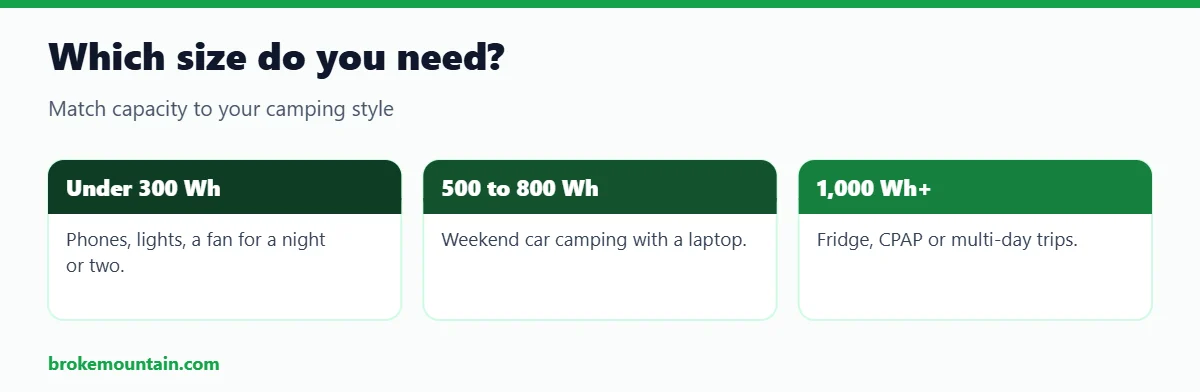
Capacity is measured in watt-hours (Wh): how much energy the battery stores. Output is measured in watts (W): how much power it can deliver at once. You need enough capacity for your trip and enough output for your most demanding device.
- Under 300Wh: phones, lights, a small fan and a camera for a night or two.
- 500 to 800Wh: weekend car camping with a laptop, a small fridge for part of the day, and lights.
- 1,000Wh and up: a 12V camp fridge for a full day, CPAP for several nights, or cooking appliances for short periods.
How to Calculate Your Power Needs
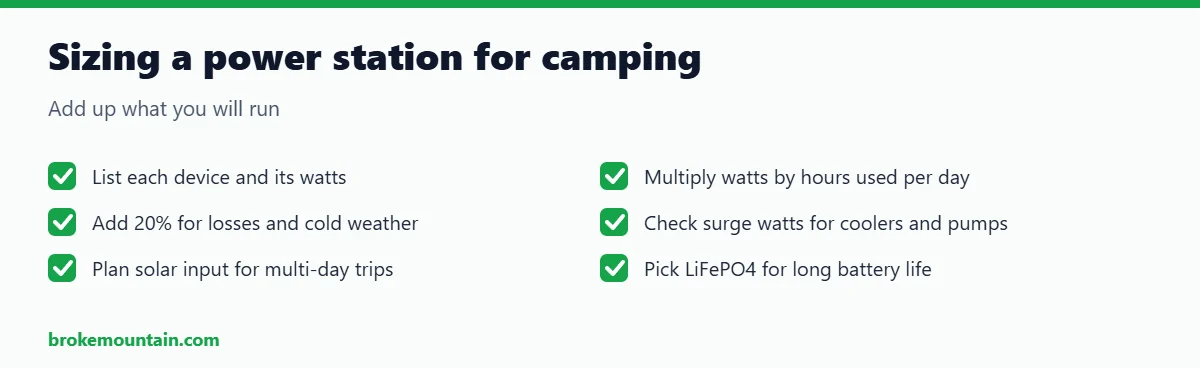
- List your devices and find each one’s power draw in watts (on its label or charger).
- Estimate daily use: watts × hours per day = watt-hours per day. A 45W fridge running a third of the time uses roughly 360Wh a day.
- Add a buffer: add about 20% for conversion losses, cold weather and battery ageing.
- Multiply by days: for a three-day trip without recharging, triple your daily total, or plan solar.
- Check surge needs: devices with motors or heating elements can briefly need more than their running watts.
Solar Charging for Off-Grid Trips
A folding solar panel turns a power station into a renewable off-grid setup. Check the station’s maximum solar input (in watts) and the voltage range it accepts, and choose panels that match. Real solar output is usually lower than the panel’s rating because of sun angle, clouds and heat, so plan on less than the label suggests. Point panels at the sun and move them during the day for the best results. See portable solar panels.
Why LiFePO4 Batteries Matter
Most new power stations use lithium iron phosphate (LiFePO4) batteries. They last for thousands of charge cycles before losing significant capacity, are more stable and safer than older lithium-ion chemistries, and handle being stored for months. They are slightly heavier, but for a product you will use for years, LiFePO4 is the better choice.
Camping Tips for Power Stations
- Keep it out of extreme heat: do not leave it in direct sun or a hot car for long periods.
- Protect it from rain and dust: most units are not waterproof. Keep them in a tent, vehicle or dry bag.
- Use DC when you can: 12V and USB outputs are more efficient than AC for fridges, CPAPs and phones.
- Turn off unused outputs: an idle AC inverter still uses power.
- Charge before you go: arrive with a full battery, and top up while driving with the car charger.
- Respect quiet hours: power stations are silent, but fans inside some units can run while charging.
A power station pairs well with efficient camp gear. Choose a rechargeable headlamp, and see our picks for the best camping cookware sets for two and best lightweight camping chairs to round out your setup.
Power Station vs Gas Generator
Gas generators deliver more power for longer and refuel quickly, but they are loud, produce exhaust and are banned or restricted at many campgrounds during quiet hours. Power stations are silent, fume-free and safe to use inside a tent or van, need no fuel, and charge from solar. For most campers, a power station is the more convenient and campground-friendly choice; a generator only makes sense for heavy, continuous power needs like running an RV air conditioner.
Typical Camping Devices and Their Power Draw
Use these rough figures as a starting point when you plan. Always check the label on your own devices, because real draw varies by model, settings and outside temperature.
- Smartphone: about 10 to 15Wh for a full charge. Even a small 288Wh unit can charge a phone many times over.
- LED lantern or string lights: 3 to 10W. A whole evening of light uses very little energy.
- Rechargeable headlamp: about 5 to 10Wh to refill its battery.
- Laptop: 45 to 100W while charging, or about 50 to 90Wh for a full battery.
- Drone or camera batteries: 20 to 100Wh per battery, depending on the model.
- 12V compressor fridge: 40 to 60W while the compressor runs, which on a mild day is a third to half of the time.
- CPAP machine: 30 to 60W without the heated humidifier; much more with heat and humidity turned on.
- Box fan or tent fan: 10 to 50W depending on size and speed.
- Electric kettle or coffee maker: 800 to 1,500W for a few minutes. These need a high-output station.
- Electric blanket: 50 to 100W. Running one all night uses a lot of capacity.
Heating and cooking devices use far more energy than electronics. If you want hot coffee every morning, a gas stove is usually more efficient; see our guide to the best backpacking stoves for options that save your battery for lights and electronics.
Example Setups by Trip Type
Weekend tent camping
Two people charging phones, a camera, headlamps and a small fan need roughly 100 to 200Wh over a weekend. A 288Wh unit like the Jackery Explorer 300 Plus covers this with room to spare and is easy to carry from the car to the campsite.
Family car camping with a fridge
A 12V fridge plus phones, lights and a tablet can use 400 to 600Wh a day. A 1,000Wh-class station gets you through a day and a half or so without charging. Add a 200W solar panel, or recharge while driving, to keep going for a long weekend.
CPAP campers
Plan for at least two nights of CPAP use with the humidifier off, plus a buffer. A 1,000Wh-class unit with a regulated 12V output, such as the Bluetti AC180, gives you that margin. Ask your CPAP maker about a DC power cord, because running from DC is more efficient than using the AC adapter.
Van life and overlanding
Longer trips call for bigger capacity, expansion batteries or a permanent solar setup. Start with a 1,000Wh unit that accepts plenty of solar input, then add capacity once you know your real daily use.
What to Look for When You Buy
- Capacity (Wh): match it to your daily use and the number of days between recharges.
- Continuous and surge output (W): the continuous rating must exceed your highest-draw device.
- Battery chemistry: LiFePO4 for long life and safety.
- Charging options: fast wall charging, solar input wattage, and car charging.
- Weight and handle design: consider how far you will carry it.
- Ports: count the AC, USB-C and 12V outputs you need, and check USB-C wattage for laptops.
- Warranty and support: major brands typically offer multi-year warranties; check the current terms before buying.
- Pass-through charging: lets you charge the station while it powers devices, useful at sites with hookups.
Before a remote trip, also pack a way to call for help when there is no cell signal. Our guide to the best satellite messengers covers devices you can keep charged from your power station.
Storing and Maintaining Your Power Station
Between trips, store your power station in a cool, dry place. Many makers recommend keeping the battery partly charged for long-term storage and topping it up every few months, so check your manual for the exact advice. Keep the vents clear of dust, inspect cables for damage, and update the firmware if your unit has an app. A little care helps a LiFePO4 battery deliver years of reliable power.
Frequently Asked Questions
Can a portable power station run a camping fridge?
Yes. A 1,000Wh-class station can run a typical 12V compressor fridge for roughly a day, depending on temperature and settings. Add solar for longer trips.
How long does a power station last on a charge?
Divide its usable capacity by your devices’ total draw. For example, about 900 usable Wh running a 60W load lasts around 15 hours.
Can I charge a power station from my car?
Yes, most include a car charging cable. It is slower than wall or solar charging, but useful on long drives.
Is it safe to use a power station in a tent?
Yes. Unlike gas generators, they produce no fumes. Keep them dry, ventilated and away from heat sources.
How long do power station batteries last?
LiFePO4 units are typically rated for thousands of cycles before capacity drops noticeably, which means many years of camping use.
Final Verdict
The Anker SOLIX C1000 Gen 2 is our top pick for its high output and very fast recharge. Choose the Jackery Explorer 1000 v2 for an easy, lighter 1kWh option for family camping, the Bluetti AC180 if you need efficient CPAP power, the EcoFlow River 3 Plus for a compact, expandable unit, and the Jackery Explorer 300 Plus for light tent camping. Size your station to your devices, add solar for longer trips, and enjoy quiet, clean power at camp.
Browse portable power stations on Amazon

Hi, I am Emam Hasan — founder and editor of BrokeMountain. I oversee this blog’s hiking, camping and outdoor gear guides, making sure every article is well-researched, accurate and genuinely helpful for your time on the trail. Enjoy it!