As an Amazon Associate, BrokeMountain earns from qualifying purchases. We did not test these devices in person; this guide is based on maker specifications, independent test results and hiker feedback. Subscription plans and prices change often, so check the provider’s current plans before buying.
Most hiking emergencies happen out of cell range: a twisted ankle on a remote trail, a sudden storm, a wrong turn at dusk. A satellite messenger lets you send messages, share your location and call for help from almost anywhere on Earth, using satellites instead of cell towers. For solo hikers, backpackers and anyone heading into the backcountry, it is one of the most valuable pieces of safety gear you can carry.
This guide compares the best satellite messengers for hiking, explains how they differ from personal locator beacons, and covers subscription costs.
Quick Picks
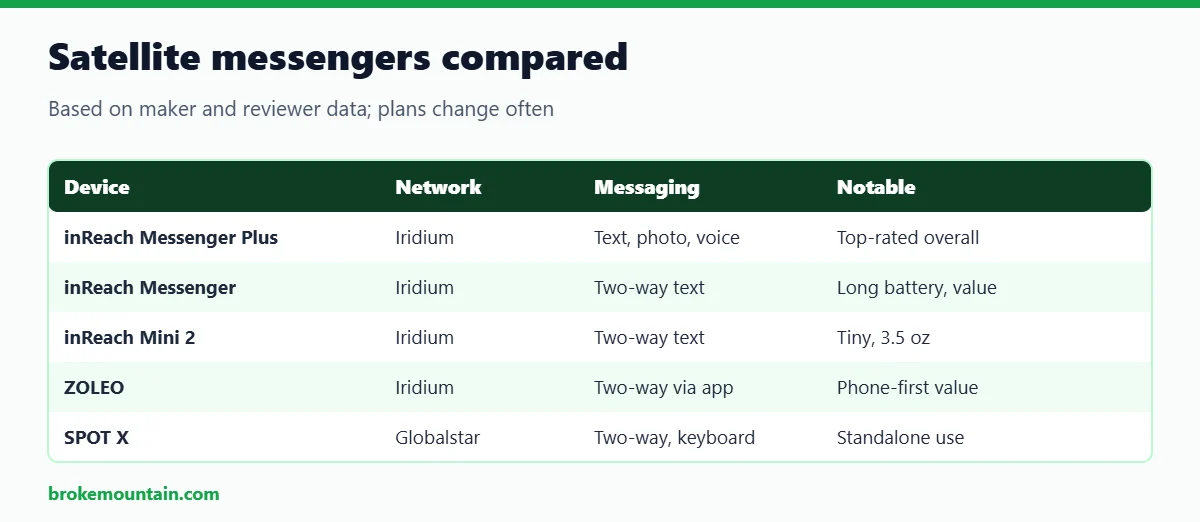
- Best overall: Garmin inReach Messenger Plus
- Best value two-way messenger: Garmin inReach Messenger
- Smallest and lightest: Garmin inReach Mini 2
- Best phone-first option: ZOLEO Satellite Communicator
- Best standalone with keyboard: SPOT X
- Newest premium compact: Garmin inReach Mini 3 Plus
How Satellite Messengers Work
Satellite messengers connect to satellite networks rather than cell towers. Garmin inReach devices and ZOLEO use the Iridium network, while SPOT uses Globalstar. A head-to-head test published by Yahoo Tech comparing the inReach Mini 2 and SPOT X notes that Iridium has a constellation of 66 satellites versus Globalstar’s 24, which is one reason Iridium devices are known for truly global coverage.
Most messengers pair with a phone app so you can type messages on your phone’s keyboard, then send them through the satellite device. They also offer live tracking so friends can follow your route, and an SOS button that connects to a 24/7 emergency response centre.
1. Garmin inReach Messenger Plus
Best overall. OutdoorGearLab rates the inReach Messenger Plus its best overall satellite communicator, highlighting robust backcountry communication and tracking. Beyond two-way text, it can send photos and voice messages over satellite, which can be very helpful when describing an injury or a location to rescuers or family. It works with the Garmin Messenger app and requires a Garmin subscription.
Pros: photo and voice messaging, strong SOS, good battery life.
Cons: pricier than basic messengers; photo and voice use more of your plan.
Check the inReach Messenger Plus on Amazon
2. Garmin inReach Messenger
Best value two-way messenger. The standard inReach Messenger focuses on what most hikers need: two-way text, location sharing and SOS. OutdoorGearLab names it the best value for two-way messaging and advises that if you have no satellite device yet, you should get the Messenger rather than the Mini 2. GearJunkie lists up to 28 days of battery, a weight of about 4 ounces, the Iridium network and plans starting around $11.95 per month.
Pros: excellent battery life, simple, affordable, reliable Iridium coverage.
Cons: no photo or voice messaging; limited on-device typing.
Check the inReach Messenger on Amazon
3. Garmin inReach Mini 2
Smallest and lightest. The inReach Mini 2 is tiny, weighing about 3.5 ounces, and GearJunkie lists up to 14 days of battery. It offers two-way messaging, tracking, SOS and basic navigation features like TracBack, and pairs with Garmin watches and phones. It is ideal for ultralight hikers, trail runners and climbers who want the smallest possible device.
Pros: very small and light, proven design, works with Garmin watches.
Cons: tiny screen; shorter battery life than the Messenger.
Check the inReach Mini 2 on Amazon
4. ZOLEO Satellite Communicator
Best phone-first option. ZOLEO is designed around your smartphone: you send and receive messages in the ZOLEO app, and the device handles the satellite link. It uses the Iridium network, and GearJunkie lists about 200 hours of battery, a weight of about 5.3 ounces and plans from around $20 per month. Each ZOLEO comes with a dedicated phone number and email address, so friends can message you easily. Many reviewers consider it excellent value for hikers who always carry a phone.
Pros: easy app-based messaging, dedicated number, good value device.
Cons: limited use without a phone; plan pricing differs from Garmin’s.
5. SPOT X
Best standalone with keyboard. The SPOT X has a built-in physical keyboard, so you can type messages without a phone. It uses the Globalstar network, which has fewer satellites and less coverage in some remote regions than Iridium. It is larger than the inReach Mini 2 because of its keyboard, but it suits hikers who prefer not to rely on a phone for messaging.
Pros: physical keyboard, works without a phone.
Cons: bulkier; Globalstar coverage is less global than Iridium.
6. Garmin inReach Mini 3 Plus
Newest premium compact. Garmin’s newest compact inReach adds a colour touchscreen and supports two-way text, photo and short voice messages through the Garmin Messenger app, according to retailer listings. OutdoorGearLab lists it at around $500 in its 2026 testing. It is the choice for hikers who want photo and voice messaging in the smallest Garmin package.
Pros: photo and voice in a compact device, colour touchscreen.
Cons: most expensive option here.
Check the inReach Mini 3 Plus on Amazon
Satellite Messenger vs PLB vs Phone Satellite SOS
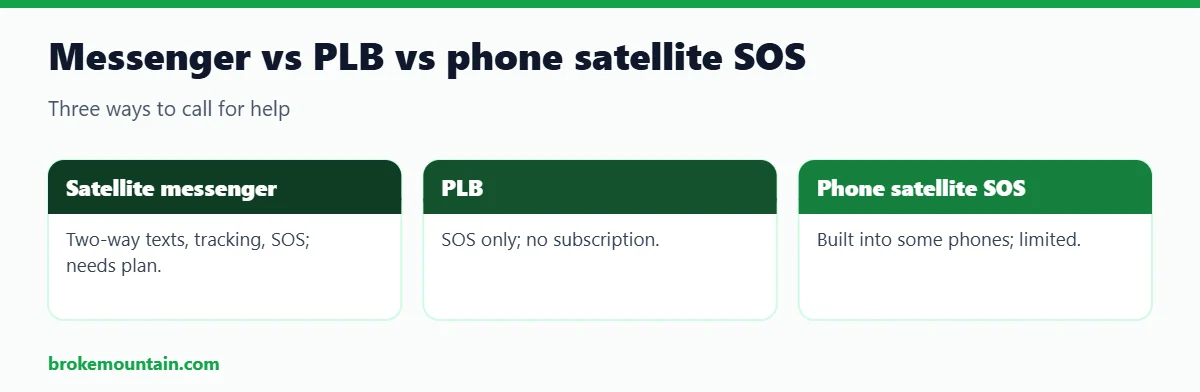
Satellite messengers offer two-way texting, tracking and SOS, but need a subscription. Two-way messaging lets rescuers ask questions and lets you tell family you are safe, which avoids unnecessary rescues.
Personal locator beacons (PLBs), such as the Ocean Signal rescueME PLB1 or ACR ResQLink, send a one-way distress signal to government search and rescue services. They need no subscription and have very powerful signals, but cannot send messages or confirm help is coming.
Phone satellite SOS is built into some newer smartphones and carrier plans. It is a useful backup, but coverage, features and battery depend on your phone and plan, and phones are more fragile in the outdoors.
Choosing the Right Device
Network
Iridium (Garmin, ZOLEO) offers global coverage, including polar regions. Globalstar (SPOT) covers most populated areas but has gaps in some remote regions.
Messaging style
Phone-first devices like ZOLEO and inReach Messenger are easiest to type on. Standalone keyboards (SPOT X) or on-device options suit people who do not want to depend on a phone.
Battery life
Long trips call for long battery life. The inReach Messenger and ZOLEO last far longer per charge than the tiny Mini 2.
Subscription cost
Plans vary by message allowance, tracking frequency and contract length. Some offer monthly plans you can pause between seasons. Factor the yearly cost into your decision, not just the device price.
How to Set Up and Use a Satellite Messenger
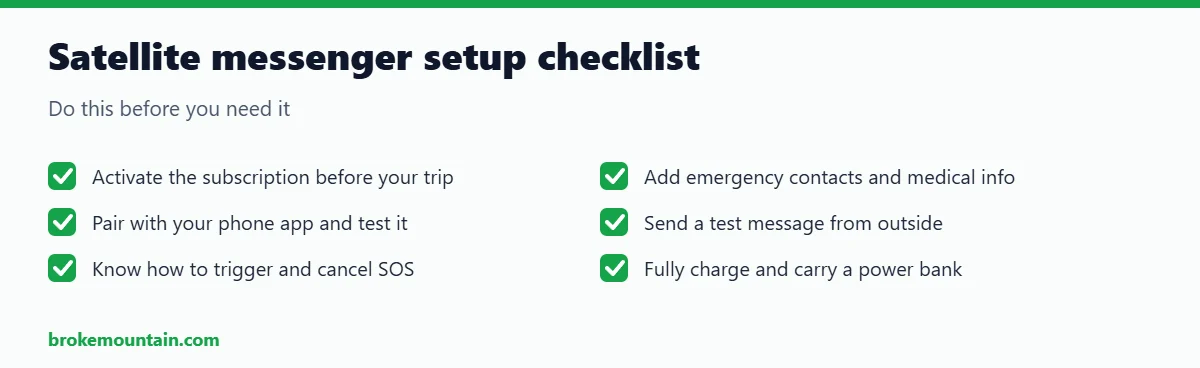
- Activate early: sign up for a plan and activate the device several days before your trip.
- Add contacts and info: set emergency contacts and any medical information in your account.
- Pair and test: pair with your phone and send a test message from outdoors, where the device can see the sky.
- Learn SOS: understand how to trigger SOS, how to communicate with the response centre, and how to cancel a false alarm.
- Carry it on you: clip it to a shoulder strap, not deep in your pack, so you can reach it if you fall or get separated from your pack.
- Share your plan: tell someone your route and expected return, and share your tracking map.
A satellite messenger works best alongside good navigation. If you want a single device for both, consider a GPS with built-in inReach; see our guide to the best handheld GPS for hiking. Pack essentials like a headlamp and a way to treat water, such as the best water filters for backpacking.
Understanding Subscription Plans
The device price is only part of the cost. Every two-way satellite messenger needs a plan, and plans usually differ in three ways:
- Message allowance: basic plans include a set number of messages per month, while higher tiers offer unlimited texting. Preset “check-in” messages are often free or unlimited.
- Tracking interval: cheaper plans may track your location less often. More frequent tracking gives family a more detailed map but uses more battery.
- Contract length: annual contracts are usually cheaper per month, while flexible monthly plans can be paused or suspended between trips, which suits seasonal hikers.
Before buying, estimate how many trips you take a year and how many messages you send. A hiker who goes out a few weekends each summer may save money on a flexible monthly plan, while someone in the backcountry year-round is better off with an annual plan. Check activation fees and suspension rules too.
Battery Tips for Long Trips
Battery life varies hugely with settings. Frequent tracking intervals, cold temperatures, poor sky view and heavy messaging all drain the battery faster. To stretch it, set a longer tracking interval, turn off the device at camp if you do not need tracking overnight, keep it warm in cold weather, and carry a small power bank and cable. See compact power banks.
Who Should Carry a Satellite Messenger?
- Solo hikers: nobody is there to go for help if you are injured.
- Backpackers on multi-day trips: longer trips mean more time out of contact and more chance of something going wrong.
- Hikers in remote or mountainous areas: cell coverage is often non-existent in national parks, canyons and high country.
- Hunters, anglers and trail runners: anyone travelling far from roads benefits from SOS and check-ins.
- Families: a messenger lets you send “we are fine” updates so people at home do not worry.
Even on shorter hikes, a messenger is cheap insurance compared with the consequences of being stuck without help. Pair it with a well-packed bag; our guide to the best hiking daypacks under $100 covers packs with shoulder-strap attachment points for keeping a messenger within reach.
False Alarms and Responsible Use
Accidental SOS activations do happen, usually when a device is pressed inside a pack. Most devices have a protective cover or require holding the button for several seconds. If you trigger SOS by mistake, cancel it right away and reply to the response centre to confirm you are safe. Only use SOS for genuine emergencies; for non-urgent problems, message friends or family who can help arrange assistance.
Frequently Asked Questions
Do satellite messengers need a subscription?
Yes, all two-way satellite messengers need an active plan for messaging, tracking and SOS. PLBs do not.
Will a satellite messenger work anywhere?
Iridium devices work almost anywhere with a clear view of the sky. Heavy tree cover, deep canyons and being indoors can delay messages.
Is a satellite messenger better than a PLB?
For most hikers, yes, because two-way messaging lets you communicate details and receive confirmation. PLBs are excellent no-subscription SOS-only backups.
Can my family track me?
Yes. Most messengers share a live map link so friends and family can follow your progress.
What happens when I press SOS?
The device sends your location to a 24/7 emergency response centre, which contacts local search and rescue and, with two-way devices, messages you for details.
Can I text any phone number with a satellite messenger?
Yes. Most messengers can send texts to any mobile number or email address, and recipients can reply. Some plans charge per message, so check your allowance.
Do satellite messengers work inside a tent or car?
Often, but more slowly. Messages send fastest with a clear view of the sky, so place the device outside or near an open door if a message is stuck.
Is a satellite messenger worth it for day hikes?
For popular trails with cell coverage, maybe not. For remote day hikes, solo outings or winter trips, it is worth carrying.
Final Verdict
The Garmin inReach Messenger Plus is the best all-round satellite messenger, with photo and voice messaging. The inReach Messenger offers the best value for two-way texting and battery life, the inReach Mini 2 is the smallest, ZOLEO is great for phone-first users, SPOT X suits those who want a keyboard, and the inReach Mini 3 Plus is the premium compact choice. Whichever you pick, activate it early and keep it within reach.
Browse satellite messengers on Amazon

Hi, I am Emam Hasan — founder and editor of BrokeMountain. I oversee this blog’s hiking, camping and outdoor gear guides, making sure every article is well-researched, accurate and genuinely helpful for your time on the trail. Enjoy it!