
Quick answer: in the organic vs sintered disc brake pads debate, organic (resin) pads give stronger bite straight away, run quieter and feel smoother, but wear faster and fade sooner when hot or wet. Sintered (metallic) pads last longer, handle heat on long descents and keep working in mud and rain, but they are noisier, need a longer bed-in and can wear rotors faster. Choose organic for dry trail riding and lighter riders; choose sintered for wet climates, big descents, heavier riders and e-MTBs.
BrokeMountain is reader-supported. We may earn a commission when you buy through links on this page, at no extra cost to you. Learn more.
How we put this together: we haven’t lab-tested these brake pads ourselves. We compared guidance from SRAM, Shimano and independent bike-tech sources, and we link each source. Always follow your brake maker’s instructions for compatible pads and rotors.
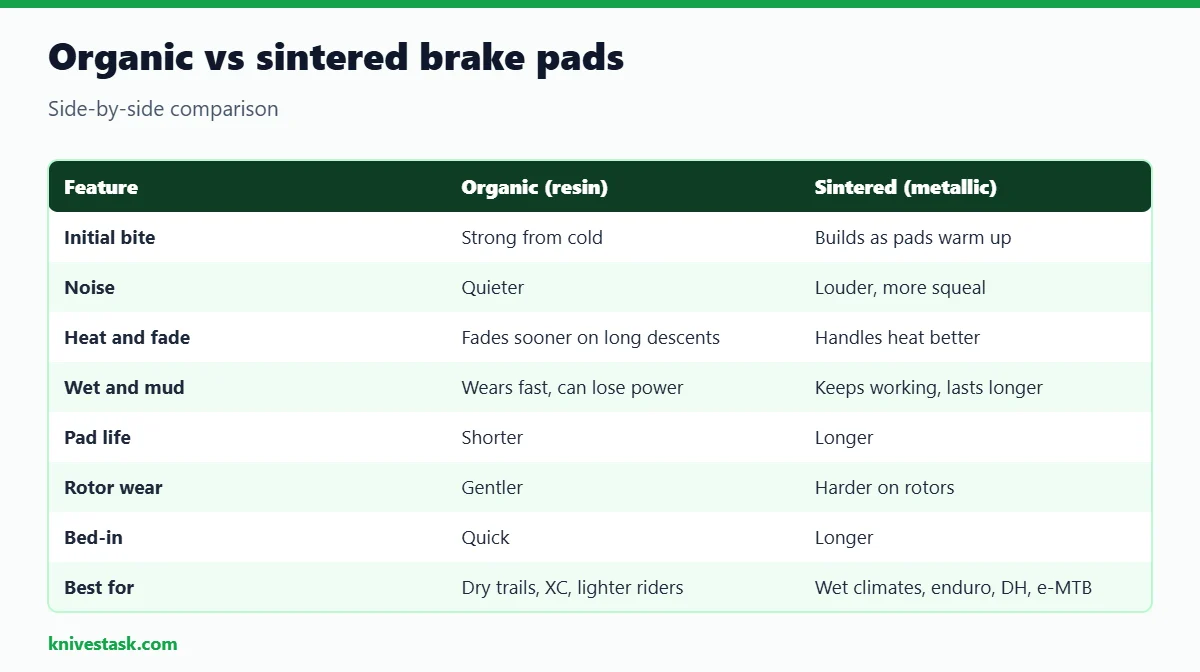
Organic vs sintered disc brake pads at a glance
| Feature | Organic (resin) | Sintered (metallic) |
|---|---|---|
| Initial bite | Strong from cold | Builds as pads warm up |
| Noise | Quieter | Louder, more squeal |
| Heat and fade | Fades sooner on long descents | Handles heat better |
| Wet and mud | Wears fast, can lose power | Keeps working, lasts longer |
| Pad life | Shorter | Longer |
| Rotor wear | Gentler | Harder on rotors |
| Bed-in | Quick | Longer |
| Best for | Dry trails, XC, lighter riders | Wet climates, enduro, DH, e-MTB |
What are organic (resin) brake pads?
Organic pads, also called resin pads, are made from a mix of fibers and other materials bonded together with resin. SRAM says they give a more consistent initial bite without needing to warm up, run quieter and bed in more quickly, and that many SRAM brakes ship with organic pads.
The downside is durability. SRAM notes that organic pads are not the best choice for wet or muddy conditions and that they wear faster than sintered pads, especially when wet. They can also overheat and fade on long, steep descents, when the resin gets too hot.
SRAM sells three organic versions for many of its brakes: Quiet (black backing plate), Powerful (grey backing plate) and Lightweight (aluminum backing plate).
What are sintered (metallic) brake pads?
Sintered pads, also called metallic or metal pads, are made from metal particles fused together under heat and pressure. SRAM describes its sintered pads as using small metal fibers, aimed at heavy or extreme-duty riding such as long, steep descents where high temperatures are a concern. It says they excel in all conditions, especially wet and muddy ones.
The trade-offs, according to SRAM: sintered pads need a more thorough bed-in, tend to be louder and may not grab as hard at first, but they give consistent performance once warmed up. SRAM’s sintered pads have a copper-colored backing plate, which makes them easy to identify. Worldwide Cyclery adds that sintered pads fade less than organic pads on long, steep descents, which is why many racers and heavy brakers use them.
Organic vs sintered: the key differences explained
Bite and feel
Organic pads feel grabby and smooth from the first pull of the lever, which many trail and cross-country riders like. Sintered pads can feel a little wooden when cold, then bite hard once they warm up. If you ride short, punchy trails and rarely brake for long, organic pads often feel better.
Heat and fade
Braking turns speed into heat. On a long descent, especially with a heavy rider or an e-bike, the pads and rotors can get very hot. Sintered pads cope with that heat better, so they are less likely to fade. Organic pads can glaze when overheated, which reduces power until you clean or replace them.
Wet and muddy conditions
This is where sintered pads shine. Grit and water act like sandpaper on soft organic material, so organic pads can wear out very quickly in a wet season. If you ride in the Pacific Northwest, the UK or anywhere with regular mud, sintered pads usually make more sense.
Noise
Organic pads are generally quieter. Sintered pads are more likely to squeal or howl, particularly when wet or when they are not properly bedded in. Noise is not a safety issue by itself, but contaminated pads (from oil or chain lube) can be both noisy and weak.
Pad life and rotor wear
Sintered pads last longer in most conditions, but the harder material wears rotors faster. Organic pads are gentler on rotors but are replaced more often. Over a season, the total cost can come out fairly similar; it depends on where and how you ride.
Check your rotors first: “resin only” rotors
Not every rotor can take sintered pads. Pinkbike explains that rotors which are not compatible with metal pads are almost always laser-etched with “resin pads only”, that Shimano rotors always state this, and that SRAM does not make resin-only rotors. Budget Shimano rotors are the most common example. Putting sintered pads on a resin-only rotor can wear it out quickly and make a lot of noise.
Before you switch to sintered pads, look closely at your rotor for a “resin only” marking. If it has one, either stick with organic pads or upgrade the rotors at the same time.
Should you replace rotors when switching compounds?
SRAM recommends fitting new rotors whenever you change pad compound, because new pad material on a rotor that has been used with a different compound can cause noise and reduce braking performance. Swapping like for like is fine. SRAM also says switching between its Quiet and Powerful organic pads, in either direction, needs new rotors.
You do not always have to follow this strictly, but if you switch compounds and get noise or weak braking that a fresh bed-in does not fix, the old pad deposit on the rotor is the likely cause. Our guide to the best hydraulic disc brakes for MTB covers rotor sizes and upgrades if you are changing more than just pads.
How to bed in new brake pads
Both compounds need bedding in, which transfers an even layer of pad material onto the rotor. SRAM says the process takes about 10 minutes. A typical routine looks like this:
- Find a safe, flat area with room to speed up and slow down.
- Ride at a moderate speed and brake firmly to walking pace, without locking the wheel.
- Repeat about 10 times per brake.
- Then do a few harder stops from a higher speed.
- Let the brakes cool before riding trails, and never touch hot rotors.
Sintered pads usually need more repetitions than organic pads before they reach full power. Follow your brake maker’s specific instructions, as they vary.

Which brake pads are best for you?
- Dry trail or cross-country riding: organic pads for quiet, strong bite.
- Wet, muddy or gritty conditions: sintered pads for longer life.
- Long, steep descents, enduro or downhill: sintered pads for heat resistance.
- Heavier riders or e-MTBs: sintered pads, often with larger rotors.
- Budget rotors marked “resin only”: organic pads, unless you upgrade the rotors.
Many riders split the difference by running sintered pads up front, where most braking happens, and organic pads at the rear. Some brands also sell semi-metallic pads that blend the two.
For specific pad picks for your brakes, see our guides to the best mountain bike brake pads, the best brake pads for Shimano Deore, the best brake pads for SRAM Guide RSC and the best brake pads for SRAM Code R. Heavier riders should also read our guide to mountain bikes for heavy riders.
Check Shimano metal (sintered) pads on Amazon
Check Shimano resin (organic) pads on Amazon
Check SRAM sintered pads on Amazon
Make sure the pad shape matches your caliper model before you order, as pad shapes differ even within one brand.

When to replace disc brake pads
Replace pads when the friction material is worn thin. Each brand sets its own minimum thickness, so check the manual for your brake model. Also replace them if they are contaminated with oil or brake fluid, because contaminated pads rarely recover fully. Warning signs include a lever that pulls further than usual, grinding noises and a sudden loss of power.
Frequently asked questions
Are sintered or organic brake pads better?
Neither is better for everyone. Organic pads are better for quiet, strong bite in dry conditions. Sintered pads are better for heat, wet weather, long descents and pad life.
Can I switch from organic to sintered pads?
Usually yes, if your rotors are not marked “resin only” and the pad shape fits your caliper. SRAM recommends new rotors when changing compound, and you should bed in the new pads.
Why are my sintered pads so loud?
Sintered pads are naturally louder, and noise gets worse when they are wet, not bedded in or used on a rotor that carries organic pad material. Clean the rotor, bed the pads in again and check for contamination.
Do sintered pads wear out rotors?
They wear rotors faster than organic pads, and they can damage cheaper “resin only” rotors. Quality rotors designed for metal pads handle them well.
The bottom line
Organic vs sintered disc brake pads comes down to where and how you ride. Organic pads give quiet, instant bite for dry trails and lighter riders, while sintered pads last longer and resist fade in wet weather and on long descents. Check your rotors for a “resin only” marking, match the pad shape to your caliper, and bed in new pads properly, whichever you choose.
Last checked: November 2026. Brake pad compounds, part numbers and compatibility change, so check your brake and rotor maker’s documents before you buy.

Hi, I am Emam Hasan — founder and editor of BrokeMountain. I oversee this blog’s hiking, camping and outdoor gear guides, making sure every article is well-researched, accurate and genuinely helpful for your time on the trail. Enjoy it!


