Quick answer: the best camping tarps and rain flies for 2026 are the ENO ProFly Rain Tarp for general camping, at 22 oz and about $85, and the Paria Sanctuary Sil Tarp for backpackers who want low weight at a fair price, at 10 oz and $90. The Hennessy Hex Rainfly is the hammock pick, the Decathlon Quechua tarp with poles is the value choice for car camping, and Dyneema tarps from Zpacks and Hyperlite Mountain Gear are the lightest at about 7 to 11 oz.
BrokeMountain is reader-supported. We may earn a commission when you buy through links on this page, at no extra cost to you. Learn more.
How we put this together: we haven’t tested these tarps in person. We compared manufacturer specifications with results from independent testers and we link each source. Prices differ between retailers and regions, so check the listing before you buy.
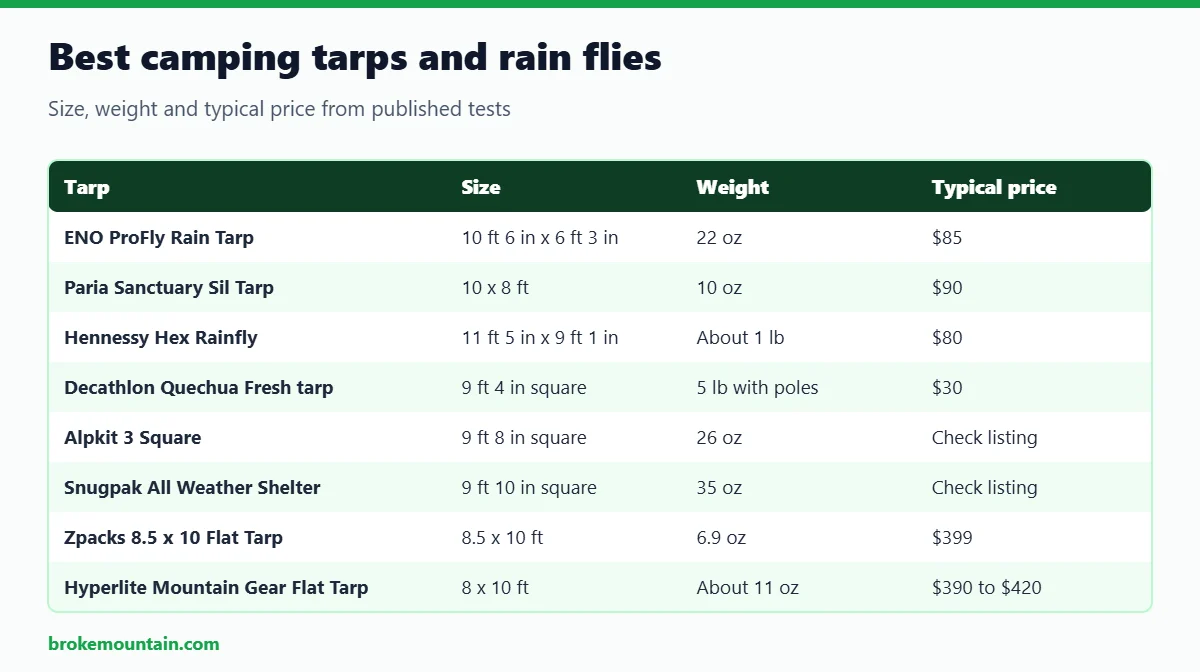
Best camping tarps and rain flies at a glance
| Tarp | Size | Weight | Fabric | Typical price | Best for |
|---|---|---|---|---|---|
| ENO ProFly Rain Tarp | 10 ft 6 in x 6 ft 3 in | 22 oz | 70D nylon | $85 | Best overall |
| Paria Sanctuary Sil Tarp | 10 x 8 ft | 10 oz | Sil/PU coated | $90 | Backpacking value |
| Hennessy Hex Rainfly | 11 ft 5 in x 9 ft 1 in | About 1 lb | 70D polyester | $80 | Hammocks |
| Decathlon Quechua Fresh tarp | 9 ft 4 in square | 5 lb with poles | Polyester | $30 | Car camping value |
| Alpkit 3 Square | 9 ft 8 in square | 26 oz | Polyester | Check listing | Many pitch options |
| Snugpak All Weather Shelter | 9 ft 10 in square | 35 oz | 210T polyester | Check listing | Bushcraft |
| Zpacks 8.5 x 10 Flat Tarp | 8.5 x 10 ft | 6.9 oz | Dyneema | $399 | Lightest |
| Hyperlite Mountain Gear Flat Tarp | 8 x 10 ft | About 11 oz | Dyneema | $390 to $420 | Premium ultralight |
| Gossamer Gear Twinn Tarp | Two-person | 9.7 oz | 10D nylon | $175 | Shaped tarp for two |
Figures come from Advnture’s camping tarp tests and Section Hiker’s ultralight tarp guide. Sizes are converted from the metric figures where the source gave them.
What do campers use a tarp for?
- Camp kitchen and living space: a dry place to cook, eat and sit when it rains.
- Extra cover over a tent door, so you can get in and out without soaking the inside.
- Hammock rain fly: the roof of a hammock setup.
- Main shelter: ultralight hikers sleep under a tarp in place of a tent.
- Shade on hot, open sites.
- Emergency shelter on day hikes.
1. ENO ProFly Rain Tarp: best overall
Advnture’s best overall camping tarp. It measures 320 by 190 cm, weighs 22 oz and is made of 70D ripstop nylon with a PU coating, at $84.95. It is light for its size. It has only six tie-down points, which limits the ways you can pitch it.
- Good: light; simple; works over a hammock or as a lean-to.
- Less good: few tie-outs; narrow for a group.
- Best for: general camping and hammock users.
Check the ENO ProFly Rain Tarp on Amazon
2. Paria Sanctuary Sil Tarp: backpacking value
Section Hiker lists it at 10 by 8 feet, 10 oz and $90, far below the price of most ultralight tarps. It is a shaped tarp in silicone and PU coated fabric. Coated tarps of this kind are usually seam-taped, so there is no sealing to do.
Check the Paria Sanctuary Sil Tarp on Amazon
3. Hennessy Hex Rainfly: hammocks
Advnture’s best tarp for hammock camping: 348 by 277 cm, about 1 lb, in 70D PU-coated ripstop polyester, at $79.95. The six-sided shape is quick to put up and covers both ends of a hammock. It works best with trees to hang it from.
Check the Hennessy Hex Rainfly on Amazon
4. Decathlon Quechua Fresh tarp: car camping value
Advnture’s best value pick at about $30. It is 285 cm square and comes with poles, pegs and lines, so it stands on its own without trees. The full kit weighs 2.3 kg, and the tarp alone about 1 kg, so it is for the car.
5. Alpkit 3 Square: many pitch options
Advnture’s best lightweight bushcraft tarp: 295 cm square, 26 oz, in polyester with a 5,000 mm waterproof rating. It has many tie loops around the edge. It has no loops along the ridge line.
6. Snugpak All Weather Shelter: bushcraft
Advnture’s best bushcraft tarp: 300 cm square, 35 oz, in 210T ripstop polyester with a 2,000 mm coating. Pitched as a diamond it gives efficient shelter. It is heavy for minimalist hikers.
Check the Snugpak All Weather Shelter on Amazon
7. Zpacks 8.5 x 10 Flat Tarp: lightest
Section Hiker lists it at 6.9 oz and $399 in Dyneema composite fabric. Dyneema is the lightest and most waterproof tarp fabric, needs no seam sealing and barely stretches. It costs a great deal and packs bulkier than its weight suggests.
A Dyneema flat tarp in 8 ft 6 in square or 8 by 10 ft, at 10.6 to 11.6 oz and $390 to $420 in Section Hiker’s table. Flat tarps can be pitched many ways and take more skill.
9. Gossamer Gear Twinn Tarp: shaped tarp for two
A catenary-cut tarp in 10D nylon at 9.7 oz and $175. Section Hiker explains that catenary-cut tarps are lighter, quieter in wind and easier to pitch than flat tarps, and are usually limited to an A-frame shape.
Which of the best camping tarps and rain flies suits you?
| You are | Sensible choice |
|---|---|
| Car camping with a group | Decathlon Quechua tarp with poles, or a 10 x 10 ft square |
| Hammock camping | Hennessy Hex Rainfly or ENO ProFly |
| Backpacking on a budget | Paria Sanctuary Sil Tarp |
| Going ultralight | Zpacks or Hyperlite Dyneema flat tarp |
| Learning bushcraft pitches | Alpkit 3 Square or Snugpak All Weather Shelter |
| Wanting one tarp for everything | A 10 x 10 ft coated nylon or polyester square |
How to choose from the best camping tarps and rain flies
Size
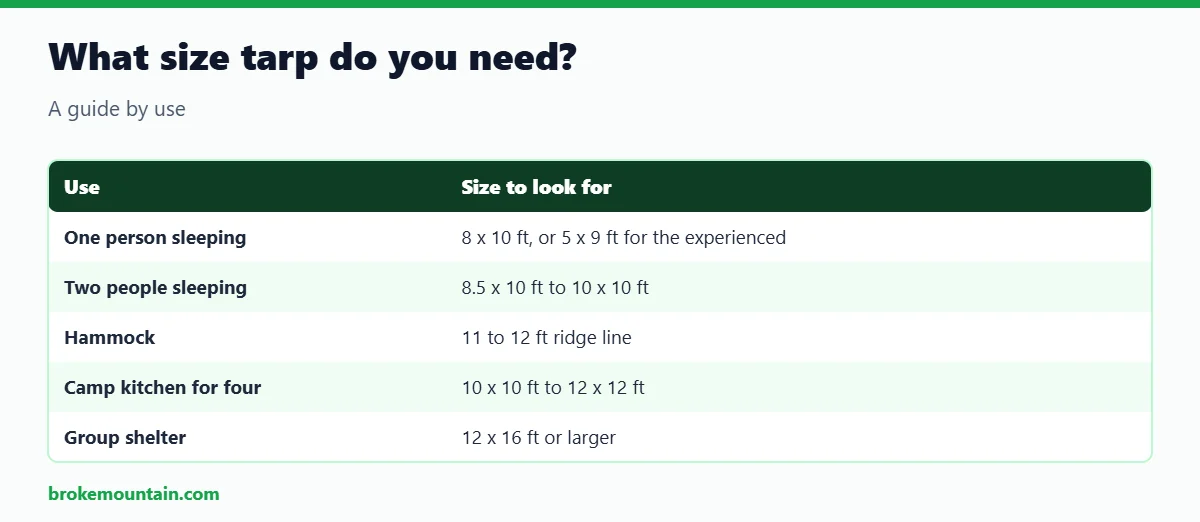
| Use | Size to look for |
|---|---|
| One person sleeping | 8 x 10 ft, or 5 x 9 ft for the experienced |
| Two people sleeping | 8.5 x 10 ft to 10 x 10 ft |
| Hammock | 11 to 12 ft ridge line |
| Camp kitchen for four | 10 x 10 ft to 12 x 12 ft |
| Group shelter | 12 x 16 ft or larger |
Section Hiker notes that most people prefer a two-person tarp even when camping alone, for room to keep gear out of the rain. Advnture adds that very small tarps save weight and leave little margin in heavy rain.
Shape
- Flat square or rectangle: the most pitch options; takes practice.
- Catenary cut: curved edges pull tight; easy A-frame; fewer options.
- Hex and diamond: quick to pitch; good for hammocks. Advnture finds shaped designs more consistent in bad weather.
Fabric
| Fabric | Good | Less good |
|---|---|---|
| Polyethylene (hardware tarp) | Very cheap; tough | Heavy; bulky; noisy |
| PU-coated polyester | Cheap; little stretch when wet | Heavier |
| Silnylon | Strong; light; packs small | Stretches when wet; may need seam sealing |
| Silpoly | Light; low stretch | May need seam sealing |
| Dyneema (DCF) | Lightest; waterproof; no stretch | Very expensive; bulky when packed |
Tie-outs
More tie-out points mean more ways to pitch. Advnture advises looking for reinforced edges and stress points, and ridge-line loops if you plan to hang the tarp from a line.
What else you need
Many tarps come without lines or pegs. Plan for:
- A ridge line of about 30 ft of cord
- Six to eight guy lines
- Six to eight stakes
- Two poles or trekking poles where there are no trees; see what hiking sticks are for
- A groundsheet if you sleep under it; see tent footprints and ground tarps

Four pitches worth learning
- A-frame: the tarp over a ridge line with both sides staked out. Good rain cover with airflow.
- Lean-to: one edge high, one edge on the ground. Blocks wind from one side and gives a view.
- Diamond: one corner high on a tree or pole, the opposite corner staked. Fast for one person.
- Flying square over a table: four corners out on poles or trees with the centre raised, for a camp kitchen.
Pitch the low side into the wind. Give the fabric a slope so rain runs off and does not pool. Re-tension nylon tarps after rain, since the fabric stretches when wet.
Tarp safety
- Check overhead for dead branches before you tie to trees.
- Use wide straps or pad the line to protect bark.
- Keep the tarp well above and away from stoves and fires. Synthetic fabric melts and burns.
- Never cook under a tarp pitched low and closed.
- In lightning, a tarp gives no protection.
- Take it down in strong wind before it tears.
Campground rules on tying to trees vary; see the National Park Service camping pages. For light at camp, see camping lanterns, and for the tent itself, family car camping tents.
Tarp or tent?
| Tarp | Tent | |
|---|---|---|
| Weight | 7 oz to 2 lb | 2 to 6 lb for backpacking |
| Insects | No protection without a bug net | Full protection |
| Rain | Good if pitched well | Good |
| Wind | Depends on pitch and skill | Easier |
| Ventilation | Excellent | More condensation |
| Skill needed | More | Less |
Section Hiker notes that people who sleep on the ground under a tarp usually add a bivy sack or bug bivy and a groundsheet.
Care
- Dry the tarp fully before storing it.
- Seal seams on silnylon and silpoly tarps if the maker says to.
- Stuff silnylon; fold or roll Dyneema.
- Keep cord wound and stakes in a separate bag so they do not puncture the fabric.
Common mistakes with camping tarps
- Pitching it flat. Water pools and the tarp sags or collapses. Always give it a slope.
- Buying too small. Blown rain reaches a long way under the edges.
- Forgetting cord and stakes. Many tarps include neither.
- Tying knots that jam. Learn a taut-line or trucker’s hitch, or use line tensioners.
- Leaving it up in a gale. Lower one side or take it down.
- Storing it wet. Coatings peel and mildew sets in.
Frequently asked questions
What size tarp is best for camping?
10 by 10 ft covers a small group’s kitchen or two sleepers. 8 by 10 ft suits one person.
What is the difference between a tarp and a rain fly?
A rain fly is a tarp shaped for a hammock or a specific tent. A flat tarp is a general sheet with tie-outs.
Are cheap blue tarps good for camping?
They work for car camping and as groundsheets. They are heavy and noisy for backpacking.
Is silnylon or polyester better?
Silnylon is lighter and stronger. Polyester sags less when wet and usually costs less.
Can I use a tarp instead of a tent?
Yes, with practice. Add insect protection and a groundsheet.
How do I stop a tarp flapping?
Use every tie-out, pitch it tight and low on the windward side, and re-tension after rain.
Last checked: November 2026. Prices, specifications and availability change, so confirm details on the maker’s or retailer’s page before you buy.

Hi, I am Emam Hasan — founder and editor of BrokeMountain. I oversee this blog’s hiking, camping and outdoor gear guides, making sure every article is well-researched, accurate and genuinely helpful for your time on the trail. Enjoy it!