
Quick answer: good flat pedals for mountain biking have a large, thin, slightly concave platform, 8–12 replaceable pins per side, and smooth sealed bearings or bushings. For most riders, a quality composite pedal such as the RaceFace Chester or OneUp Composite is the best value. Aluminium pedals are thinner and more adjustable but cost more. Pair any of them with flat-pedal shoes that have soft, sticky rubber soles.
BrokeMountain is reader-supported. We may earn a commission when you buy through links on this page, at no extra cost to you. Learn more.
How we chose: we haven’t tested these pedals in person. Our picks are based on manufacturer specifications, published reviews and how each pedal compares on the features that matter most for trail riding. Check the current listing for exact sizes and weights before you buy, since brands update their models.
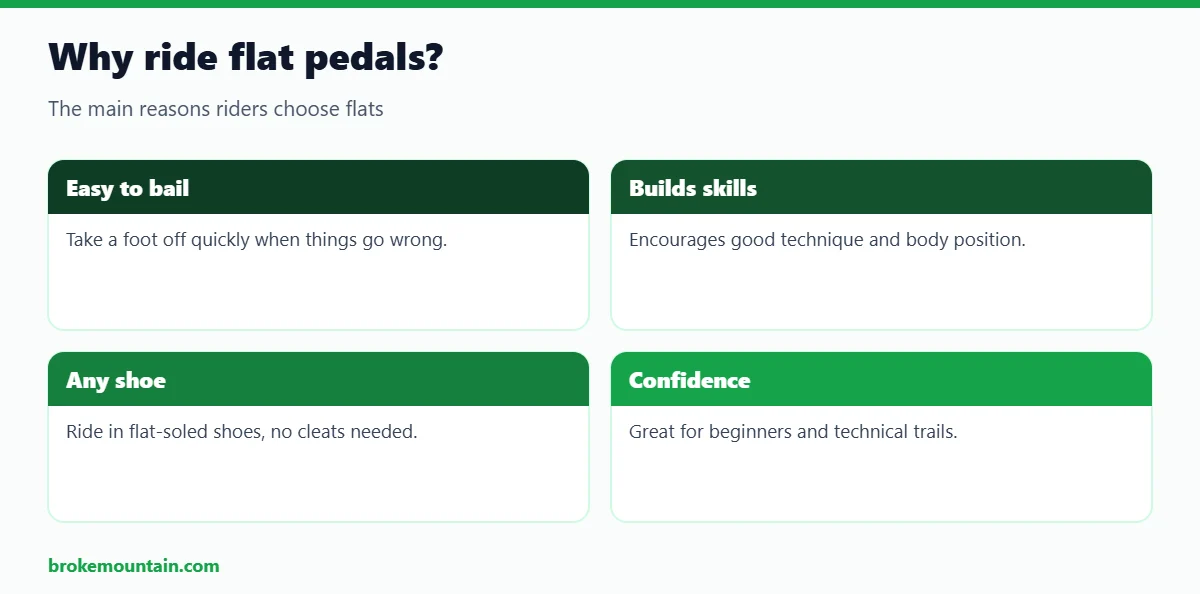
Why ride flat pedals?
Flat pedals (also called platform pedals) let you step off the bike instantly, which builds confidence on steep, loose or technical trails. Many coaches recommend them for learning, because they don’t hide bad technique: to keep your feet planted through rough ground and jumps, you have to drop your heels and stay balanced. Wikipedia’s bicycle pedal article notes that research hasn’t shown a clear efficiency advantage for clipless pedals over flats, so for most trail riders the choice comes down to feel and confidence.
- You can put a foot down instantly in tricky sections.
- They help build good technique for jumping and cornering.
- You can ride in any shoes, though flat-pedal shoes grip far better.
- They are popular for downhill, dirt jumping, trail and beginner riding.
What to look for
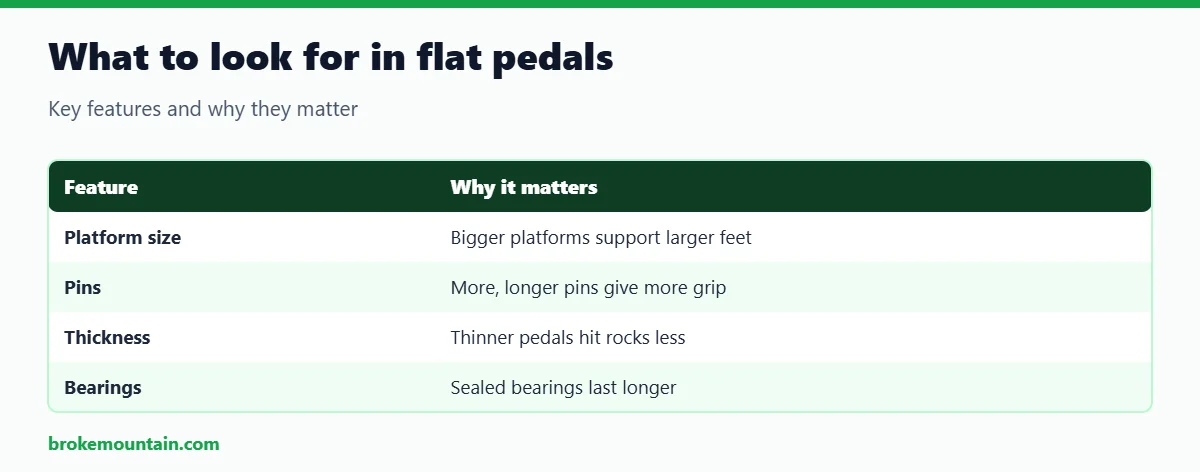
| Feature | What’s good |
|---|---|
| Platform size | About 100 × 100 mm or larger for most adult feet; bigger feet suit 110 mm+ platforms |
| Thickness | Around 11–17 mm; thinner pedals strike rocks less and feel more stable |
| Concave | A slightly dished platform keeps your foot centred |
| Pins | 8–12 per side, replaceable, ideally adjustable height |
| Body material | Aluminium (strong, thin) or nylon composite (cheap, light, slides off rocks) |
| Axle and bearings | Chromoly steel axle with sealed bearings or quality bushings, ideally serviceable |
| Weight | About 300–450 g per pair is typical |
Composite or aluminium?
Composite (nylon) pedals have improved a lot. They are cheap, light and tend to glance off rocks instead of catching, and a scratched composite pedal still works fine. Their main drawback is that the body has to be slightly thicker for strength, and the pins can’t be as tall or adjustable as on a metal pedal. Aluminium pedals can be thinner and stiffer, with taller replaceable pins for maximum grip, but they cost more and a hard rock strike can bend the body or a pin.
For most trail riders, a good composite pedal is the sensible starting point. Riders who race enduro or downhill, or who just want the thinnest, grippiest platform, often move to aluminium later.
The best flat pedals for mountain biking
1. RaceFace Chester: best all-round composite pedal
The Chester is one of the most popular composite flat pedals, and it’s easy to see why. According to RaceFace, the current version has a nylon composite body on a chromoly steel axle, a 16 mm platform height and 11 pins per side (nine metal, two moulded). It also comes in two sizes: Small at 105 × 100 mm and Large at 115 × 110 mm, so riders with big feet aren’t left hanging off the edge.
Reviewers consistently praise its toughness for the price. Bikerumor’s long-term review reported plenty of rock strikes with little more than a flattened moulded pin. The internals are serviceable, and it comes in a wide range of colours.
- Good for: trail riders, beginners and anyone who wants a tough pedal at a fair price.
- Watch out for: the moulded pins wear faster than the steel ones; the older model is still sold, so check you’re buying the size and version you want.
Check RaceFace Chester prices on Amazon
2. OneUp Components Composite Pedal: best for bigger feet
OneUp’s composite pedal is the Chester’s closest rival. Its platform is roughly 114 mm long by 104 mm wide, so it suits larger shoes well, and its weight is similar to the Chester at around 355–360 g a pair. It has a low profile for a composite pedal, a concave shape and replaceable steel pins, and is well known for its grip.
- Good for: riders with bigger feet, or anyone who wants a slightly larger platform.
- Watch out for: it usually costs a little more than the Chester.
Check OneUp Composite pedal prices on Amazon
3. ROCKBROS CNC Aluminium Pedals: best budget aluminium pedal
ROCKBROS makes a large range of low-cost pedals, and its CNC-machined aluminium flats are among the lightest budget options, at roughly 300 g a pair for some models. You get a metal body and replaceable pins for not much more than a basic composite pedal.
- Good for: riders on a tight budget who want a thin aluminium platform.
- Watch out for: bearing quality and long-term durability vary more than with established brands; check what pin and bearing type the listing specifies.
Check ROCKBROS aluminium pedal prices on Amazon
4. CXWXC CX-930 Aluminium Pedals: budget pick with a large platform
The CX-930 is a widely sold budget aluminium flat pedal with a broad platform, replaceable pins and sealed bearings, at around 365 g a pair. It’s a common upgrade for riders replacing the plastic pedals that came with an entry-level bike.
- Good for: commuters and trail riders upgrading from stock pedals.
- Watch out for: it’s thicker than premium aluminium pedals, so expect more rock strikes on technical ground.
Check CXWXC pedal prices on Amazon
5. ROCKBROS Nylon Fiber Pedals: cheapest decent option
If you just need a grippy, light pedal for occasional rides or a kid’s bike, ROCKBROS’s nylon pedals cost very little and are far better than the smooth plastic pedals fitted to many cheap bikes. They’re a sensible stop-gap until you know what you want from a more expensive pedal.
- Good for: occasional riders, kids’ bikes and spare bikes.
- Watch out for: moulded or short pins give less grip than a quality composite pedal with steel pins.
Check ROCKBROS nylon pedal prices on Amazon
Quick comparison
| Pedal | Body | Best for | Main trade-off |
|---|---|---|---|
| RaceFace Chester | Nylon composite | All-round trail riding | Moulded pins wear faster |
| OneUp Composite | Nylon composite | Bigger feet | Slightly pricier |
| ROCKBROS CNC aluminium | Aluminium | Budget metal pedal | Durability varies |
| CXWXC CX-930 | Aluminium | Upgrading stock pedals | Thicker platform |
| ROCKBROS nylon | Nylon | Occasional riders, kids | Less grip |
How to ride flat pedals well
New flat-pedal riders often complain that their feet bounce off in rough sections. Most of that comes down to technique rather than the pedal:
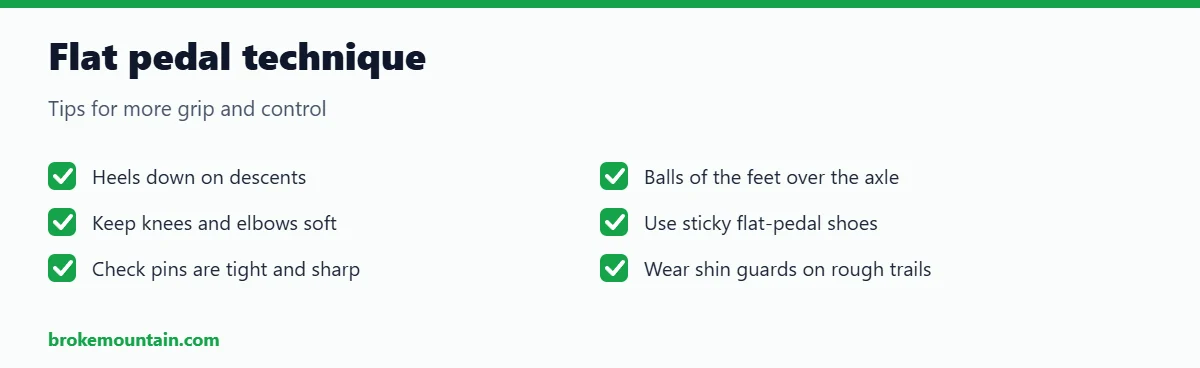
- Heels down: on descents and over bumps, drop your heels so the pedal pins dig into your sole and your weight pushes into the pedals rather than off them.
- Ball of the foot slightly forward: many riders place the pedal axle just behind the ball of the foot, a little further forward than with clipless, for more stability. Experiment to find what feels secure.
- Soft knees and elbows: let the bike move underneath you. Stiff legs let the bike kick your feet off the pedals.
- Level pedals when coasting: keep the cranks horizontal through rough ground so both feet share the load and neither pedal hits rocks.
- Learn to bunny hop properly: with flats you can’t pull the bike up with your feet, so you learn to lift it with your body position. That’s a useful skill whatever pedals you use later.
Setting up pins for grip
Pins are what make a flat pedal work, and small adjustments make a noticeable difference:
- Pin length: longer pins grip harder but make it harder to reposition your foot and hurt more if you slip. Many pedals let you add or remove washers to change pin height, so you can start lower and go higher as you get used to them.
- Pin count: removing a pin or two from the middle of the platform can make it easier to move your foot, while keeping the outer pins gives stability at the edges.
- Replacing pins: pins that thread in from the back of the pedal are easier to remove when bent, because the damaged end isn’t the part you have to grip. Keep a few spares in your kit.
- Thread locker: a small drop of medium-strength thread locker stops pins from backing out, but don’t overdo it or you won’t get them out later.
When to replace your pedals
Most flat pedals fail slowly rather than suddenly. Replace or rebuild them if you notice any of these:
- Side-to-side play in the pedal body that tightening doesn’t fix, which usually means worn bearings or bushings.
- A gritty or notchy feel when you spin the pedal by hand.
- A cracked body, especially near the axle, on composite pedals after big rock strikes.
- Stripped pin threads that won’t hold new pins.
- A bent axle, which you’ll often feel as a wobble while pedalling.
Rebuild kits make sense for good pedals like the Chester or OneUp. For budget pedals, replacement is usually cheaper and quicker than trying to source parts.
Who should consider clipless instead?
Flats suit most trail riders, but clipless pedals are worth a look if you mostly ride long, smooth cross-country routes, race, or like the feeling of being attached to the bike on steep climbs. Clipless pedals hold your foot in exactly the same place on every pedal stroke, which some riders find more comfortable over many hours. If you’re new to mountain biking, though, flats are the easier and safer way to learn, and you can always switch later.
Don’t forget the shoes
A flat pedal is only half of the grip equation. Ordinary trainers with hard, deep tread can skate around even on a pinned pedal. Dedicated flat-pedal shoes from brands like Five Ten, Ride Concepts or Shimano have flat, soft, sticky rubber soles that let the pins bite, plus a stiffer sole that spreads pressure so your feet don’t ache on long climbs. If you’re deciding between flats and clipless, our guide to XC race shoes covers the clipless side.
Fitting and care tips
- Grease the pedal threads and tighten firmly. The left pedal has a reverse thread, so it tightens anticlockwise.
- Check pins regularly and replace bent or missing ones to keep your grip.
- Service bearings or bushings when a pedal feels rough or develops play; many good pedals have rebuild kits. A decent mountain bike tool kit will include the hex keys and pedal spanner you need.
- Lower your saddle on descents so you can move your weight back and keep your heels down. A dropper post makes this much easier.
Protect your shins
Pinned pedals grip well, which also means they hurt when a foot slips off and the pedal spins into your shin. On technical trails, bike parks and jump lines, shin guards or knee pads with shin coverage are worth wearing, especially while you’re getting used to flats.
Frequently asked questions
Flat or clipless pedals?
Flats for confidence, skills and quick foot-downs; clipless for a locked-in feel on long rides and racing. Many riders keep a set of each and switch depending on the trail.
Do I need special shoes for flat pedals?
They’re not required, but flat-pedal MTB shoes with sticky rubber soles grip much better than trainers.
Are plastic pedals good?
Good composite pedals with steel pins are tough, light and cheap, and they slide off rocks instead of catching. Cheap smooth plastic pedals without pins are a different thing and offer little grip.
Will flat pedals fit my bike?
Almost all adult mountain bikes use the standard 9/16-inch pedal thread. Some kids’ and very cheap bikes use the smaller 1/2-inch thread, so check before you buy.
How long do flat pedals last?
With occasional bearing service and pin replacements, a quality pedal can last for years. Budget pedals usually wear out sooner because their bearings can’t be rebuilt.
Keep reading

Hi, I am Emam Hasan — founder and editor of BrokeMountain. I oversee this blog’s hiking, camping and outdoor gear guides, making sure every article is well-researched, accurate and genuinely helpful for your time on the trail. Enjoy it!


