Quick answer: the best microspikes for winter hiking are the Kahtoola MICROspikes, the top pick for hiking at GearJunkie, CleverHiker and Treeline Review, at about 11 oz and $90. The Black Diamond Access Spike is a lighter rival at 8.9 oz, the Hillsound Trail Crampon has the most bite for steep, icy trails, the Kahtoola EXOspikes suit mixed ground in the shoulder seasons, and the Yaktrax Walk is the cheap choice for pavements and car parks. For steep ice and hard snow slopes you need crampons and an ice axe.
BrokeMountain is reader-supported. We may earn a commission when you buy through links on this page, at no extra cost to you. Learn more.
How we put this together: we haven’t tested these traction devices in person. We compared manufacturer specifications with results from independent testers and we link each source. Winter hiking carries real risk. Traction devices help on packed snow and ice and do not replace skill, judgement or the right equipment for steep terrain.
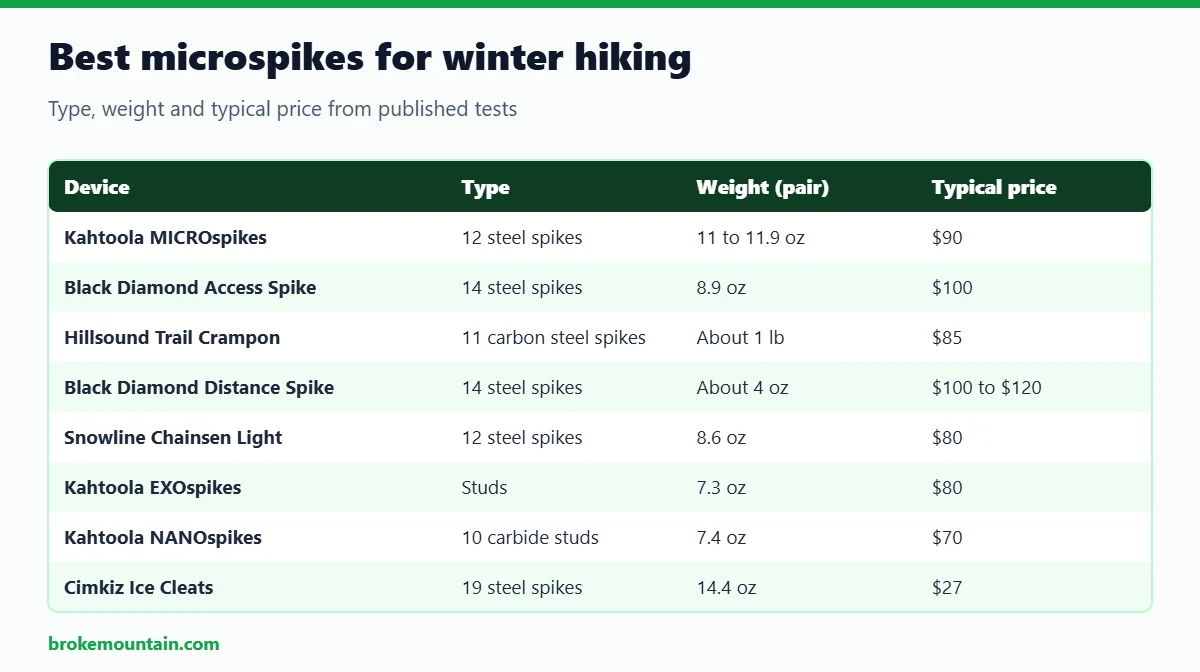
Best microspikes for winter hiking at a glance
| Device | Type | Weight (pair) | Typical price | Best for |
|---|---|---|---|---|
| Kahtoola MICROspikes | 12 steel spikes | 11 to 11.9 oz | $90 | Best for hiking |
| Black Diamond Access Spike | 14 steel spikes | 8.9 oz | $100 | Lighter all-rounder |
| Hillsound Trail Crampon | 11 carbon steel spikes | About 1 lb | $85 | Steep, icy trails |
| Black Diamond Distance Spike | 14 steel spikes | About 4 oz | $100 to $120 | Running; fast and light |
| Snowline Chainsen Light | 12 steel spikes | 8.6 oz | $80 | Light hiking |
| Kahtoola EXOspikes | Studs | 7.3 oz | $80 | Mixed ground; shoulder season |
| Kahtoola NANOspikes | 10 carbide studs | 7.4 oz | $70 | Icy roads and paths |
| Cimkiz Ice Cleats | 19 steel spikes | 14.4 oz | $27 | Budget spikes |
| Yaktrax Walk | Steel coils | 3.2 to 5.4 oz | $22 to $25 | Pavements |
Figures come from CleverHiker’s traction device tests, GearJunkie’s winter traction guide and Treeline Review. Where the sites give different weights or prices we show the range.
What are microspikes?
Microspikes are small steel spikes linked by chains and held on your shoe by a stretchy rubber harness. “MICROspikes” is Kahtoola’s product name, and hikers use the word for the whole type. They pull on over hiking boots or trail shoes in seconds and bite into packed snow and ice on ordinary trails.
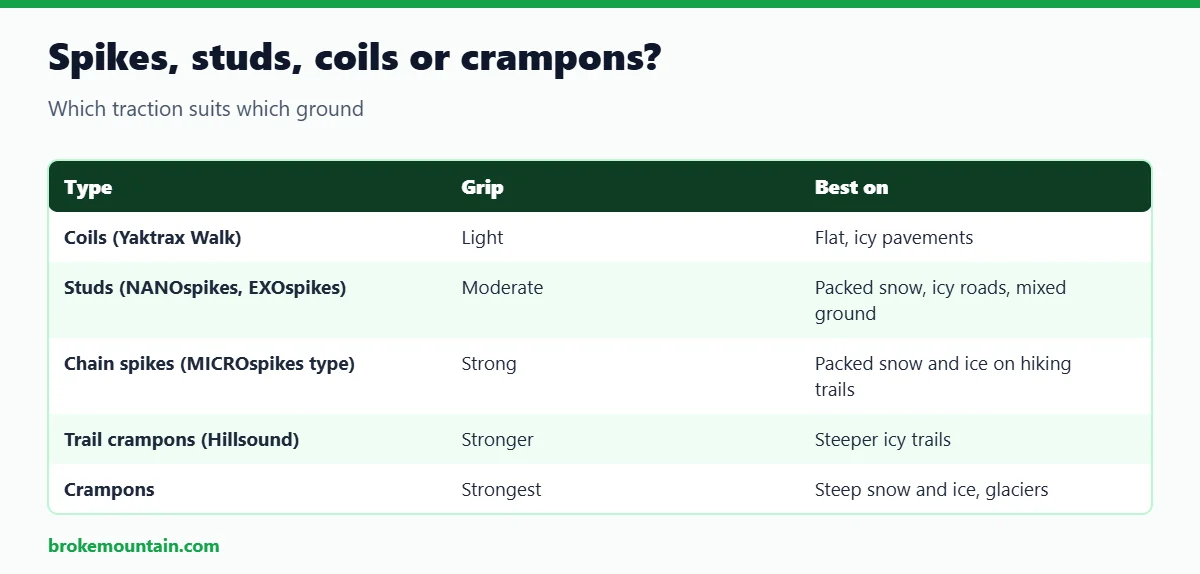
Spikes, studs, coils or crampons?
| Type | Grip | Best on | Not for |
|---|---|---|---|
| Coils (Yaktrax Walk) | Light | Flat, icy pavements | Trails and slopes |
| Studs (NANOspikes, EXOspikes) | Moderate | Packed snow, icy roads, mixed ground | Steep ice; deep fresh snow |
| Chain spikes (MICROspikes type) | Strong | Packed snow and ice on hiking trails | Steep, hard ice |
| Trail crampons (Hillsound) | Stronger | Steeper icy trails | Technical climbing |
| Crampons | Strongest | Steep snow and ice, glaciers | Casual walking |
CleverHiker’s summary matches this: spikes grip steep ice and mixed terrain best, and studs suit slick packed snow and faster movement. GearJunkie advises spikes for hiking on snow and ice and coils or studs for town walks.
1. Kahtoola MICROspikes: best for hiking
GearJunkie’s best overall traction device, scoring 9.5 out of 10 at $90 and 11 oz, with 12 stainless steel spikes per foot. CleverHiker names them the best hiking spikes, rated 4.7, and Treeline Review picks them as best for hiking. CleverHiker found they fit securely on a range of footwear and suit hiking shoes and light boots best.
- Good: strong grip on ice and mixed ground; durable; quick to put on.
- Less good: GearJunkie notes weak grip in mud and slush; pricier than copies.
- Best for: most winter day hikes on packed trails.
Check the Kahtoola MICROspikes on Amazon
2. Black Diamond Access Spike: lighter all-rounder
CleverHiker’s best ice cleats overall, rated 4.8, at $100 and 8.9 oz with 14 spikes. Traction is excellent for the weight. They are not as heavy-duty as some.
Check the Black Diamond Access Spike on Amazon
3. Hillsound Trail Crampon: steep, icy trails
GearJunkie’s best heavy-duty spikes, scoring 8.8 at $85. Each has 11 carbon steel spikes about 17 mm long and a very secure harness. CleverHiker calls them the most aggressive hiking spikes. They weigh about 1 lb, take longer to put on, and are more than you need on mostly bare trails.
Check the Hillsound Trail Crampon on Amazon
4. Black Diamond Distance Spike: running and fast hiking
Treeline Review’s best overall winter traction device, with 14 spikes per foot, 0.31 inches long. GearJunkie rates it best ultralight at 3.9 oz, and CleverHiker best for running at 4.1 oz. It packs very small. It is expensive, and GearJunkie found it not very durable.
5. Snowline Chainsen Light: light hiking
GearJunkie’s best lightweight hiking spikes, scoring 7.9 at $80 and 8.6 oz, with 12 shorter spikes. They are easy to put on and less durable.
6. Kahtoola EXOspikes: mixed ground
CleverHiker’s pick for the shoulder seasons at $80 and 7.3 oz. Studs on a tough grid cope with stretches of bare rock and dirt between icy patches. CleverHiker notes they stop working in more than an inch or two of fresh snow.
Check the Kahtoola EXOspikes on Amazon
7. Kahtoola NANOspikes: icy roads and paths
GearJunkie’s best road running spikes, scoring 8.4 at $70 and 7.4 oz, with 10 tungsten carbide studs. The harness is low and secure. They are not for rough terrain, and CleverHiker says they are not ideal on hiking boots.
8. Cimkiz Ice Cleats: budget spikes
GearJunkie’s best budget spikes at $27 and 14.4 oz, with 19 steel spikes on chains. Grip on ice and packed snow is strong. They are not for steep or technical ground, and you should expect a shorter life.
9. Yaktrax Walk: pavements
The budget pick at both sites, at $22 to $25. Steel coils give light traction for flat, icy pavements and car parks. They are not hiking gear.
Check the Yaktrax Walk on Amazon
Which device for which hiker?
| You are | Sensible choice |
|---|---|
| Hiking packed winter trails | Kahtoola MICROspikes |
| Wanting less weight in the pack | Black Diamond Access Spike |
| On steeper, icier trails | Hillsound Trail Crampon |
| Trail running in winter | Black Diamond Distance Spike |
| Crossing patchy ice in spring and autumn | Kahtoola EXOspikes |
| Walking the dog on icy streets | Yaktrax Walk or NANOspikes |
| On a tight budget | Cimkiz Ice Cleats |
When microspikes are not enough
Section Hiker puts it simply: microspikes are for packed snow and thin ice, and crampons are for thicker ice, rock and snow slabs. Stop and reassess if:
- the slope is steep enough that a slip would turn into a slide;
- the surface is hard, clear ice;
- you are kicking steps or using your hands;
- the snow is deep and soft, where snowshoes work better.
Steep snow needs crampons, an ice axe and the training to use them. Avalanche terrain needs avalanche training and equipment. Turning round is always an option.
How to choose the best microspikes for winter hiking
- Footwear: check the device suits your shoes. CleverHiker found some models feel loose on trail runners, and others do not suit stiff boots.
- Size: follow the maker’s chart for your boot size. GearJunkie notes some brands size oddly for US footwear, so try them on if you can. Insulated winter boots may need a size up.
- Spike length: longer spikes grip better on ice and feel awkward on bare ground.
- Weight: you carry them more than you wear them on many hikes.
- Harness: thicker rubber stays stretchy in the cold and lasts longer.
- Extras: a storage bag stops spikes tearing your pack. A strap over the instep adds security.

How to put them on and use them
- Sit down or brace against a tree.
- Hook the front over the toe of your boot, with the label or raised tab at the front.
- Pull the harness back over the heel.
- Check the chains lie flat under the sole and the spikes are centred.
- Walk with your feet slightly apart so the spikes do not catch your trousers or the other boot.
- Take them off for long stretches of bare rock, which blunts the spikes and is slippery on steel.
Put them on before the icy section, not halfway across it.
What to wear with them
- Waterproof boots; see how to waterproof hiking boots.
- Warm socks; see merino wool hiking socks.
- Trekking poles with snow baskets for balance; see what hiking sticks are for.
- Layers, hat and gloves; see what to wear when hiking.
Winter days are short and cold. Carry a headlamp, extra layers and an emergency shelter, and read the National Park Service hiking safety advice before you go.
Care
- Knock off snow and rinse off road salt.
- Dry them fully before storing, since chains and spikes can rust.
- Check the rubber for cracks and the chain links for wear each season.
- Store them in their bag, away from heat and sunlight.
Common mistakes with microspikes
- Leaving them in the car. Trailheads are often clear while shaded sections higher up are sheet ice.
- Putting them on too late. Stop on safe ground before the ice.
- Trusting them on steep slopes. They do not hold a slide.
- Wearing them on long bare stretches. Spikes blunt, and steel slips on smooth rock.
- Buying coils for trails. Coil devices are for pavements.
- Wrong size. Too large and they roll off; too small and the rubber tears.
- Carrying them loose. Use the bag, or they will hole your jacket and pack.
Planning a winter hike
- Check the forecast, the avalanche bulletin where one applies, and recent trip reports for trail conditions.
- Start early. Daylight is short, and snow softens and refreezes through the day.
- Tell someone your route and return time.
- Carry the ten essentials, with extra warm layers and a headlamp. See what to bring when you go hiking.
- Set a turnaround time and keep to it.
- Go with someone experienced on your first winter outings.
Price against performance
| Budget | What you get |
|---|---|
| $20 to $30 | Coils for pavements, or heavy budget chain spikes with a shorter life |
| $70 to $80 | Studded devices and light chain spikes |
| $85 to $100 | The benchmark hiking spikes: MICROspikes, Access Spike, Hillsound |
| $100 to $120 | Ultralight running spikes and strap-on trail crampons |
For regular winter hiking, the $85 to $100 group is where the best microspikes for winter hiking sit. They last for years and the cost per outing is small.
Frequently asked questions
Are microspikes worth it?
Yes, for anyone who hikes on packed snow or icy trails. They prevent the most common winter falls.
Can I use microspikes on trail runners?
Yes. Lighter models such as the Distance Spike are made for them.
Microspikes or snowshoes?
Microspikes for packed, firm trails. Snowshoes for deep, soft snow. Many winter hikers carry both.
Do microspikes work on ice?
On flat and moderate icy trails, yes. On steep, hard ice you need crampons.
How long do microspikes last?
Several winters with care. Walking on rock and pavement wears the spikes faster.
What size should I buy?
Use the maker’s size chart for your boot size, and size up for bulky insulated boots.
Last checked: November 2026. Prices, specifications and availability change, so confirm details on the maker’s or retailer’s page before you buy.

Hi, I am Emam Hasan — founder and editor of BrokeMountain. I oversee this blog’s hiking, camping and outdoor gear guides, making sure every article is well-researched, accurate and genuinely helpful for your time on the trail. Enjoy it!