
Quick answer: if you ride your mountain bike mostly on roads, bike paths or smooth gravel, swapping knobbly tyres for slick or semi-slick tyres makes it quieter, faster and more efficient. For pure road riding, wide balloon slicks such as the Schwalbe Big Apple give a smooth, cushioned ride. For commuting where flats are a nuisance, puncture-resistant tyres like the Schwalbe Marathon range are hard to beat. If you still ride some dirt, a semi-slick with a smooth centre and grippy edges is the best compromise.
BrokeMountain is reader-supported. We may earn a commission when you buy through links on this page, at no extra cost to you. Learn more.
How we chose: we haven’t tested these tyres in person. Our picks are based on manufacturer information, retailer guidance and long-standing rider feedback. Sizes change often, so check that a tyre is made in your wheel size and width before you buy.
Why fit slick tyres to a mountain bike?
Knobbly mountain bike tyres are designed to bite into dirt, mud and loose rock. On pavement, those knobs squirm, buzz and waste energy. Many mountain bikes, especially older ones, spend most of their time on roads, bike paths and canal towpaths, so fitting the right tyres can transform them into comfortable, fast commuters or town bikes. Online retailer Bike Tires Direct makes the same point: fitting slick or semi-slick tyres can bring an old mountain bike back into regular use.
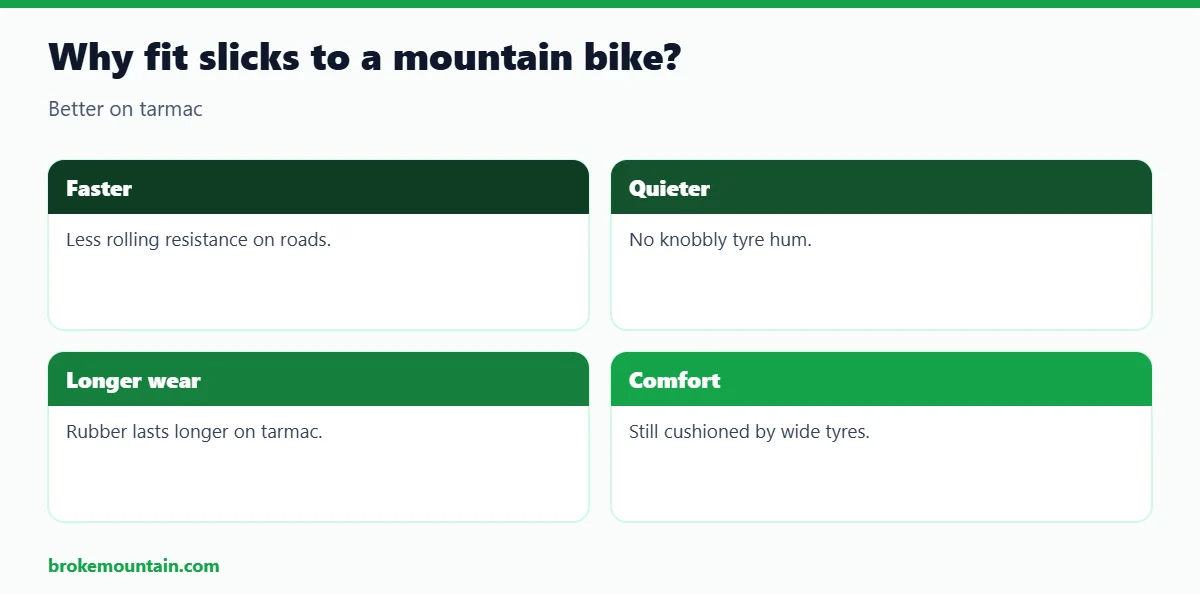
Benefits of slick tyres include:
- Lower rolling resistance: you’ll ride faster for the same effort, and long bike-path rides feel far less tiring.
- Quieter ride: no more knobby hum on tarmac.
- Better grip on pavement: more rubber touches the road, especially in the dry.
- Longer tread life: smooth tyres don’t wear knobs down on hard surfaces.
- Comfort: wide, high-volume slicks soak up potholes and rough roads.
Types of road tyres for mountain bikes
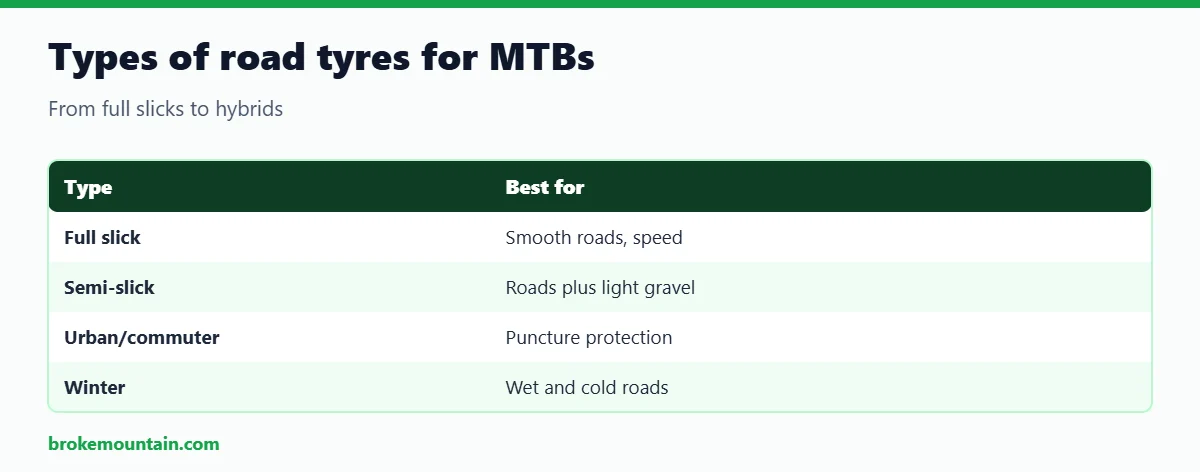
| Type | Tread | Best for |
|---|---|---|
| Full slick | Smooth, sometimes with small grooves | Roads and bike paths only |
| Balloon slick | Smooth, very wide and high volume | Comfortable cruising and commuting |
| Touring / commuting | Smooth or lightly patterned, puncture protection | Daily commuting and touring |
| Semi-slick | Smooth centre, knobs on the edges | Mixed roads, gravel and easy trails |
What to look for
- Wheel size: mountain bikes use 26, 27.5 (650b) or 29-inch wheels. Check the size printed on your current tyres, such as 27.5 x 2.25.
- Width: narrower tyres (around 1.5–2.0 inches) roll faster and are lighter; wider tyres (2.2 inches and up) are more comfortable and look more at home on a mountain bike. Check your rim width supports the tyre.
- Puncture protection: a protective belt under the tread adds weight but saves a lot of roadside repairs on glass-strewn city streets.
- Wet grip: small sipes or grooves and a good rubber compound help on wet roads.
- Folding or wire bead: folding tyres are lighter and easier to carry as a spare; wire beads are cheaper.
- Reflective sidewalls: useful for commuting in the dark.
For a broader overview of tyre categories, evo’s guide to choosing bike tyres explains how road, commuter, gravel and mountain bike tyres differ.
The best road and slick tyres for mountain bikes
1. Schwalbe Big Apple: best for comfort
The Big Apple is Schwalbe’s classic “balloon” tyre. It’s wide and high-volume with a smooth tread, so it rolls easily and cushions bumps like built-in suspension. It’s available in 26, 27.5 and 29-inch sizes, including 29 x 2.0 and around 29 x 2.35, making it a popular way to turn a mountain bike or cruiser into a comfortable town bike. Schwalbe’s closely related Super Moto-X and Big Ben tyres follow the same idea.
- Good for: relaxed commuting, city riding and comfortable fitness rides.
- Watch out for: the soft, flexible sidewalls feel a little vague when cornering hard.
Check Schwalbe Big Apple prices on Amazon
2. Schwalbe Marathon range: best for puncture resistance
Schwalbe’s Marathon tyres are some of the best-selling commuting and touring tyres in the world, and BikePerfect’s overview of the Schwalbe range notes that the Marathon line is mostly used for commuting. Versions such as the Marathon Plus focus on maximum puncture protection, while lighter versions like the Marathon Supreme roll faster. Many sizes are made to fit mountain bike rims.
- Good for: daily commuters and tourers who hate fixing flats.
- Watch out for: the heavily protected versions are heavy and can be hard to fit.
Check Schwalbe Marathon prices on Amazon
3. Maxxis Hookworm: toughest urban slick
The Hookworm is a thick, durable street tyre that has long been popular with urban, dirt-jump and street riders. Its tough casing handles kerbs, steps and rough city streets, and it’s available in several mountain bike sizes.
- Good for: urban riders who are hard on tyres.
- Watch out for: it’s heavy, so it isn’t the fastest-rolling choice.
Check Maxxis Hookworm prices on Amazon
4. Maxxis DTH: best for 26-inch dirt jump and street bikes
The DTH is a light, fast-rolling tyre with a smooth centre and a little edge tread, aimed at dirt jump, street and pump-track riding. It’s mainly made in 26-inch sizes, which suits older mountain bikes and dirt jumpers.
- Good for: 26-inch bikes used on pump tracks, skate parks and streets.
- Watch out for: limited size range for 27.5 and 29-inch wheels.
Check Maxxis DTH prices on Amazon
5. Semi-slick tyres: best for mixed riding
If your rides mix roads with gravel paths or easy trails, a semi-slick tyre keeps much of the speed of a slick while adding grip at the edges for loose corners. Options include tyres such as the Maxxis Holy Roller and Continental’s gravel-style mountain bike tyres for 26-inch bikes, and the Michelin Country Rock for 27.5-inch bikes.
- Good for: riders who split time between pavement and dirt.
- Watch out for: they’re a compromise; they won’t match a full slick on roads or a knobby tyre on technical trails.
Check semi-slick tyre prices on Amazon
Quick comparison
| Tyre | Type | Best for | Main trade-off |
|---|---|---|---|
| Schwalbe Big Apple | Balloon slick | Comfort | Soft cornering feel |
| Schwalbe Marathon | Commuting/touring | Puncture resistance | Weight |
| Maxxis Hookworm | Urban slick | Durability | Heavy |
| Maxxis DTH | Dirt jump/street | 26-inch bikes | Few sizes |
| Semi-slicks | Hybrid tread | Mixed surfaces | Compromise |
Setting the right pressure for road tyres
Slick tyres usually run at higher pressures than trail tyres, because there’s no need for extra grip on loose ground. Higher pressure lowers rolling resistance on smooth surfaces, but too much makes the ride harsh on rough roads. Check the pressure range printed on the tyre sidewall and start in the middle, then adjust for comfort. Wide balloon tyres can run lower pressures for comfort without losing much speed. Our mountain bike tyre pressure guide explains how pressure affects grip and comfort.
Other ways to make a mountain bike better on the road
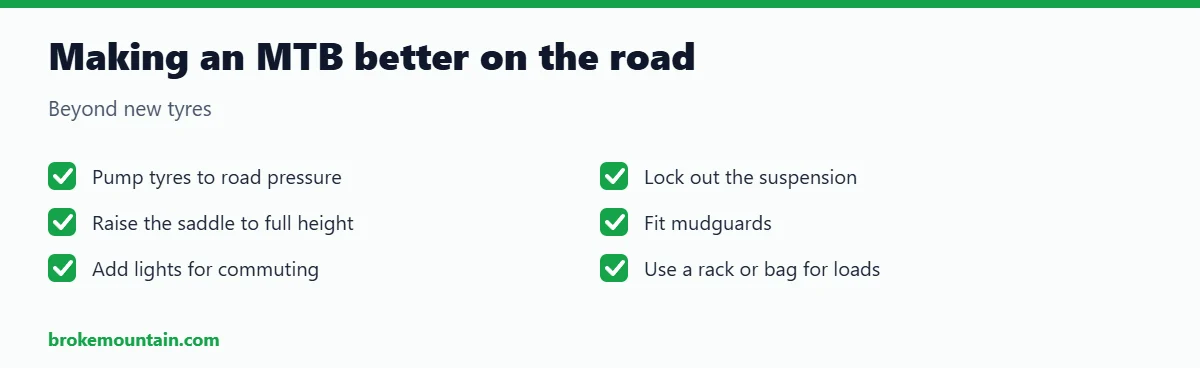
- Lock out the suspension: if your fork or shock has a lockout, use it on smooth roads to stop the bike bobbing.
- Raise the saddle to the right height: a correct saddle height makes pedalling far more efficient.
- Add mudguards and a rack: handy for commuting in all weathers.
- Fit lights: a good front and rear light set makes road riding much safer. See our guide to mountain bike lights.
- Consider a taller gear: if you spin out on flat roads, a larger chainring helps, though most riders don’t need to change anything.
Fitting new tyres
- Let all the air out, push the tyre beads into the centre of the rim and lever off one side with tyre levers.
- Check the rim tape covers all spoke holes, and fit a new tube if the old one is worn.
- Fit the new tyre in the direction shown by the arrow on the sidewall, if there is one.
- Inflate slowly and check the bead sits evenly all the way around before riding.
If a new tyre is very tight, warm it in the sun first and work the bead into the rim’s central channel as you go. Keep your old knobby tyres: if you want to hit the trails again, you can swap them back in a few minutes. Our guide to the best mountain bike tyres covers off-road options.
Choosing by wheel size
26-inch
Older mountain bikes and many dirt jump bikes use 26-inch wheels. This size has the widest choice of urban, cruiser and street tyres, from balloon slicks to tough dirt jump tyres, because it has been around for decades.
27.5-inch (650b)
Many mountain bikes from the last decade use 27.5-inch wheels. The choice of slick tyres is smaller than for 26 or 29-inch wheels, but there are good commuting and semi-slick options, and some gravel tyres in 650b sizes also fit well.
29-inch
29-inch wheels share the same rim diameter as 700c road and hybrid wheels, so there’s a huge range of commuting, touring and gravel tyres that fit. Check that the tyre width suits your rim’s internal width.
Riding in wet and winter conditions
Slick tyres grip well on wet tarmac thanks to their large contact patch, but they struggle on wet leaves, ice and painted road markings. In winter, slow down in corners, avoid braking while leaning, and consider a semi-slick or a tyre with a softer compound if you ride on mixed surfaces. Where roads freeze regularly, dedicated studded winter tyres are the safest option.
Commuting kit to go with your new tyres
If your mountain bike is becoming a commuter, a few extras make daily riding easier:
- Puncture repair kit and mini pump: even puncture-resistant tyres can flat. Our guides to puncture repair kits and mini pumps cover what to carry.
- A good lock: a sturdy lock suited to where you park.
- Mudguards: keep road spray off you and your bag.
- Bright lights front and rear: essential on roads at dusk and in winter.
Slick tyres for electric mountain bikes
Electric mountain bikes are heavier and often faster on the road than regular bikes, which puts more stress on tyres. If you’re converting an e-MTB for commuting, choose tyres that the manufacturer lists as suitable for e-bikes. These usually have stronger casings, tougher rubber and better puncture protection to cope with the extra weight and the torque from the motor. Wider, high-volume tyres also add comfort and stability at higher speeds. Very fast e-bikes may legally need specially approved tyres in some countries, so check the rules where you live if your bike is a high-speed model. As with any tyre, keep the pressure within the range printed on the sidewall, and check it regularly, because heavy bikes are harder on under-inflated tyres.
Frequently asked questions
Will slick tyres make my mountain bike much faster?
On smooth roads, yes. Most riders notice a big difference in speed, noise and effort.
Can I ride trails on slick tyres?
Easy, dry gravel paths are fine, but full slicks have very little grip on loose dirt, mud or wet roots. Semi-slicks are a better choice if you ride some trails.
Are wider slick tyres slower?
Not necessarily. At the right pressure, a wide tyre can roll as fast as a narrow one on real-world roads and is more comfortable, though it weighs more.
Can I fit road bike tyres to my mountain bike?
Only if they match your wheel size. Most road bikes use 700c wheels, which are the same diameter as 29-inch mountain bike wheels, but very narrow road tyres may not suit wide mountain bike rims.
Do slick tyres puncture more easily?
Not inherently, but city streets have more glass and debris than trails. Choose a tyre with a puncture protection layer for commuting.
How long do slick tyres last?
It depends on your weight, the road surface and the tyre’s compound, but slick tyres generally last much longer on roads than knobbly mountain bike tyres, because there are no knobs to wear down. Replace them when the tread is worn flat, the casing shows through, or the sidewalls crack.
Keep reading

Hi, I am Emam Hasan — founder and editor of BrokeMountain. I oversee this blog’s hiking, camping and outdoor gear guides, making sure every article is well-researched, accurate and genuinely helpful for your time on the trail. Enjoy it!


