Quick answer: the best backpacking saw for most people is a folding saw with a 7-inch (180–190 mm) blade, such as the Bahco Laplander or the lighter Silky F180. Both weigh around 5 to 7 ounces, lock safely and cut wrist-thick wood quickly. For bigger firewood, the Silky Gomboy 240 cuts faster, and for car camping a folding frame saw like the Gerber Freescape handles thicker logs.
BrokeMountain is reader-supported. We may earn a commission when you buy through links on this page, at no extra cost to you. Learn more.
How we put this together: we haven’t tested these saws in person. We compared manufacturer and retailer specifications and published user reviews. Prices change often, so check the current price before you buy.
Best backpacking saws at a glance
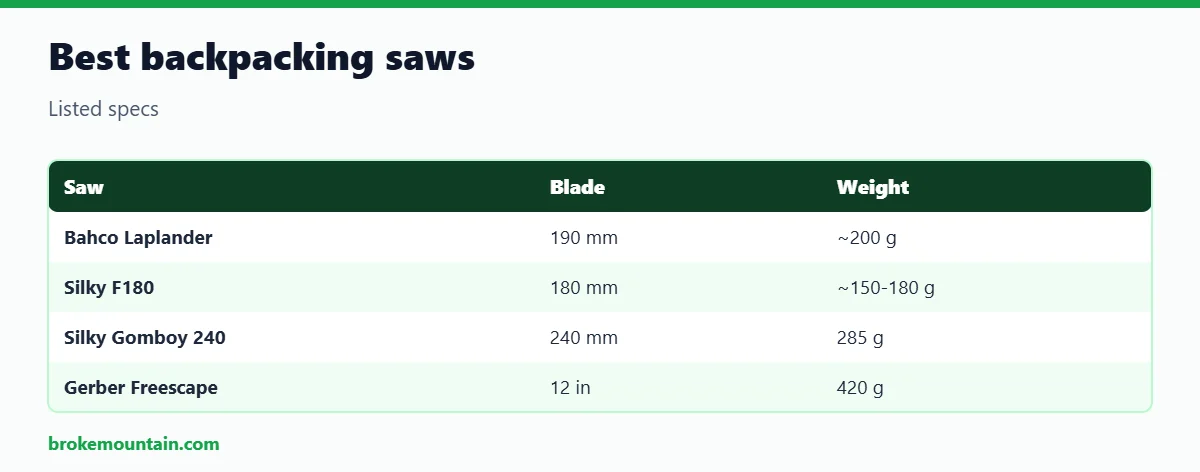
| Saw | Type | Blade | Listed weight | Best for |
|---|---|---|---|---|
| Bahco Laplander | Folding | 190 mm (7.5 in) | About 200 g (7 oz) | All-round backpacking and bushcraft |
| Silky F180 | Folding | 180 mm (7 in) | About 150–180 g (5–6 oz) | Light backpacking |
| Silky Gomboy 240 | Folding | 240 mm (9.5 in) | 285 g (10 oz) | Faster cutting, bigger wood |
| Gerber Freescape Camp Saw | Folding frame saw | 12 in | 14.8 oz (420 g) | Car camping and firewood |
Weights are manufacturer or retailer figures and vary a little between sellers.
| Bahco Laplander | Check latest price |
| Silky F180 | Check latest price |
| Silky Gomboy 240 | Check latest price |
| Gerber Freescape Camp Saw | Check latest price |
Do you need a saw for backpacking?
Often, no. If you cook on a stove and do not light fires, a saw is extra weight. Many backcountry areas also restrict or ban fires, and the best firewood for a small, low-impact fire is sticks you can break by hand.
A saw earns its place when you camp in cold or wet seasons and rely on a fire, travel by canoe, clear fallen branches from trails, practise bushcraft, or car camp where firewood comes in long pieces. For most campers, a saw is also safer, lighter and more precise than an axe or hatchet.
Types of camping saws
| Type | Pros | Cons | Best for |
|---|---|---|---|
| Folding saw | Compact, safe, light | Smaller cuts | Backpacking, bushcraft |
| Folding frame or bow saw | Fast cutting of bigger logs | Bulky, heavier | Car camping, firewood |
| Pocket chain saw | Very light, packable | Tiring to use, less control | Emergency kits |
| Wire saw | Ultralight | Slow, breaks easily | Survival backup only |
The best backpacking and camping saws reviewed
1. Bahco Laplander: best all-round backpacking saw
The Laplander is the saw many bushcraft instructors recommend first. Knivesandtools describes it as one of the most popular saws for bushcrafting, with coarse 7 TPI teeth suited to wood, plastic and even bone. Bahco’s own data sheet lists a 190 mm blade, a 405 mm open length and a weight of 200 g. The blade has a low-friction, rust-resistant coating, and a button locks it both open and closed.
The teeth cut on both the push and pull strokes, which makes it forgiving for beginners, and it works in both green and dry wood. It is not the fastest saw for its size, and the coated blade is softer than Silky’s, but it is tough, inexpensive and replacement blades are sold.
- Pros: affordable, locks open and closed, tough blade, good in green and dry wood.
- Cons: slower than a Silky; slightly heavier than the F180.
2. Silky F180: best lightweight backpacking saw
The F180 is Silky’s budget folding saw, made in Japan. Silky describes it as viewed by many as the ideal all-around folding saw. It has a 180 mm (7-inch) blade in a fibreglass-reinforced handle with a rubber insert, and comes with large teeth (about 6.5 per inch) for green wood or fine teeth for dry hardwood. Sellers list its weight between about 150 g and 180 g. The blade locks in two positions, which helps with awkward cuts close to the ground.
Silky saws cut on the pull stroke only. They are very fast and leave a clean cut, but the thin blade can bend or snap if you force it on the push. Let the saw do the work.
- Pros: light, very sharp, two locking angles, choice of tooth size.
- Cons: blade can bend if pushed hard; no lock when closed on some versions.
3. Silky Gomboy 240: best for faster cutting
If you process a lot of wood, a longer blade saves time and effort because each stroke cuts further. The Arborist Store lists the Gomboy 240 with a 240 mm (9.45-inch) blade, 8.5 teeth per inch in the medium-tooth version and a weight of 285 g, with a non-slip rubber handle. It handles branches and logs up to roughly forearm thickness comfortably, and it comes with a carry case.
At about 10 ounces it is still packable for canoe trips, winter camping and group trips where one person carries the fire kit. For solo summer backpacking, the smaller saws above are enough.
- Pros: fast, long stroke, comfortable handle, replaceable blade.
- Cons: heavier and longer; costs more.
4. Gerber Freescape Camp Saw: best for car camping firewood
The Freescape is a folding frame saw: a 12-inch blade held under tension in a four-sided frame that collapses flat around the blade. Bushwear lists it at 14.8 oz (420 g), with a closed size of about 13.8 x 1.8 x 1.1 inches, and notes that it folds flat without removing parts and accepts standard 12-inch blades.
A tensioned blade cuts straighter through thick logs than a folding saw, and replacement blades are cheap and easy to find. It is too heavy and long for most backpacking, but it is ideal in a car-camping box or canoe barrel.
- Pros: cuts thicker logs, standard replaceable blades, folds flat with no loose parts.
- Cons: heavy for backpacking; frame limits the depth of cut.
Which backpacking saw should you buy?
- Your first saw, for general camping and bushcraft: the Bahco Laplander. It is hard to damage and inexpensive.
- You count ounces and cut carefully: the Silky F180 with large teeth.
- You rely on a fire in winter or travel by canoe: the Silky Gomboy 240.
- You car camp and cut bought firewood to length: the Gerber Freescape.
- You never light fires: leave the saw at home and save the weight.
Whichever you choose, pair it with a sturdy fixed-blade knife for splitting small pieces rather than carrying an axe. A saw to cut wood to length and a knife to split it covers nearly every campfire job with less weight and less risk than a hatchet.
Folding saw vs pocket chainsaw vs wire saw
Pocket chainsaws and wire saws look tempting because they weigh almost nothing. In practice, a pocket chainsaw needs two hands, a kneeling stance and a lot of effort, and it binds easily in green wood. Wire saws are slower still and often snap. Both make sense only in a survival kit that you hope never to open. If you expect to cut wood on a trip, a folding saw is far quicker and safer for only a few ounces more.
Green wood vs dry wood
Green, living wood is soft and wet, so it clogs fine teeth; coarse teeth with deep gullets clear it best. But campers should not be cutting living trees. Dead, dry wood is what burns, and it is harder, so a medium tooth pattern is a good compromise. If you only buy one blade, choose medium or large teeth; fine-tooth blades are mainly for carpentry and very hard, seasoned wood.
What to look for in a backpacking saw
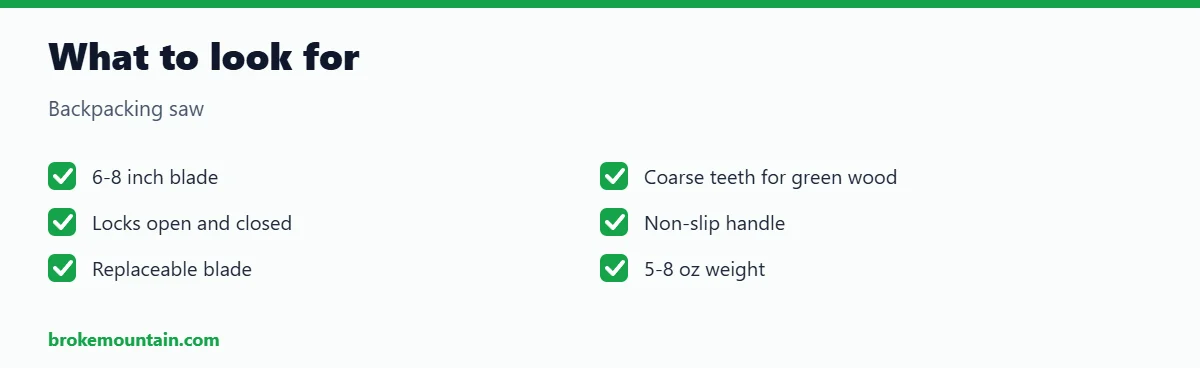
- Blade length: 6 to 8 inches is the sweet spot for backpacking. As a rule of thumb, a saw comfortably cuts wood up to about half its blade length in diameter.
- Tooth pattern: coarse teeth (about 6 to 7 per inch) clear sawdust well in green wood; finer teeth (10 or more per inch) cut dry hardwood more smoothly.
- Cutting stroke: pull-stroke saws are fast with thin blades; push-and-pull saws are more forgiving.
- Locking mechanism: the blade should lock open securely. A lock when closed stops it opening in your pack.
- Handle: non-slip and comfortable with wet or gloved hands.
- Replaceable blades: a new blade costs far less than a new saw.
- Weight: 5 to 8 ounces is typical for a good folding saw.
How to use a camping saw safely
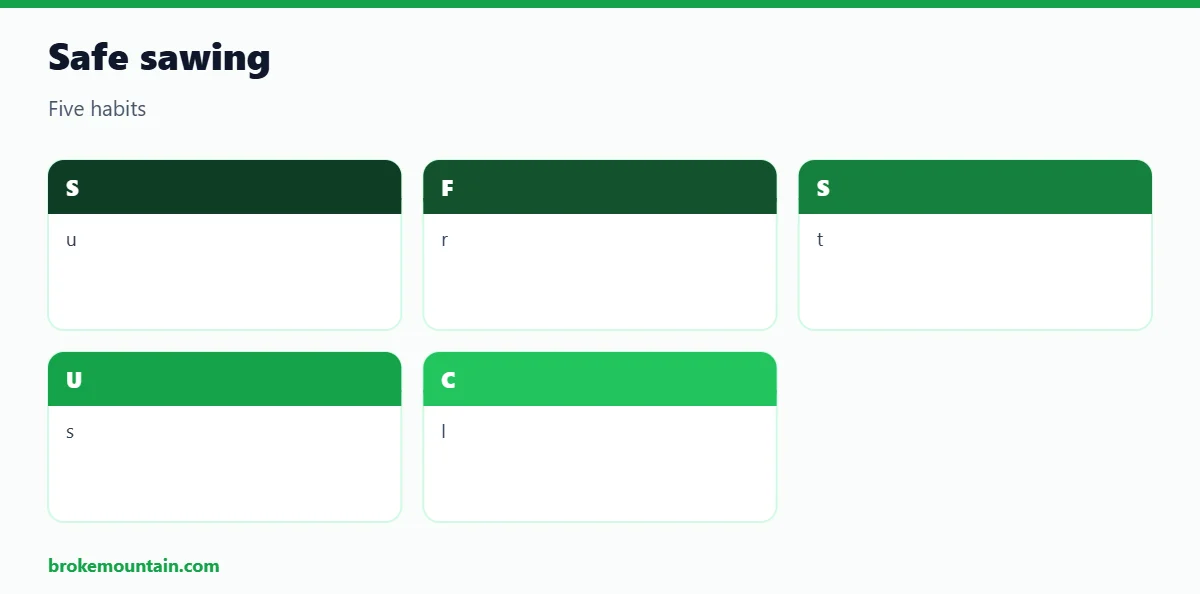
- Support the wood on a log or a low stump so the cut opens as you saw and does not pinch the blade.
- Keep your free hand well away from the blade path. Cross your holding arm over to the far side of the blade so a slip moves away from your hand.
- Start with light pull strokes to make a groove, then use the full length of the blade without forcing it.
- Close and lock the saw as soon as you finish each job.
- Wear gloves on your holding hand if you have them.
- Clean off sap with a little alcohol or oil and dry the blade before storing it.
Care and maintenance
- Clean: resin builds up on the blade and makes it drag. Wipe it off with rubbing alcohol or a little cooking oil.
- Dry: fold the saw away only when the blade is dry, and add a drop of oil to the pivot now and then.
- Protect: do not twist the blade in the cut or use the saw as a lever. Bent blades rarely straighten properly.
- Check the lock: if the blade wobbles when open, tighten the pivot screw before using it.
- Replace, do not sharpen: hardened teeth last a long time but cannot be filed. Fit a new blade when cutting becomes slow.
Fires, firewood and Leave No Trace
- Check fire rules before your trip; many areas ban fires seasonally or year-round.
- Cut only dead and down wood where collecting is allowed. Never cut living trees or standing dead trees, which are wildlife habitat.
- Keep fires small and use existing fire rings.
- Do not transport firewood long distances, as it can spread tree pests. Buy it near where you camp.
For planning, see how much firewood you need for camping.
Frequently asked questions
Is a saw better than an axe for camping?
For most campers, yes. A saw is safer, lighter and more precise, and it cuts wood to length with less effort.
What is the best ultralight backpacking saw?
A small folding saw with a 6- to 7-inch blade, such as the Silky F180, at around 5 to 6 ounces.
What size saw do I need for firewood?
A 7-inch blade handles wrist-thick wood. For logs 4 inches and thicker, choose a 9- to 12-inch blade.
How do I keep a camping saw sharp?
Keep it clean and dry and avoid cutting into soil. Most modern saws have hardened teeth that cannot be filed, so replace the blade when it starts to bind or tear.
Can I take a saw on a plane?
Not in hand luggage. Pack it in checked baggage and check your airline’s rules.
Keep reading
- How much firewood do I need for camping?
- Best camping shovels
- Backpacking cooking gear
- All gear buying guides
Last checked: November 2026. Prices and specifications change, so confirm details with the retailer before you buy.

Hi, I am Emam Hasan — founder and editor of BrokeMountain. I oversee this blog’s hiking, camping and outdoor gear guides, making sure every article is well-researched, accurate and genuinely helpful for your time on the trail. Enjoy it!