
Quick answer: good full-suspension mountain bikes make rough trails faster, more comfortable and more fun, but quality suspension costs money. Expect to spend roughly $2,000 to $2,500 or more for a new full-suspension bike from an established brand with an air shock, hydraulic brakes and a 1x drivetrain. Strong budget picks include the Marin Rift Zone 2, Polygon Siskiu T8 and Trek Fuel EX 5. If you have more to spend, the Santa Cruz Tallboy, Santa Cruz Hightower and Ibis Ripmo are among the best-reviewed trail bikes. Below about $1,800, a well-equipped hardtail is usually the better bike.
BrokeMountain is reader-supported. We may earn a commission when you buy through links on this page, at no extra cost to you. Learn more.
How we put this together: we haven’t ridden these bikes in person. This guide is based on independent group tests and reviews from The Loam Wolf, MBR, Flow Mountain Bike, OutdoorGearLab and others. Specs and prices change every model year, so check the current version before you buy.
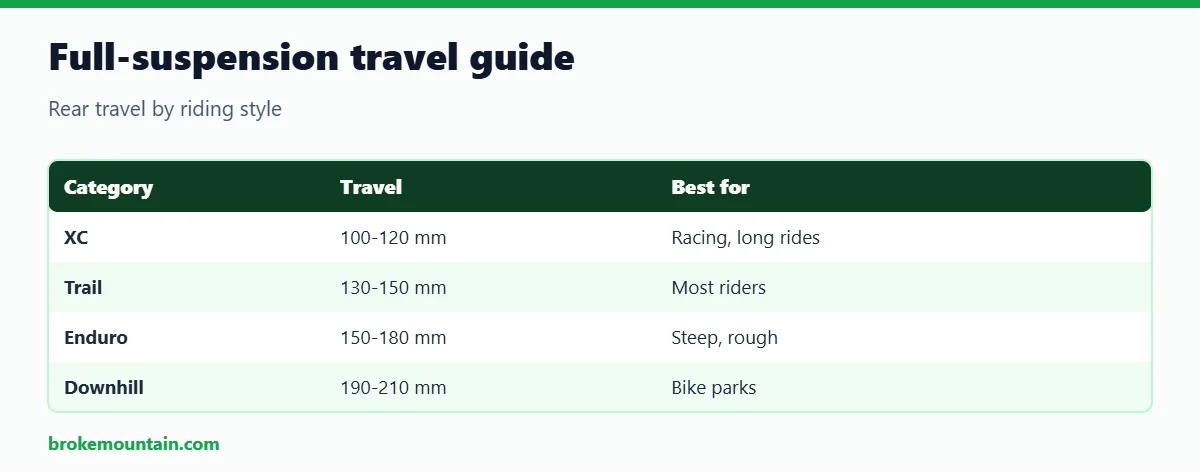
Choose the right travel for your riding
| Category | Rear travel | Best for |
|---|---|---|
| Cross-country (XC) | 100 to 120 mm | Racing, long rides, smooth to moderate trails |
| Down-country / short-travel trail | 110 to 130 mm | Fast, efficient trail riding |
| Trail | 130 to 150 mm | The best all-rounder for most riders |
| All-mountain / enduro | 150 to 180 mm | Steep, rough descents and bike parks |
| Downhill | 190 to 210 mm | Uplift and bike-park riding only |
For most people, a trail bike with about 130 to 150 mm of rear travel is the right choice. It climbs well enough for long rides and has enough suspension for rough descents. If you mostly ride smooth, fast trails, a shorter-travel bike will feel quicker. If you ride steep, rocky trails or bike parks, look at longer-travel bikes or our downhill bike guide.
What to look for in a full-suspension mountain bike
- Rear shock: an air shock with rebound adjustment, ideally with a climb switch, from RockShox, Fox, Marzocchi or similar.
- Fork: an air fork with proper damping and travel to match the rear. Our suspension fork guide explains the differences.
- Suspension design: modern designs from established brands pedal well. Avoid basic single-pivot designs with cheap coil springs found on very low-cost bikes.
- Brakes: hydraulic discs, ideally four-piston on trail and enduro bikes. See our hydraulic brake guide.
- Drivetrain: a 1x 11 or 12-speed system.
- Dropper post: standard on most trail bikes from mid-range up, and one of the best upgrades if yours doesn’t have one. See our dropper post guide.
- Fit and geometry: size by reach, and check the bike suits your height.
Best full-suspension mountain bikes: our picks
1. Marin Rift Zone 2 (best budget all-rounder)
The Rift Zone 2 is one of the most praised budget full-suspension bikes. In The Loam Wolf’s budget bike roundup of five full-suspension bikes under $2,500, it won the best do-it-all bike under $2,500. Their tested 29er had 130 mm of rear travel, a 140 mm fork and a price of $2,299. Testers found it climbed well and was stable yet agile on descents, though they wanted more powerful brakes.
- Best for: new full-suspension riders who want one bike for everything.
- Watch for: brakes are the first upgrade to consider.
Check Marin Rift Zone prices on Amazon
2. Polygon Siskiu T8 (best value)
Polygon sells direct and packs a lot of bike into the price. MBR lists the Siskiu T8 at the top of its best budget full-suspension bikes and notes that the cheaper Siskiu D5 is the old Calibre Bossnut with a different badge and parts. MBR also points out that it doesn’t rate any full-suspension bike under £1,000 among the best full-suspension bikes overall, which is a useful reality check on cheap full-suss.
- Best for: riders who want the most bike for the money.
- Watch for: direct-sale bikes need home assembly and setup.
Check Polygon Siskiu prices on Amazon
3. Trek Fuel EX 5 (best from a big-brand dealer)
The Fuel EX is one of Trek’s most popular trail bikes. The Loam Wolf tested the Gen 5 Fuel EX 5 at $2,499 with 130 mm of rear travel, a 140 mm fork and 29in wheels, and noted its 35 mm inner-width rims and 2.6in tyres. Buying from a Trek dealer makes warranty claims and servicing easy. Newer generations of the Fuel EX have more travel and higher prices.
- Best for: riders who want dealer support.
- Watch for: check which generation and build you are buying.
Check Trek Fuel EX prices on Amazon
4. Canyon Spectral (best direct-sale trail bike)
The Canyon Spectral family covers alloy and carbon trail bikes with different travel options. Direct sales keep the spec high for the price. Flow Mountain Bike groups the Spectral with the Specialized Stumpjumper 15 and Santa Cruz Hightower as burlier trail bikes.
- Best for: riders who want good parts for the money and are happy to set up a bike at home.
- Watch for: sizing and delivery times; no local shop support.
Check Canyon Spectral prices on Amazon
5. Specialized Stumpjumper 15 (best adjustable trail bike)
The Stumpjumper is Specialized’s main trail bike and comes in alloy and carbon builds. It is a common choice for riders who want one bike that can handle long rides and rough descents. Check the alloy builds if you want a lower price.
- Best for: riders who want a versatile trail bike from a big dealer network.
- Watch for: premium builds get expensive quickly.
Flow Mountain Bike named the Santa Cruz Tallboy 6 its best trail bike overall in its August 2026 update, praising it as light, efficient and playful with smooth, grippy suspension. It sits between short-travel bikes and burlier trail bikes, which makes it a strong all-rounder.
- Best for: riders who want a fast, efficient trail bike.
- Watch for: premium price.
7. Santa Cruz Hightower (best long-travel trail bike)
The Hightower is a 29er trail bike for rough terrain. Flow Mountain Bike rates it the best long-travel trail bike, and OutdoorGearLab named the Hightower 90 its best aggressive trail bike, noting the fourth generation has 150 mm of rear travel and a 160 mm fork with Santa Cruz’s VPP suspension.
- Best for: riders who want enduro-like confidence without a full enduro bike.
- Watch for: high price.
8. Ibis Ripmo V3 (best overall trail bike, OutdoorGearLab)
OutdoorGearLab named the Ibis Ripmo V3 its best overall trail bike. The Ripmo is a longer-travel 29er known for climbing well for its travel, and it is a good choice for riders who want one capable bike for big days.
- Best for: experienced riders who want a top-level do-it-all bike.
- Watch for: premium price and fewer dealers than the biggest brands.
Full-suspension mountain bikes compared
| Bike | Level | Best for |
|---|---|---|
| Marin Rift Zone 2 | Budget | All-round trail riding |
| Polygon Siskiu T8 | Budget | Value |
| Trek Fuel EX 5 | Budget | Dealer support |
| Canyon Spectral | Mid-range | Spec for the money |
| Specialized Stumpjumper 15 | Mid to premium | Versatility |
| Santa Cruz Tallboy 6 | Premium | Fast trail riding |
| Santa Cruz Hightower | Premium | Rough terrain |
| Ibis Ripmo V3 | Premium | Big all-round days |
Alloy or carbon frame?
Most budget and mid-range full-suspension mountain bikes use aluminium frames, while premium models are often carbon. Carbon frames are usually lighter and can be tuned for stiffness and comfort, but they cost much more. A good alloy frame with better suspension and brakes often rides better than a carbon frame with basic parts at the same price. If you are deciding where to spend, put the money into the fork, shock, brakes and tyres first. Our guide to carbon mountain bikes for the money covers the trade-offs in more detail.
Wheel size: 29in, 27.5in or mixed
Most modern full-suspension mountain bikes for adults use 29in wheels, which roll over roots and rocks more easily and hold speed well. Some trail and enduro bikes use a mixed setup with a 29in front and a 27.5in rear, which keeps the rolling benefits up front but makes the bike feel more playful and gives shorter riders more clearance. Smaller frame sizes may come with 27.5in wheels. Try both if you can, but for most riders a 29er is the safe choice.
Full-suspension e-mountain bikes
Nearly all e-mountain bikes are full-suspension. The motor helps you climb, so many riders choose more travel than they would on a normal bike. E-bikes are heavier and more expensive, and they need stronger tyres, brakes and wheels. If you are considering one, see our guide to the best electric mountain bikes, and check local trail rules, as some trails do not allow e-bikes.
Budget full-suspension bikes: what to know
Very cheap full-suspension bikes, such as many big-box and online-marketplace models under $500, use steel or heavy aluminium frames, a basic spring shock with little or no damping, and low-end parts. They are fine for casual riding on paths, but on real trails they bob, bounce and wear quickly. A good used full-suspension bike from an established brand, or a new trail hardtail, is a better investment. Our guides to the best hardtails and mountain bikes under $1,000 cover the alternatives.
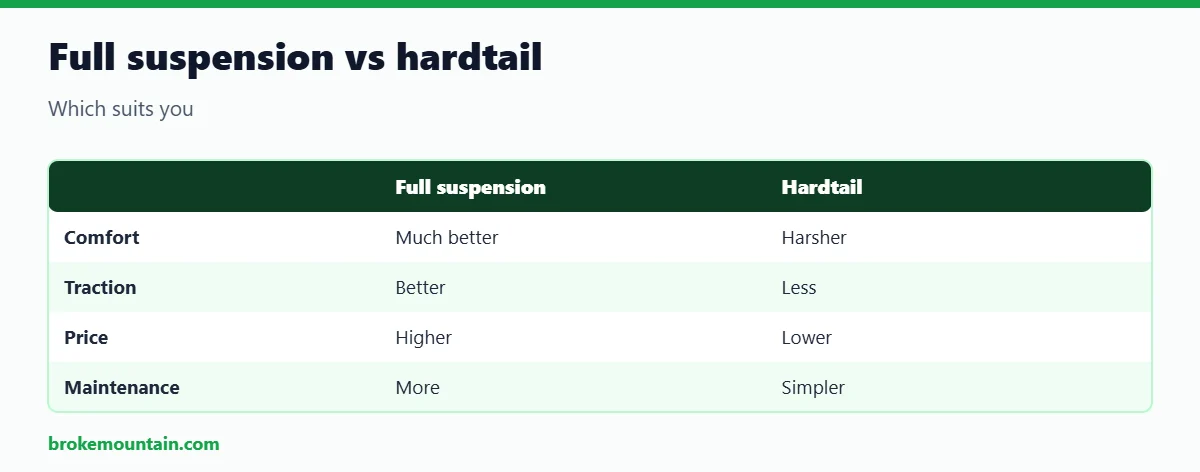
Full suspension vs hardtail
| Full suspension | Hardtail | |
|---|---|---|
| Comfort on rough trails | Much better | Harsher |
| Traction | Better on roots and rocks | Less |
| Price | Higher | Lower for the same parts |
| Maintenance | More: pivots and shock | Simpler |
| Weight | Heavier | Lighter |
If your budget is limited, a hardtail with good brakes, tyres and fork often rides better than a cheap full-suspension bike. If your trails are rough and you can afford a quality full-suspension bike, the extra comfort and grip are worth it.
Setting up your suspension
Even good full-suspension mountain bikes ride badly if the suspension is set up wrong. Start with these basics:
- Set sag: most trail bikes run about 25 to 30% sag at the rear; check the manufacturer’s recommendation.
- Set rebound: start in the middle of the range. Too fast feels bouncy; too slow feels harsh over repeated hits.
- Use the climb switch on long smooth climbs if your shock has one.
- Check tyre pressure, which has a big effect on grip and comfort. See our tyre pressure guide.
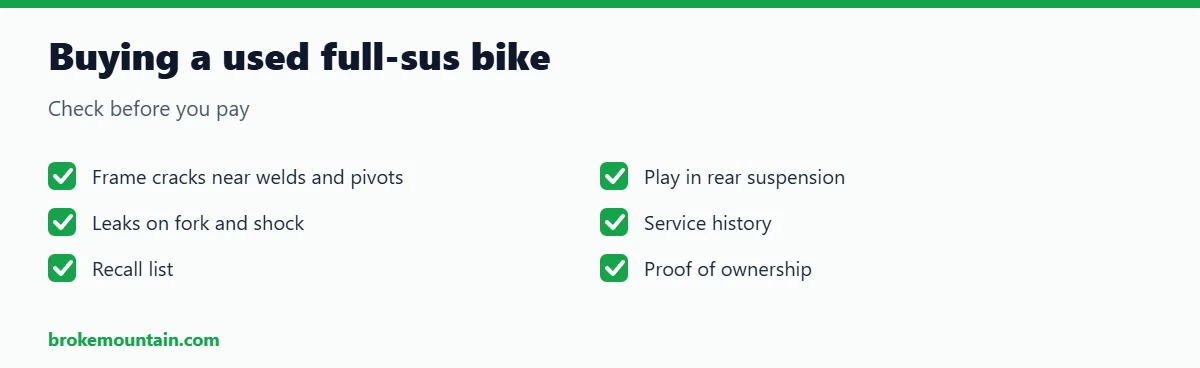
Buying a used full-suspension bike
- Check the frame for cracks, especially around welds and pivots.
- Check for play in the rear suspension, which means worn bearings or bushings.
- Look for oil leaks and scratches on fork stanchions and the shock body.
- Ask when the fork and shock were last serviced.
- Check the frame is not on a recall list, and ask for proof of ownership.
Frequently asked questions
Is full suspension worth it for beginners?
It can be on rough trails, but a hardtail is cheaper, simpler and great for learning. If your local trails are very rough, an entry-level full-suspension bike from a good brand is worth considering.
How much should I spend on a full-suspension mountain bike?
Around $2,000 to $2,500 for a reliable new entry-level bike from an established brand; less if you buy used.
Do full-suspension bikes need more maintenance?
Yes. Pivot bearings, shock servicing and more parts need checking. Budget for regular servicing.
What is the best full-suspension mountain bike brand?
There is no single best brand. Santa Cruz, Specialized, Trek, Canyon, Ibis, Marin and Polygon all make well-reviewed full-suspension bikes. See our mountain bike brands guide.
Keep reading
- Best hardtail mountain bikes
- Best downhill mountain bikes
- Best mountain bike brands
- Best budget mountain bikes under $1,000

Hi, I am Emam Hasan — founder and editor of BrokeMountain. I oversee this blog’s hiking, camping and outdoor gear guides, making sure every article is well-researched, accurate and genuinely helpful for your time on the trail. Enjoy it!


