
Quick answer: on a typical mountain bike size chart, most adults ride a Small mountain bike at about 5’4″ to 5’7″, a Medium at 5’7″ to 5’10”, a Large at 5’10” to 6’1″ and an Extra-large above 6’1″, according to BikeRadar’s general size chart. These are starting points only: every brand sizes its bikes a little differently, so always check the chart for the exact model, then confirm the fit with standover clearance, reach and saddle height.
BrokeMountain is reader-supported. We may earn a commission when you buy through links on this page, at no extra cost to you. Learn more.
How we put this together: this guide combines general size charts from BikeRadar and evo with brand size charts published by retailers, and we link each source. Every brand sizes its bikes a little differently, so always check the size chart for the exact model you are buying.
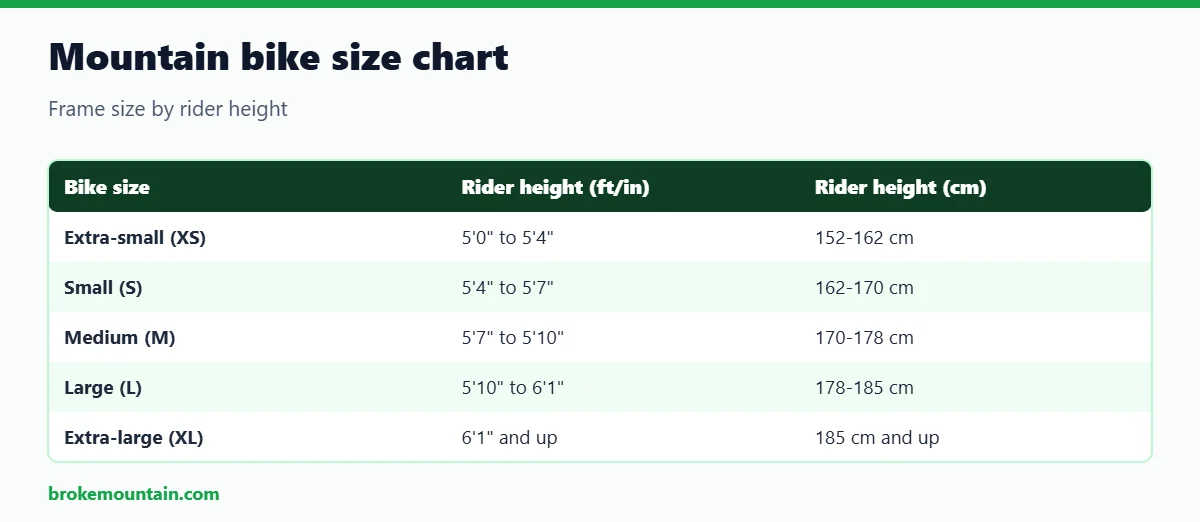
Mountain bike size chart by height
| Bike size | Frame size | Rider height (ft/in) | Rider height (cm) |
|---|---|---|---|
| Extra-small (XS) | 13-14 in | 5’0″ to 5’4″ | 152-162 cm |
| Small (S) | 14-16 in | 5’4″ to 5’7″ | 162-170 cm |
| Medium (M) | 16-18 in | 5’7″ to 5’10” | 170-178 cm |
| Large (L) | 18-20 in | 5’10” to 6’1″ | 178-185 cm |
| Extra-large (XL) | 20-22 in | 6’1″ and up | 185 cm and up |
This general chart comes from BikeRadar, which also recommends checking each manufacturer’s own chart. Frame sizes in inches are a legacy measurement of seat tube length; most brands now use letter sizes (S, M, L) instead.
How to read a mountain bike size chart
A mountain bike size chart usually lists three things: the letter size, the old frame size in inches and a rider height range. Read it in this order:
- Find your height in the rider height column, measured barefoot.
- Note the letter size next to it; this is the size you order.
- Check the overlap: where two height ranges overlap, you can ride either size.
- Look for inseam or reach if the chart lists them; they help riders with long or short legs.
- Compare the model’s geometry table if you already own a bike you like, by matching its reach figure.
Ignore the inch frame size on modern bikes; two “17-inch” frames from different brands can fit very differently. The letter size and the height range on the brand’s own mountain bike size chart are what matter.
Why brand size charts differ
Two riders of the same height can fit different sizes on two different brands. Modern mountain bikes are sized mainly by reach (the horizontal distance from the bottom bracket to the top of the head tube), not by seat tube length, and every brand has its own geometry. A few examples show how much the height ranges move:
- Santa Cruz Bronson: Medium for 5’5″ to 5’9″, Large for 5’9″ to 6’1″, and an XXL for riders up to 6’7″, according to evo’s Bronson size chart.
- Co-op Cycles DRT (REI’s house brand): Medium for 5’6″ to 5’9″ and Large for 5’9″ to 6’0″, per REI’s product size chart.
- Trek: uses letter sizes and adds an M/L size on many models for riders who sit between Medium and Large.
That is why a rider who is 5’9″ might ride a Medium on one bike and a Large on another. Use the general chart above to narrow it down, then use the brand’s chart to decide.
Should you size up or size down?
If your height falls on the line between two sizes, think about how you ride. According to evo’s mountain bike sizing guide:
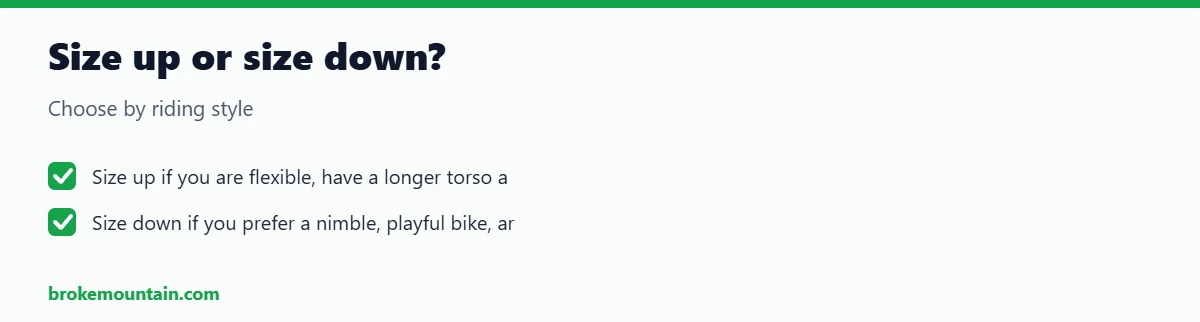
- Size up if you are flexible, have a longer torso and like to ride straight over rough terrain at speed. A longer bike feels more stable when the trail gets fast and steep.
- Size down if you prefer a nimble, playful bike, are less flexible, have a shorter torso or ride more casually. A shorter bike is also easier to stay comfortable on for long rides.
BikeRadar also warns that a bike that is too small can feel twitchy and nervous. Small changes in stem length, handlebar width and saddle position can fine-tune fit, but they cannot fix a frame that is the wrong size.
How to check your mountain bike fit
Once the mountain bike size chart has given you a size, check these points, ideally on a test ride:
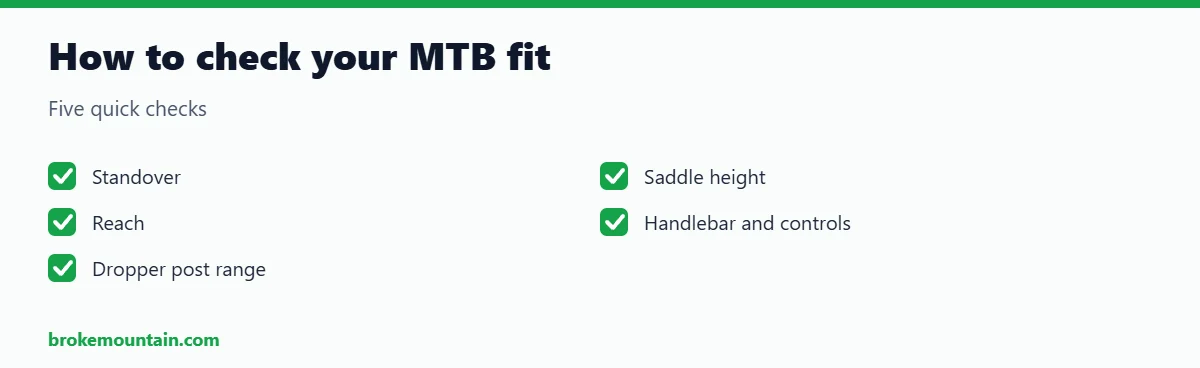
- Standover: stand over the bike with your feet flat. BikeRadar recommends at least an inch of clearance between the top tube and your crotch.
- Saddle height: your leg should be almost straight at the bottom of the pedal stroke, with a slight bend at the knee.
- Reach: standing on the pedals, you should feel balanced, not cramped or stretched out.
- Handlebar and controls: you should reach the brake levers without twisting your wrists.
- Dropper post range: check the saddle drops low enough for steep descents.
A dropper post makes saddle height a non-issue on descents. Our guide to the best dropper posts for mountain bikes explains how to choose the right travel for your size.
What about inseam?
Some size charts also list inseam, especially for riders with long or short legs for their height. Measure from the floor to your crotch while standing barefoot against a wall. If your inseam is long for your height, you may prefer the larger of two sizes; if it is short, standover clearance matters more and the smaller size may suit you better. Trek’s published chart, for example, pairs a Small with a 29 to 31 inch inseam.
Women’s mountain bike sizing
Women’s-specific mountain bikes usually use the same letter sizes and the same mountain bike size chart, and retailers such as Academy Sports note they typically have smaller frames and narrower handlebars for shorter riders. Many women ride unisex bikes perfectly well; the size chart and test ride matter more than the label. See our picks for the best women’s mountain bikes under $1,000.
Sizing tips for specific riders
- Heavier riders: check the bike’s weight limit as well as its size; see mountain bikes for heavy riders.
- Budget buyers: entry-level hardtails follow the same charts; see good mountain bikes for under $1,000.
- Comfort seekers: the right saddle can make a big difference; see the best saddles for mountain bikes.
Check short MTB stems on Amazon
Frequently asked questions
What size mountain bike do I need for my height?
As a starting point, Small for about 5’4″ to 5’7″, Medium for 5’7″ to 5’10”, Large for 5’10” to 6’1″ and Extra-large above 6’1″. Always confirm with the brand’s own chart.
What size mountain bike for a 5’9″ person?
At 5’9″ you are usually between Medium and Large. Choose Medium for a nimble, playful ride or Large for more stability, and check the brand chart, as some brands offer an M/L size.
What size mountain bike for a 6 foot person?
Most 6-foot riders fit a Large. Very long-legged or tall-torso riders may prefer an Extra-large on some brands.
Is a 27.5 or 29 inch wheel better for my size?
It depends on the bike model. Some brands change wheel size and even suspension travel across the size range of the same model, so the smallest frames may use smaller wheels. Choose the frame size first, then check which wheel size that size comes with.
The bottom line
A mountain bike size chart gets you close: Small, Medium, Large or Extra-large based on your height. The brand’s own chart and a quick fit check do the rest. If you are between sizes, size up for stability and speed, or size down for a nimble, comfortable ride, and test-ride both if you can.
Last checked: November 2026. Brand size charts change between model years, so check the current chart for your exact bike before you buy.

Hi, I am Emam Hasan — founder and editor of BrokeMountain. I oversee this blog’s hiking, camping and outdoor gear guides, making sure every article is well-researched, accurate and genuinely helpful for your time on the trail. Enjoy it!


