As an Amazon Associate, BrokeMountain earns from qualifying purchases. We did not test these dropper posts in person; this guide is based on maker specifications, independent reviews and rider feedback.
A dropper post lets you lower your saddle with a thumb lever while you ride, then raise it again for climbing. It is one of the biggest upgrades you can make to a trail or enduro mountain bike: with the saddle out of the way, you can move your weight back on steep descents, corner lower and ride technical sections with more confidence. Fewer than ten years ago droppers were rare; today almost every trail bike comes with one.
Not all dropper posts are equal, though. They differ in travel, stack height, insertion depth, weight, reliability and how easy they are to service. This guide compares the best dropper posts for mountain bikes and explains how to choose the right size for your frame and legs.
Looking for a rigid post instead? If you want a light fixed post for cross-country racing, see our guide to the best carbon mountain bike seatposts.
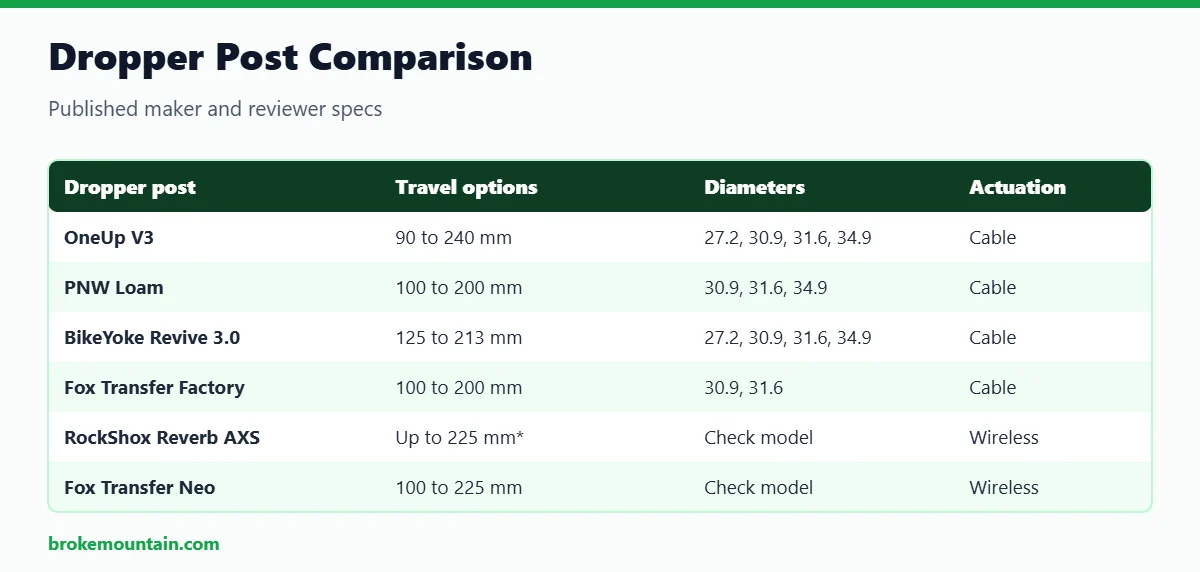
*Travel options for wireless posts vary by model year; check the current listing before you buy.
Quick Picks
- Best overall: OneUp Components V3
- Best budget: PNW Components Loam
- Smoothest and most serviceable: BikeYoke Revive 3.0
- Best for Fox-equipped bikes: Fox Transfer Factory
- Best wireless: RockShox Reverb AXS or Fox Transfer Neo
1. OneUp Components V3
Best overall. The OneUp V3 is the dropper that keeps topping buyer’s guides, including BikeRadar’s and Bikerumor’s. Its big advantage is fit: OneUp says it has the shortest total length and stack height of any dropper post, with a 30mm compressed stack height (25mm on the 34.9mm version). That means most riders can fit more travel than with other posts, and the travel can be reduced by 10mm or 20mm with small shims to fine-tune fit.
It comes in 90, 120, 150, 180, 210 and 240mm drops, and in 27.2mm (90 and 120mm only), 30.9mm, 31.6mm and 34.9mm diameters. Listed weights for the 31.6mm version range from about 337g (90mm) to 610g (240mm). It uses a sealed cartridge that never needs to be inflated, and reviewers praise how easy it is to service at home with basic tools. Note that the remote lever is sold separately.
Pros: most drop for your frame, light, adjustable travel, easy home service, good value.
Cons: remote not included; the sealed cartridge is replaced rather than rebuilt.
Check the OneUp V3 Dropper Post on Amazon
2. PNW Components Loam
Best budget. PNW’s Loam dropper is a long-time favorite for riders who want reliable performance without a premium price. Bikerumor lists it at $229 with travel options of 100, 125, 150, 175 and 200mm and diameters of 30.9, 31.6 and 34.9mm, and measured the 31.6mm x 150mm post at 529g plus a 49g lever. PNW’s Loam lever is one of the best-liked remotes at any price, with a smooth feel and good adjustment.
The trade-off is length: earlier tests noted a longer overall length and stack height than the OneUp, and fixed extension speed. Measure your frame before you choose your travel.
Pros: great value, excellent lever, reliable.
Cons: taller stack and longer body than the OneUp; extension speed is not adjustable.
Check the PNW Loam Dropper on Amazon
3. BikeYoke Revive 3.0
Smoothest and most serviceable. BikeYoke’s Revive has a reputation for an exceptionally smooth action and solid build quality. Bikerumor lists the Revive 3.0 at $350 to $420 with 125, 160, 185 and 213mm travel and diameters from 27.2mm to 34.9mm; the 31.6mm x 213mm post weighed 633g plus a 32g lever. The Revive is known for its quick “revive” reset valve, which lets you fix a spongy post in seconds with a hex key instead of a full service.
Pros: very smooth, easy to reset on the trail, fully serviceable, long-lasting.
Cons: pricier; heavier than the OneUp at long travel.
Check the BikeYoke Revive on Amazon
4. Fox Transfer Factory
Best for Fox-equipped bikes. The Fox Transfer is fitted to many high-end bikes as original equipment, and the Factory version with Kashima coating is a popular upgrade if you want your post to match your Fox fork and shock. Bikerumor lists it at $350 to $380 in 100, 125, 150, 175 and 200mm travel and 30.9 and 31.6mm diameters, with the 31.6mm x 150mm post weighing 585g plus a 46g lever. It is available in both internally and externally routed versions.
Pros: proven reliability, smooth action, matches Fox suspension.
Cons: taller stack height than the OneUp; Factory version is pricey.
Check the Fox Transfer on Amazon
5. RockShox Reverb AXS and Fox Transfer Neo
Best wireless. Wireless droppers use a battery-powered remote, so there is no cable to route through the frame. That makes installation and swapping between bikes much easier, and the action is crisp and consistent. ENDURO Mountainbike Magazine’s group test included both the RockShox Reverb AXS and the Fox Transfer Neo. Bikerumor lists the Transfer Neo at $859 with travel from 100 to 225mm.
The downsides are price, weight, taller stack height and the need to charge batteries. They make the most sense on bikes that already use wireless shifting, or for riders who swap one post between bikes.
Pros: no cable, easy install, crisp action.
Cons: very expensive, heavier, batteries to charge.
Check the RockShox Reverb AXS on Amazon
Check the Fox Transfer Neo on Amazon
How to Choose the Right Dropper Post Length
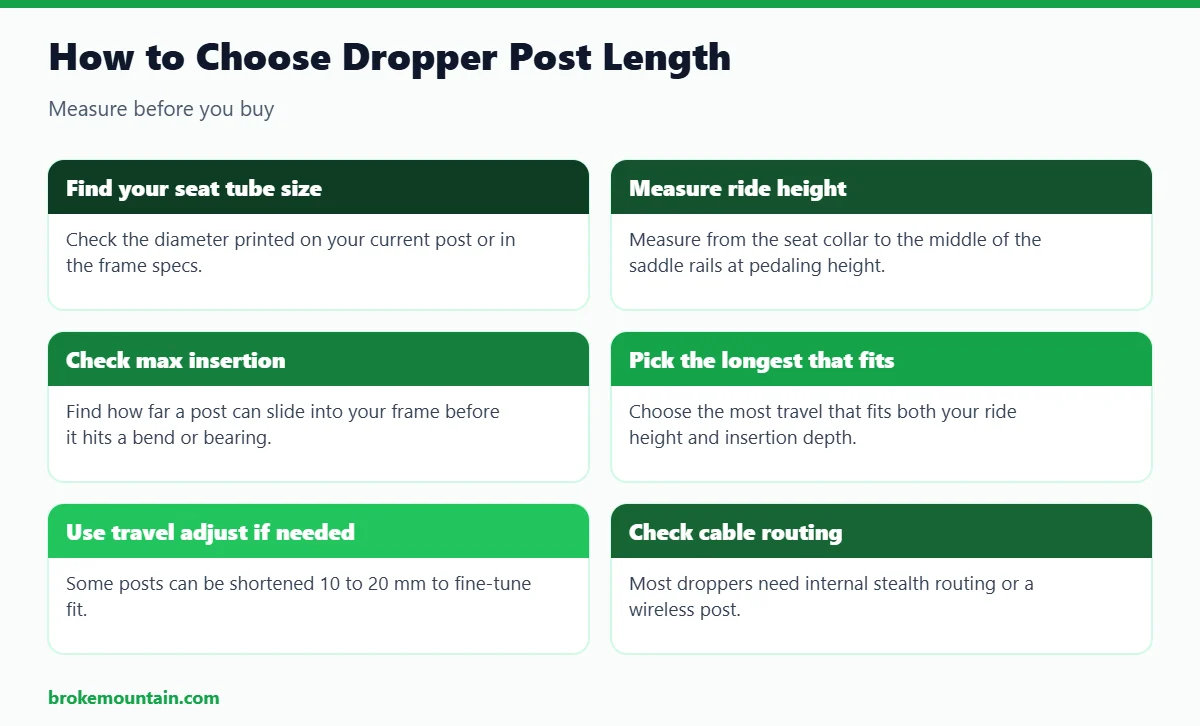
Most riders want the longest dropper that fits, because more drop gives more room to move on descents. But the post must fit two limits: your ride height (how high the saddle sits when pedaling) and your frame’s maximum insertion depth (how far a post can slide in before hitting a bend, bearing or water bottle bolt).
- Find your seat post diameter. It is usually printed on your current post or listed in your frame specs. Common sizes are 30.9, 31.6 and 34.9mm.
- Measure your ride height. With the saddle at pedaling height, measure from the top of the seat collar to the center of the saddle rails.
- Measure insertion depth. Drop a tape measure or a rigid rod down the seat tube to find the usable depth, or check the frame maker’s spec.
- Compare to the post’s dimensions. The post’s stack height plus travel must not exceed your ride height, and its total length below the collar must fit your insertion depth.
- Use a size calculator. OneUp and other brands publish online selectors that do the math for you.
As a rough guide, many riders run 150 to 180mm of drop on medium and large frames, and 200mm or more on large and extra-large frames with tall riders. Short-travel cross-country bikes often use 100 to 125mm.
Cable Routing, Diameter and Remote Levers
- Internal (stealth) routing runs the cable inside the frame to the bottom of the post. It is the standard on modern frames.
- External routing attaches the cable at the post head; it is for older frames without internal ports.
- Wireless posts need no cable at all.
- Diameter must match exactly. Shims are available to fit smaller posts into larger seat tubes, but the right size is always best.
- Remote levers mount under the left side of the bar. A good lever with a light action and adjustable position makes a big difference; many riders pair any post with a PNW Loam or OneUp lever.
Dropper Post Care and Maintenance
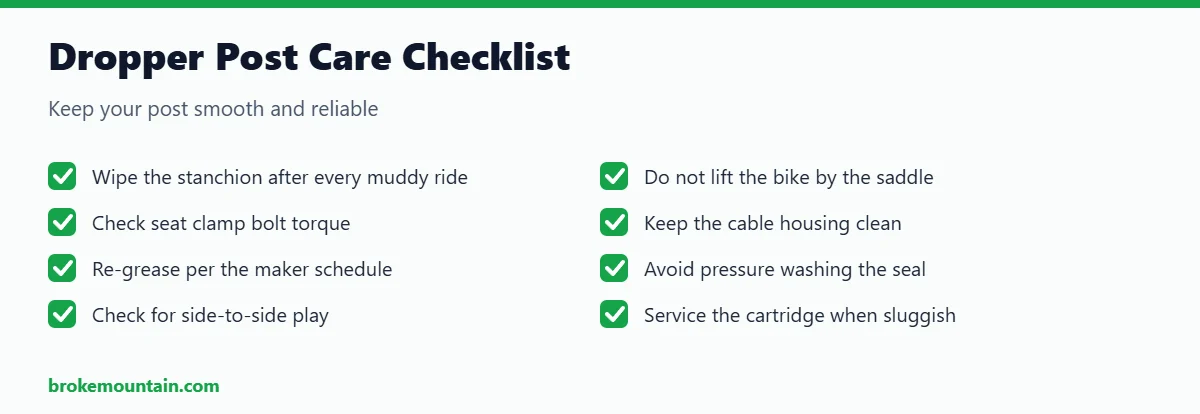
- Keep the stanchion clean: wipe off mud and dust after rides so grit does not get past the seal.
- Do not lift the bike by the saddle: on many droppers this can pull air into the cartridge and make the post sag.
- Avoid pressure washers: high-pressure water can push past seals.
- Follow the service schedule: OneUp, for example, lists a clean-and-grease interval and a longer rebuild interval. Regular light service keeps any post smooth.
- Check cable tension: a sticky or slow post is often caused by dirty cable housing or the wrong tension, not the post itself.
Keep a few spare parts and a basic tool kit in your garage bike storage setup so you can service your post at home.
Do You Need a Dropper Post?
If you ride trail, enduro, all-mountain or downhill, a dropper is a must. It makes descents safer and more fun and saves you stopping to adjust your saddle. Even many cross-country racers now use short-travel droppers on technical courses. Pure gravel riders and road riders on smooth routes are the only groups who rarely need one.
If you are shopping for a new bike, a dropper post is one of the most valuable features to look for. Many models in our guide to good mountain bikes under $1,000 already come with one, and if not, a dropper is one of the best upgrades you can add later.
Dropper Post Terms Explained
- Travel (drop): how far the saddle moves down from full height. Longer travel gives more room on descents.
- Stack height: the distance from the seat collar to the saddle rails when the post is fully lowered. A shorter stack means the saddle sits lower when dropped and lets you fit more travel.
- Total length: the full length of the post. A shorter post fits frames with bent seat tubes or limited insertion.
- Insertion depth: how far the post must or can go into the frame. Both the minimum and the frame’s maximum matter.
- Infinite adjustment: the post can stop at any height, not just a few fixed positions. All the posts in this guide work this way.
- Cartridge: the sealed hydraulic or air-and-oil unit inside that controls the post. Some are serviceable at home; others are replaced as a unit.
- Return speed: how fast the post rises. Some posts let you adjust it with air pressure; others are fixed.
Dropper Posts for Different Riding Styles
Cross-country and downcountry
Weight matters most, and you need less drop. Short-travel, lightweight posts in the 75 to 125mm range are common. Fox’s Transfer SL is one of the lightest options, and the OneUp V3 also comes in short 90 and 120mm versions, including a 27.2mm size for older or lightweight frames.
Trail riding
Most trail riders use 150 to 180mm of drop. The OneUp V3 and PNW Loam give the best mix of price, weight and reliability here.
Enduro, bike park and downhill
Riders on long-travel bikes want maximum drop and a post that survives crashes and mud. Long-travel options such as the OneUp V3 at 210 or 240mm and the BikeYoke Revive at 185 or 213mm suit tall riders and big frames. Downhill bikes, such as those in our guide to the best full-suspension downhill mountain bikes, often run the saddle low all the time, but a dropper still helps on park bikes you also pedal.
E-MTBs
Electric mountain bikes often have compact seat tubes because of the battery and motor, so short total length and insertion depth matter. Check the frame’s maximum insertion carefully before buying.
Frequently Asked Questions
Will any dropper post fit my bike?
No. You need the correct diameter, enough insertion depth for the post’s length, and the right cable routing (internal or external) for your frame. Wireless posts avoid the routing issue.
How much drop do I need?
As much as fits your ride height and frame. Measure first, then pick the longest travel that fits. Adjustable-travel posts make it easier to get a perfect fit.
Why is my dropper post sagging?
Sagging usually means air has entered the hydraulic cartridge, often from lifting the bike by the saddle. Some posts, like the BikeYoke Revive, can be reset quickly; others need a cartridge service or replacement.
Can I install a dropper post myself?
Yes, with basic tools and some patience. Internal routing takes the most time, because you need to feed the cable through the frame. A bike shop can do it if you prefer.
Are wireless dropper posts worth it?
They are easier to install and feel crisp, but cost much more. For most riders, a quality cable-actuated post gives the best value.
Final Verdict
The OneUp V3 is the best dropper post for most mountain bikers: it fits more drop into your frame, is light, and is easy to service. Choose the PNW Loam for the best value and an excellent lever, the BikeYoke Revive 3.0 for the smoothest action and quick trail resets, the Fox Transfer Factory to match your Fox suspension, and a wireless post if you want the cleanest installation. For more test results, see BikeRadar’s dropper post guide.
Browse mountain bike dropper posts on Amazon

Hi, I am Emam Hasan — founder and editor of BrokeMountain. I oversee this blog’s hiking, camping and outdoor gear guides, making sure every article is well-researched, accurate and genuinely helpful for your time on the trail. Enjoy it!