Quick answer: for a normal evening campfire of three to four hours, plan on two to four store-bought bundles of firewood. Add a bundle if you will cook over the fire, and more for cold or windy nights. For a weekend with a fire both evenings, four to eight bundles is a sensible range. Buy the wood near your campsite instead of bringing it from home, because moved firewood spreads tree-killing pests.
How we put this together: the amounts here are rules of thumb based on typical bundle sizes and burn rates, not measurements. Firewood rules come from the National Park Service and the Don’t Move Firewood campaign, linked below.
How much firewood do I need for camping? Quick estimates
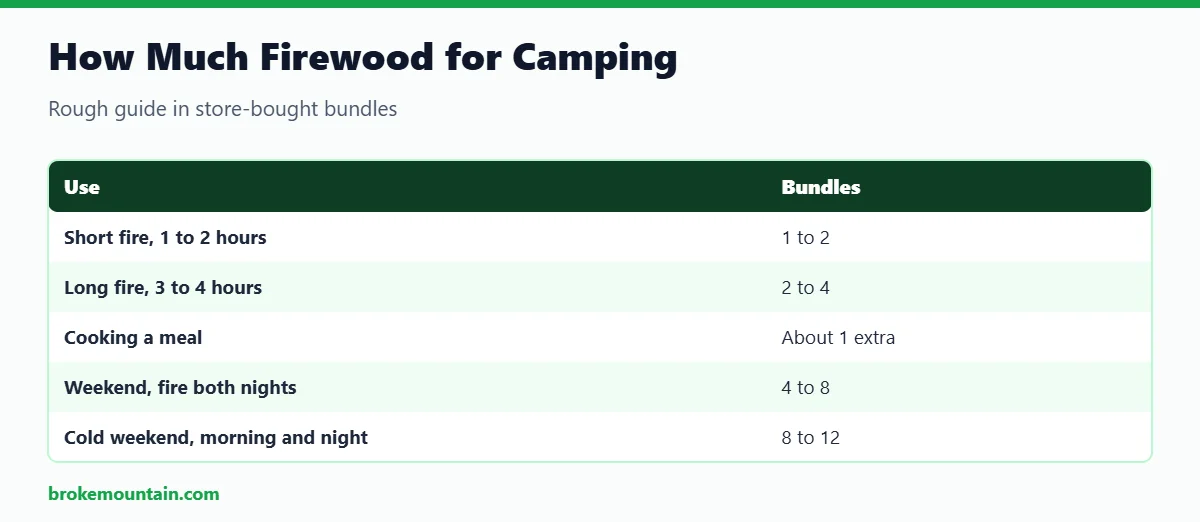
| Use | Rough amount |
|---|---|
| Short evening fire, 1 to 2 hours | 1 to 2 bundles |
| Long evening fire, 3 to 4 hours | 2 to 4 bundles |
| Cooking a meal over the fire | About 1 extra bundle |
| Morning fire for coffee and warmth | About 1 bundle |
| Weekend, fire both nights | 4 to 8 bundles |
| Cold-weather weekend, fires morning and night | 8 to 12 bundles |
A simple rule: one bundle for every one to two hours of fire. Softwood and small bundles sit at the one-hour end, dense hardwood at the two-hour end.
How big is a bundle?
A shop or campground bundle is usually a shrink-wrapped stack of five to eight split logs, about 0.75 cubic feet. Sizes are not standard, so look at what you are buying. Larger measures you may see:
| Measure | Size | Roughly equal to |
|---|---|---|
| Bundle | About 0.75 cubic feet | 5 to 8 logs |
| Face cord | 4 ft high, 8 ft long, one log deep | About 40 or more bundles |
| Full cord | 4 ft by 4 ft by 8 ft, 128 cubic feet | About 120 or more bundles |
For a one-off trip, bundles are simplest. For a week-long group camp, asking a local seller for a quarter of a face cord is often cheaper.
A worked example
Two adults camp for two nights in early autumn. They want a fire from about 7 pm to 10 pm each evening and plan to grill sausages over it on the first night. Using the rule of one bundle per one to two hours, each evening needs two to three bundles, and the cooking fire adds one more because it has to burn down to coals first. That is five to seven bundles for the trip. Buying six at the camp store on arrival, with the option of one more the next day, covers it without leaving a pile behind.
What changes how much firewood you need
- Wood type. Dense hardwoods such as oak, hickory and maple burn slowly and leave good coals. Softwoods such as pine and fir light easily and burn fast.
- Dryness. Seasoned wood burns hot and clean. Damp wood hisses, smokes and wastes heat boiling off its own water.
- Fire size. A fire of three or four logs uses a fraction of what a bonfire does.
- Weather. Wind feeds a fire and speeds it up; cold makes you build it bigger.
- Fire ring. A deep ring or a windbreak slows the burn.
- Purpose. Cooking needs a bed of coals, which takes 30 to 45 minutes of burning to build.
Hardwood or softwood?
| Hardwood | Softwood | |
|---|---|---|
| Examples | Oak, maple, hickory, ash, birch | Pine, fir, spruce, cedar |
| Lighting | Slower | Easy |
| Burn time | Long | Short |
| Coals for cooking | Good | Poor |
| Sparks and smoke | Less | More |
| Best use | Main fuel | Kindling and getting started |
The ideal load is mostly hardwood with a little softwood to start it.
Where to get firewood: buy it where you burn it
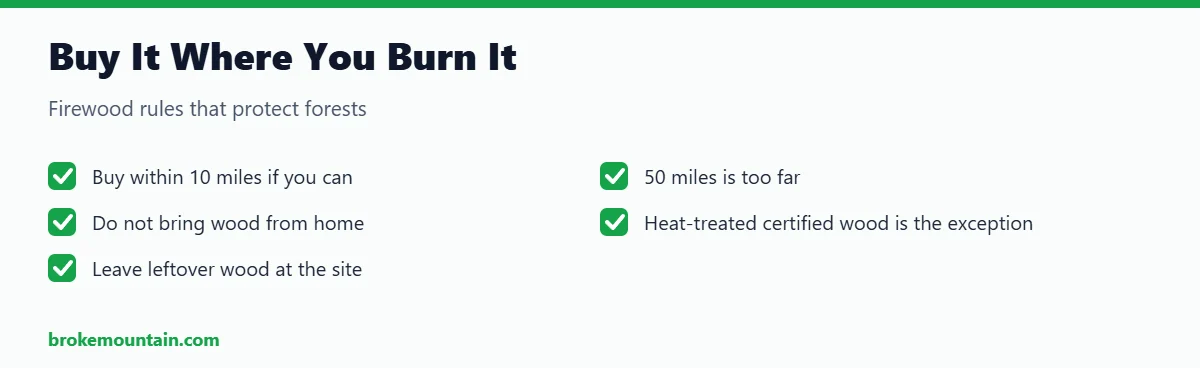
Do not bring wood from home. The National Park Service advises getting firewood within 10 miles of your destination where you can, and treats 50 miles as generally too far. The Don’t Move Firewood campaign explains why: insects and diseases that kill trees hide in or on firewood, and although they spread slowly on their own, a car can carry them hundreds of miles.
- Buy from the campground, a camp store or a roadside seller near your site.
- If you must travel with wood, buy certified heat-treated firewood with a state or federal seal.
- Seasoned wood is not safe to move just because it is old or looks clean.
- Gather dead wood from the ground only where the campground allows it, and never cut standing trees.
- Leave leftover wood at the site or with the camp host; the Park Service asks campers not to take it home either.
- Some states restrict or ban out-of-state firewood, so check before crossing a border.
Rules at the gate are getting stricter. The University of California Agriculture and Natural Resources reports that some campgrounds and parks now inspect firewood and require certified heat-treated wood or wood bought on site.
Check fire rules first
Before you buy anything, check whether fires are allowed at all. Seasonal restrictions can ban wood fires at short notice, and some sites only allow fires in the rings provided. If there is a ban, a gas stove is the alternative; see our guide to the best backpacking stoves.
How to make firewood last
- Bring kindling and fire starters so you do not burn through logs just getting it lit.
- Build small. Start with a teepee or log-cabin lay of thin pieces, then add logs one or two at a time.
- Split large logs. Smaller pieces catch faster and give you more control.
- Keep the pile dry under a tarp and off the ground.
- Use the coals. Cook over glowing coals, not flames.
- Sit close. A small fire you sit near is warmer than a big one you back away from.
- Stop adding wood 45 minutes before bed so it burns down.
Put the fire out properly
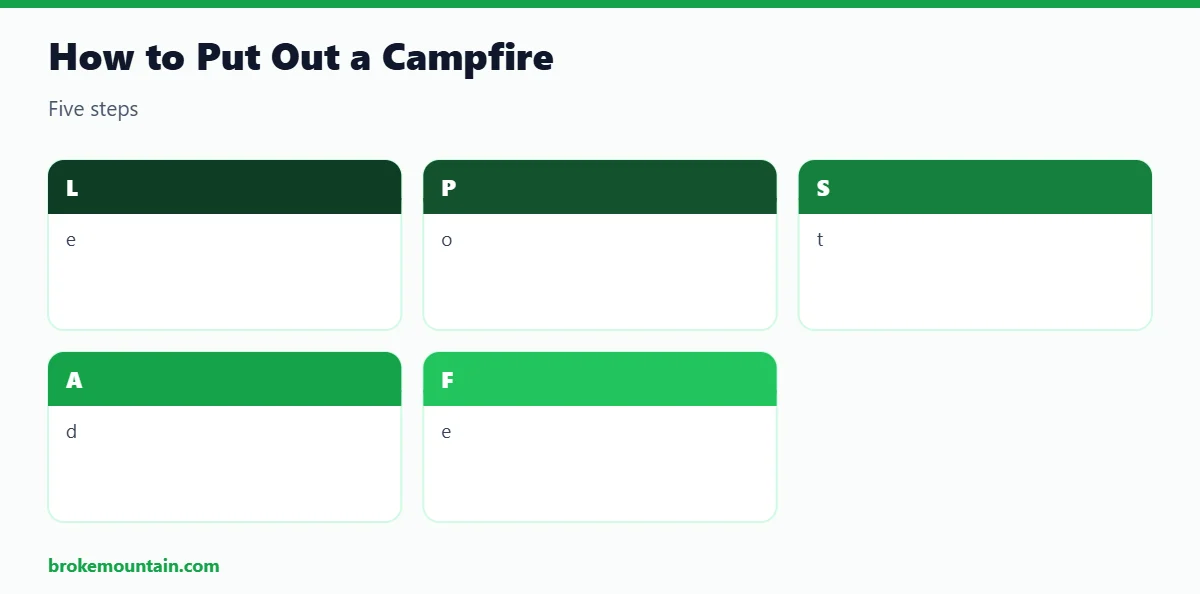
- Let the wood burn down to ash where you can.
- Pour water over all of it until the hissing stops.
- Stir the ashes and embers with a stick or shovel.
- Add more water and stir again.
- Feel with the back of your hand close to the ashes. If it is too hot to touch, it is too hot to leave.
A camping shovel and a full water container kept by the fire make this quick.
Frequently asked questions
Can I bring firewood from home?
It is restricted or banned in many areas because firewood carries invasive insects. Buy it where you burn it.
How long does a bundle of firewood last?
About one to two hours, depending on the bundle size, wood type and how big you build the fire.
How much firewood do I need for a weekend?
Four to eight bundles for evening fires on two nights; more if you also want morning fires or it is cold.
Is it cheaper to buy firewood at the campground?
Not always, but roadside sellers near the campground are often cheaper and still local.
Can I burn wood I find at the campsite?
Only if the campground allows collecting, and only dead wood already on the ground.
What should I not burn?
Rubbish, plastics, painted or treated timber, and green wood. They produce toxic or heavy smoke.
Keep reading
- How to survive camping
- Make-ahead camping meals
- Collapsible wood burning backpacking stoves
- Best camping shovels
Last checked: November 2026. Firewood and fire rules vary by state and season, so confirm locally.

Hi, I am Emam Hasan — founder and editor of BrokeMountain. I oversee this blog’s hiking, camping and outdoor gear guides, making sure every article is well-researched, accurate and genuinely helpful for your time on the trail. Enjoy it!