Quick answer: most hiking boots last about 500 to 1,000 miles (800 to 1,600 km). For someone who hikes a few times a month that is several years; for a keen hiker it can be one or two. Lightweight shoes and trail runners wear out sooner, and well-kept leather boots last longest and can often be resoled. Mileage is only a guide: replace boots when the tread, cushioning or support has gone.
How we put this together: this guide compares published lifespan figures from boot makers, retailers and outdoor publications. The numbers are estimates, and your own boots may last more or less.
How long do hiking boots last? The published figures
Sources agree on a broad range. Sierra puts quality boots and trail shoes at 500 to 1,000 miles and admits that is a huge range, shaped by your weight, your usual terrain, the type of shoe and how you maintain it. Scheels narrows it to 600 to 900 miles, which it equates to roughly one to two years of regular hiking.
Years matter less than miles. Advnture stresses that there is no simple answer because lifespan depends on the boot’s original quality, how often you hike and the ground you cover. Someone walking 50 miles a year could keep the same pair for a decade or more, as long as the materials do not perish first.
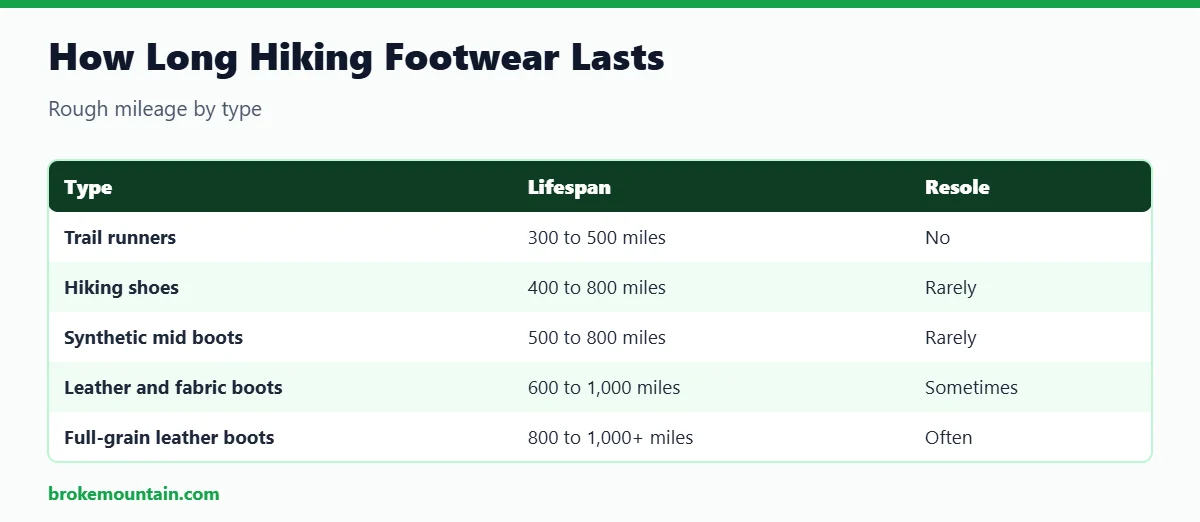
Lifespan by footwear type
| Type | Typical lifespan | What fails first | Resoleable? |
|---|---|---|---|
| Trail runners | About 300 to 500 miles | Midsole foam, mesh upper | No |
| Hiking shoes | About 400 to 800 miles | Midsole, tread | Rarely |
| Synthetic mid boots | About 500 to 800 miles | Upper at flex points, midsole | Rarely |
| Leather and fabric boots | About 600 to 1,000 miles | Tread, seams | Sometimes |
| Full-grain leather boots | About 800 to 1,000 miles or more per sole | Tread | Often |
These are rough estimates. Use the signs below, not the numbers, to decide.
How long that is in years
| Hiking habit | Miles per year | A 750-mile pair lasts about |
|---|---|---|
| Occasional: one short hike a month | 50 to 100 | 7 years or more |
| Regular: most weekends | 250 to 400 | 2 to 3 years |
| Keen: long days every week | 500 to 800 | 1 to 1.5 years |
| Thru-hiker | 2,000 or more in a season | A few months |
How to track your boot mileage
Most people have no idea how far their boots have gone, which makes the question of how long do hiking boots last hard to answer for your own pair. Three easy ways to keep count:
- Write the purchase date inside the tongue with a marker.
- Log hikes in a phone app and tag which footwear you wore; several hiking and running apps track gear mileage for you.
- Estimate: multiply your average hike length by the number of hikes you do in a year.
You do not need precision. Knowing that a pair is at roughly 600 miles tells you to start checking the tread and midsole more closely, and to budget for the next pair before a big trip, not during it. It also shows you which boots gave good value. A pair that cost twice as much but lasted three times as far was the cheaper boot per mile.
New boots need time before a long hike, so buy the replacement while the old pair still has a few weeks of life and break it in gradually.
What shortens the life of hiking boots
- Terrain. Rock, scree and tarmac grind down lugs far faster than forest paths.
- Load. A heavier hiker or a heavy pack compresses the midsole sooner.
- Wet and dirt. Grit works into the fabric and cuts fibres; mud left on leather dries it out.
- Heat. Drying boots by a fire, heater or in a hot car weakens glue and cracks leather.
- Construction. Cemented soles and soft EVA midsoles wear out sooner than stitched soles and polyurethane midsoles.
- Fit and gait. Boots that are too small or a heavy heel strike wear one area quickly.
- Age. Unused boots still degrade. Polyurethane midsoles can crumble after years in a cupboard.
Signs it is time to replace your boots
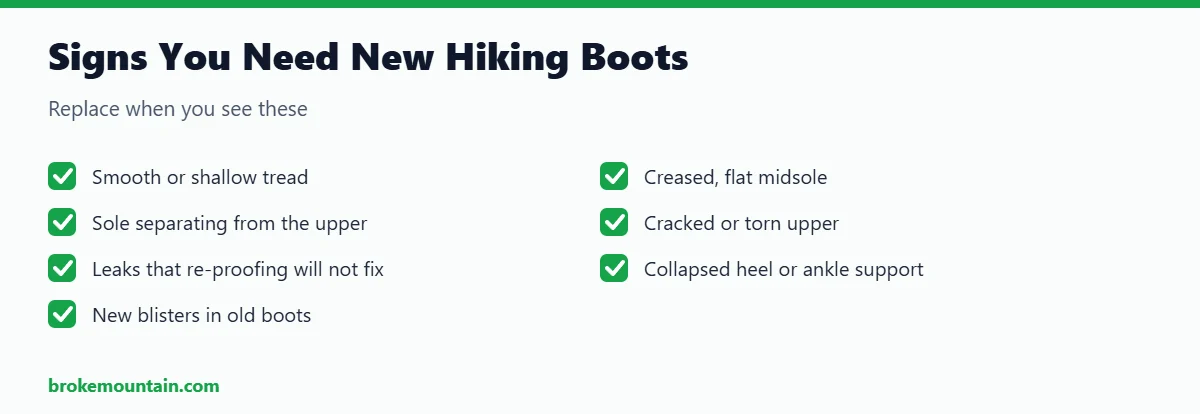
- Worn tread. Lugs are smooth or shallow at the heel and ball, and you slip where you used not to.
- Compressed midsole. Deep creases in the foam, a flat feeling underfoot, or sore knees and feet after normal hikes.
- Failed press test. Sierra describes pressing the outsole upward with your thumb to check the midsole and calls a compressed midsole the main reason to replace hiking footwear.
- Sole separating from the upper at the toe or sides.
- Cracked or torn upper, especially where the boot bends.
- Leaks that cleaning and re-proofing do not fix.
- Collapsed heel counter or ankle that no longer holds your foot.
- New blisters or hot spots in boots that used to be comfortable.
Frayed laces, worn insoles and a tired waterproof finish are not reasons to replace boots. All three are cheap to fix.
Repair, resole or replace?
| Problem | Fix |
|---|---|
| Frayed laces | Replace laces |
| Flat insoles | New insoles |
| Water no longer beads | Clean and re-waterproof |
| Small area of sole lifting | Flexible shoe adhesive, clamped overnight |
| Worn tread, sound upper and midsole | Resole, if the boot is built for it |
| Compressed or crumbling midsole | Replace |
| Torn upper, collapsed support | Replace |
Resoling suits sturdy leather boots whose uppers have years left. It is usually cheaper than a new pair of the same quality, and you keep a boot already shaped to your foot. Ask the maker or a specialist cobbler whether your model can be resoled; many light, cemented boots cannot.
How to make hiking boots last longer
- Brush off mud after every hike and rinse with plain water.
- Remove the insoles and loosen the laces so the boots air out.
- Dry slowly at room temperature. Stuff with newspaper if they are soaked; never use direct heat.
- Condition leather a few times a year so it stays supple.
- Re-proof when water stops beading.
- Rotate two pairs if you hike several days running, so the foam recovers.
- Keep them for the trail. Pavement wears lugs quickly; see are hiking boots good for everyday use?
- Store them cool, dry and out of sunlight, not in a garage or car.
- Check them a few weeks before a big trip, not the night before.

Frequently asked questions
Can hiking boots be resoled?
Many leather boots with stitched or good cemented soles can. Most lightweight fabric boots cannot.
How often should I replace hiking boots?
When you see the signs above. For regular hikers that is often every two to three years.
Do hiking boots expire if I do not use them?
Yes, slowly. Glues and foams break down with age, so flex and inspect old boots before trusting them.
Do expensive boots last longer?
Often, because of better leather, midsoles and construction, but price alone is no guarantee. Care matters as much.
Why do trail runners wear out faster than boots?
They use softer foam and thin mesh to save weight, and both break down sooner.
Is it safe to hike in worn-out boots?
On easy paths, perhaps. On wet rock or steep ground, smooth soles and collapsed support raise the risk of slips and twisted ankles.
Keep reading
- How to break in hiking boots
- How to waterproof hiking boots
- Best hiking boots for ankle support
- Are Timberlands good for hiking?
Last checked: November 2026.

Hi, I am Emam Hasan — founder and editor of BrokeMountain. I oversee this blog’s hiking, camping and outdoor gear guides, making sure every article is well-researched, accurate and genuinely helpful for your time on the trail. Enjoy it!